The Tree Collection at Evergreen Park & Arboretum
Trees are listed by common name in alphabetical order. Click or tap each species to learn more about it!
American beech (Fagus grandifolia)
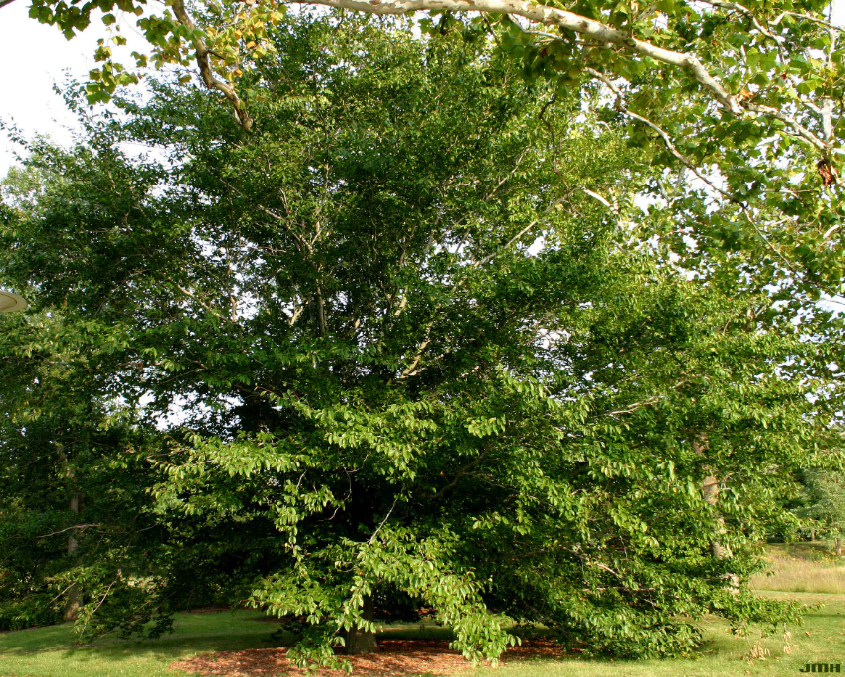
- Family: Fagaceae
- Type: Deciduous
- Average Height: 50’ to 70’
- Average Width: 40' to 80'
- Native Range: Eastern North America
- Average Years to Maturity: 40
- Average Lifespan in Years: 300
- Bark Identification: Gray, thin, smooth, mature trunks can have black fissures
- Leaf Identification: Ovate (oval ending in a oint), 3" to 5" long, toothed edges, glossy and leathery
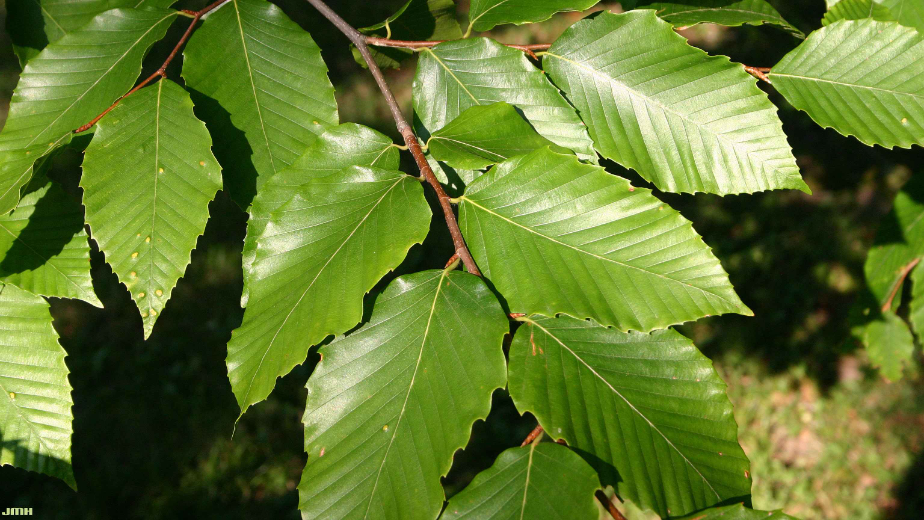
Description
The American beech is typically found in forests and thickets. This tree species is known for its triangular nuts, which are surrounded by spiny bracts. These nuts are edible after they ripen in the fall, and they are high in protein and fat. The American beech is also known for its smooth, gray bark. This tree species is native to Huntington County
Horticulture Tips
The American beech prefers full sun exposure but has a high tolerance for shade environments. It also prefers medium water supply and moist, well-drained soil. The American beech is slow-growing and long-lived. This tree species is susceptible to beech bark disease, which happens when a fungus and the beech scale, which is an insect, interact. An American beech with beech bark disease has white, wooly-like spots on its bark. There can also be darkening and discoloration in the tree's bark.
Benefits
The American beech is used as a landscaping tree for parks and large areas. It can also be used as a shade tree. If the bark of an American beech is carved, that part of the tree will be damaged and be disfigured for years. Tablets of American beech wood were used as writing material before the development of paper because of this. This characteristic was also used by early American frontiersman Daniel Boone as he went westward through the United States. He marked his progress with inscriptions on American Beech trees. The wood of this tree species is used for furniture and flooring.
The wood duck, wild turkey, blue jay, and tufted titmouse eat beechnuts. The nuts are also eaten by the black bear, white-tailed deer, fox squirrel, and wild pigs. The now extinct passenger pigeon favored the beechnut for a food source. The American Beech gets cavities in its trunk as it gets older, and many birds and squirrels use them as nesting sites.
References
- Chicago Botanic Garden
- Go Botany Native Plant Trust
- Illinois Wildflowers
- Leopold, Donald J.; Trees of the Central Hardwood Forests of North America: An Identification and Cultivation Guide. Timber Press, 1998, pp. 191-193.
- Missouri Botanical Garden
- Purdue University Fort Wayne Tree Index
- Silvics of North America
- Weeks, Sally S., et al.; native Trees of the Midwest: Identification, Wildlife Values, and Landscaping Use, Purdue University Press, West Lafayette, IN, 2005, pp. 124-125.
American elm (Ulmus americana)
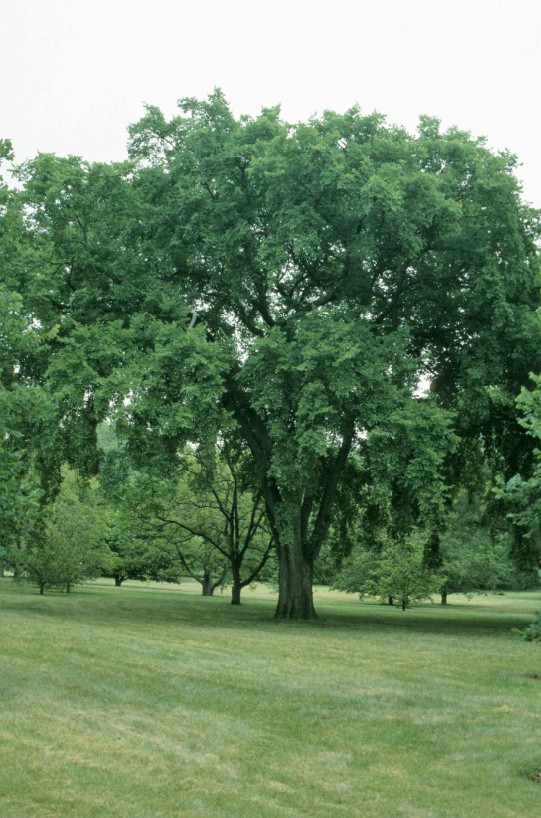
- Family: Ulmaceae
- Type: Deciduous
- Average Height: 60' to 80'
- Average Width: 40' to 60'
- Native Range: Eastern North America
- Average Years to Maturity: 40
- Average Lifespan in Years: 175
- Bark Identification: Gray or brown, cream and reddish-brown inner bark in layers, ridges and fissures with maturity
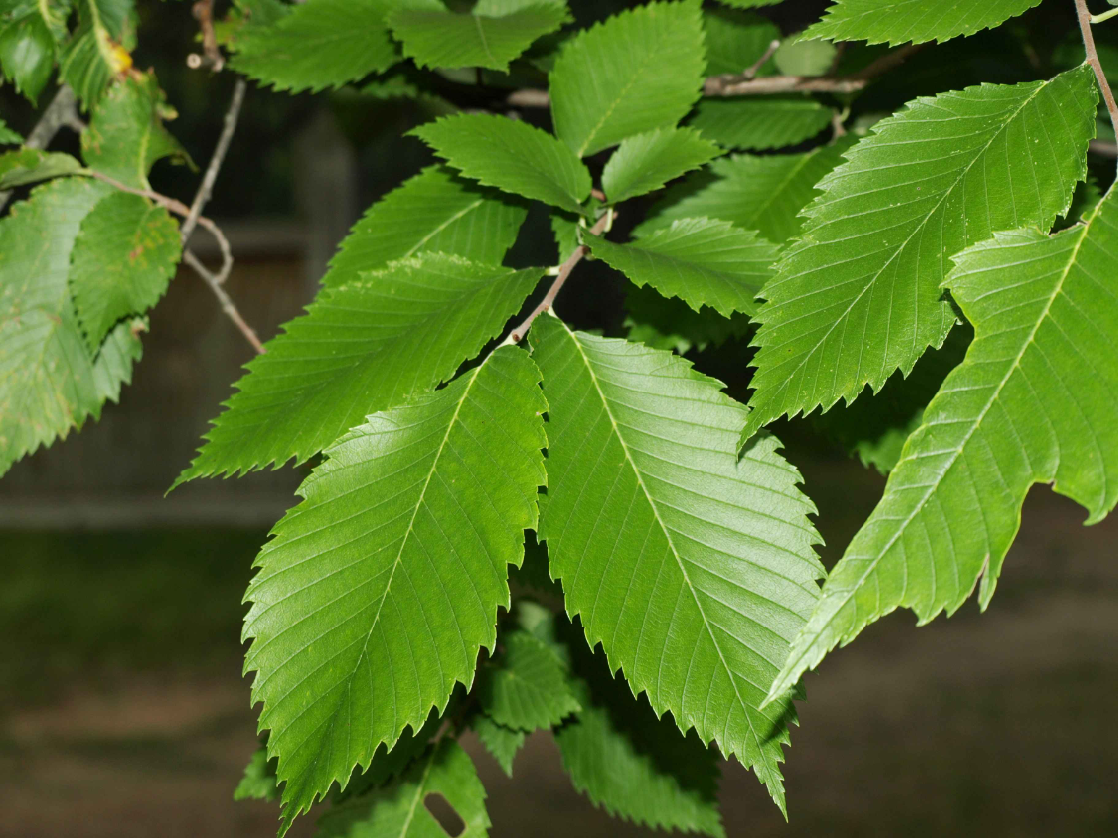
- Leaf Identification: Egg-shaped, serrated edges, pointed tip, 3" to 6" long, base is asymmetric
Description
The American elm is typically found in forests, floodplains, swamps, and manmade habitats. These habitats give the American elm its other common name of water elm. The American elm is known for its prominently veined, shiny leaves and its striped bark with maturity. It is also known for being vase-shaped and for having long, drooping branches. This tree species can be distinguished from other elm species because the upper surface of its leaves is mostly hairless and on each side of the leaves, there are 0 to 3 lateral veins that are forked. This tree species is native to Huntington County.
Horticulture Tips
The American elm prefers full sun exposure but can grow in light shade environments. It also prefers medium water supply and medium, well-drained soil. The American elm is susceptible to Dutch elm disease, which is a fatal fungal disease that spreads through bark beetles. This disease causes wilting and eventual death for the tree species. It is not recommended that the straight elm species be planted because of this disease. The cultivar ‘Jefferson’ is resistant to Dutch elm disease and is recommended to be planted.
Benefits
The American elm was widely used in the United States, especially in the 1960’s, as a landscaping and shade tree for parks, lawns, and streets. While it is still being used less because of the effects of Dutch elm disease, cultivars that are resistant to the disease are making a comeback for the elm species. This tree species has yellow fall foliage, which makes it an attractive tree. The wood of the American elm is heavy and strong and was used to make furniture, flooring, and caskets.
Insects like the elm lace bug and the European elm scale, as well as several other species, use the bark and leaves of the American elm as a food source. The native elm bark beetle and the small European elm bark beetle transmit Dutch elm disease to American elms. Birds like wood ducks, wild turkeys, Carolina chickadees, and house sparrows eat the seeds and buds of this tree species. The yellow-bellied sapsucker sucks sap through holes that it drills in the trunk of the American elm. Mammals like the gray squirrel, fox squirrel, and Eastern chipmunk also eat the seeds. The Baltimore oriole, warbling vireo, and red-shouldered hawk use this tree species as a nesting site.
References
- Chicago Botanic Garden
- Go Botany Native Plant Trust
- Illinois Wildflowers
- Leopold, Donald J.; Trees of the Central Hardwood Forests of North America: An Identification and Cultivation Guide. Timber Press, 1998, pp. 426-429.
- Morton Arboretum Photo Copyrights
- Purdue University Fort Wayne Tree Index
- Silvics of North America
- Weeks, Sally S., et al.; Native Trees of the Midwest: Identification, Wildlife Values, and Landscaping Use, Purdue University Press, West Lafayette, IN, 2005, pp. 234-235.
American hophornbeam (Ostrya virginiana)
- Family: Betulaceae
- Type: Deciduous
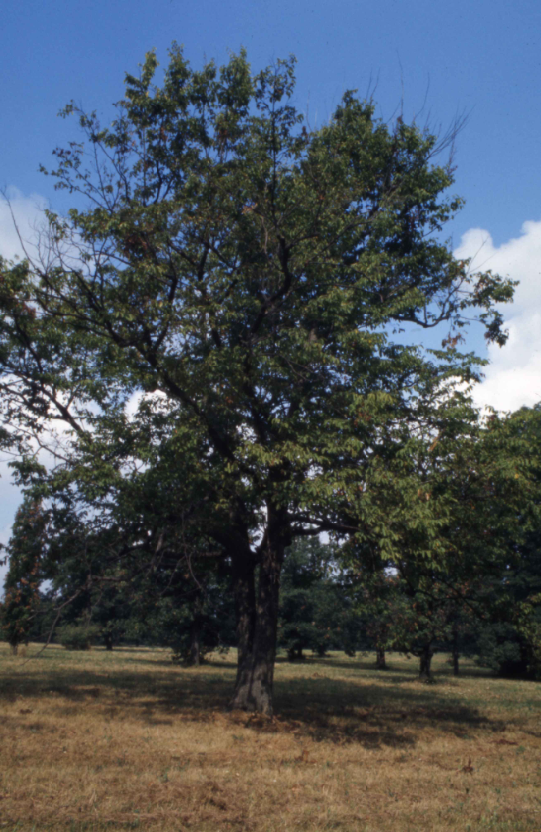
- Average Height: 20' to 40'
- Average Width: 20' to 30'
- Native Range: Eastern North America
- Average Years to Maturity: 25
- Average Lifespan in Years: 100
- Bark Identification: Brown, thin, with loose shredded scales in maturity
- Leaf Identification: Oval-shaped with serrated edges, prominent veins, 2" to 5" long
Description
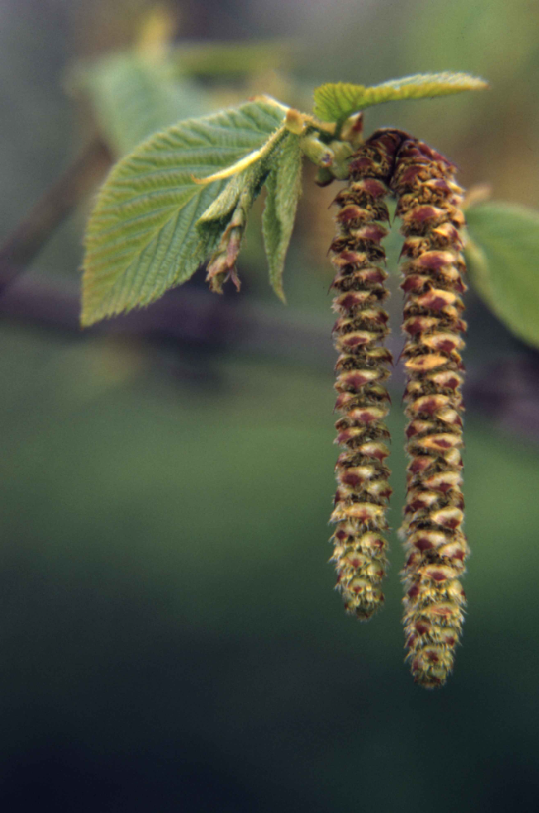
The American hophornbeam is typically found in forests, rocky slopes, and woodlands. This tree species is known for its short height. The American hophornbeam is given its common name because its female flowers are followed by sac-like, green, papery seed pods which are said to resemble the fruit of hops. The American hophornbeam can be distinguished from the American hornbeam because of its stripped bark and its sac-like seed pods. This tree species is native to Huntington County.
Horticulture Tips
The American hophornbeam prefers full sun exposure but can be in part shade environments. It also prefers medium water supply and medium to dry, well-drained soil. This tree species is known to be slow growing.
Benefits
The American hophornbeam is commonly used as a landscaping tree in lawns. It is a good choice for a street tree because of its small size. It can also be used for large gardens. Another common name given to the American hophornbeam is ironwood because of its hard and dense wood. The lumber from this tree species cannot be used for commercial lumber because of its small size, but it can be used for smaller projects. It is commonly used to make tool handles because of its hardiness. It was also used to make sleigh runners because of its durability against ice, gravel, and dirt. This hardiness gives the wood a high density, which means it does not float in water.
The ironwood tubemaker moth and the ironwood leafminer, as well as other insects, use this tree species as a food source. Birds like the ruffed grouse, downy woodpecker, and purple finch eat the buds and seeds. The fox squirrel and red squirrel also eat the buds and seeds of the American hophornbeam.
References
- Chicago Botanic Garden
- Go Botany Native Plant Trust
- Illinois Wildflowers
- Leopold, Donald J.; Trees of the Central Hardwood Forests of North America: An Identification and Cultivation Guide. Timber Press, 1998, pp. 265-267.
- Missouri Botanical Garden
- Morton Arboretum Photo Copyrights
- Purdue University Fort Wayne Tree Index
- Silvics of North America
- Weeks, Sally S., et al.; Native Trees of the Midwest: Identification, Wildlife Values, and Landscaping Use, Purdue University Press, West Lafayette, IN, 2005, pp. 148-149.
American hornbeam (Carpinus caroliniana)
- Family: Betulaceae
- Type: Deciduous
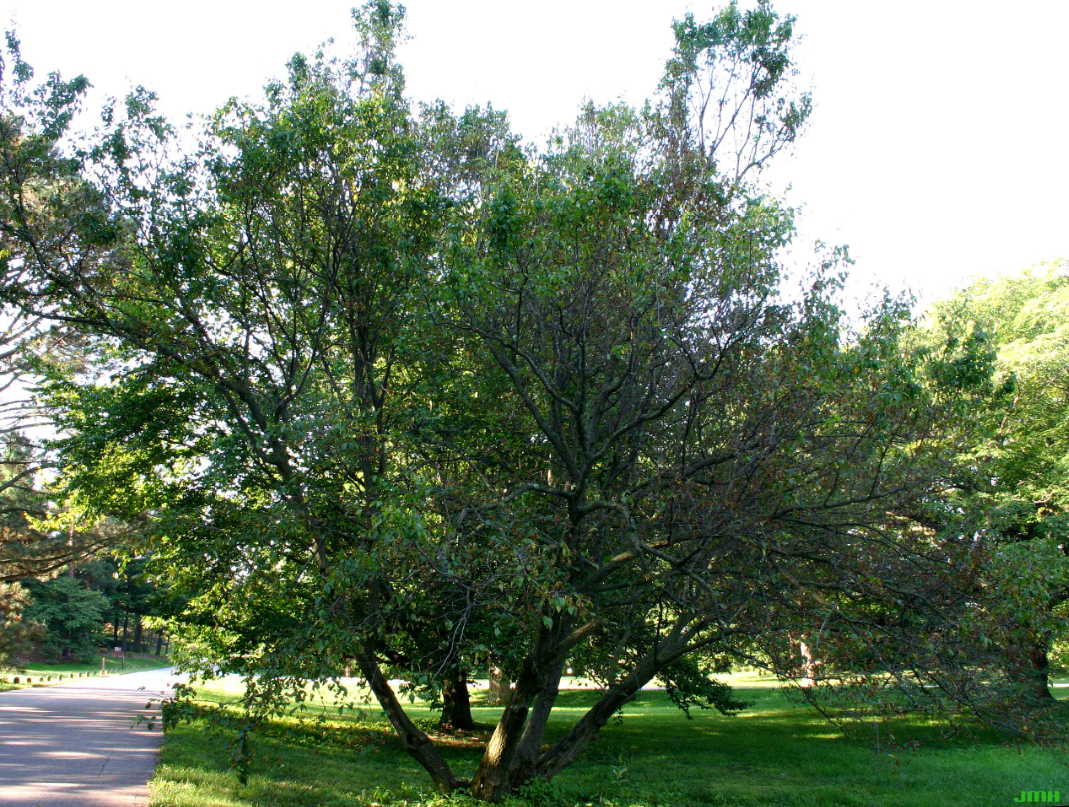
- Average Height: 20' to 30'
- Average Width: 20' to 35'
- Native Range: Eastern North American
- Average Years to Maturity: 25
- Average Lifespan in Years: 150
- Bark Identification: Gray, thin and smooth, fluted, muscle-like in mature trees
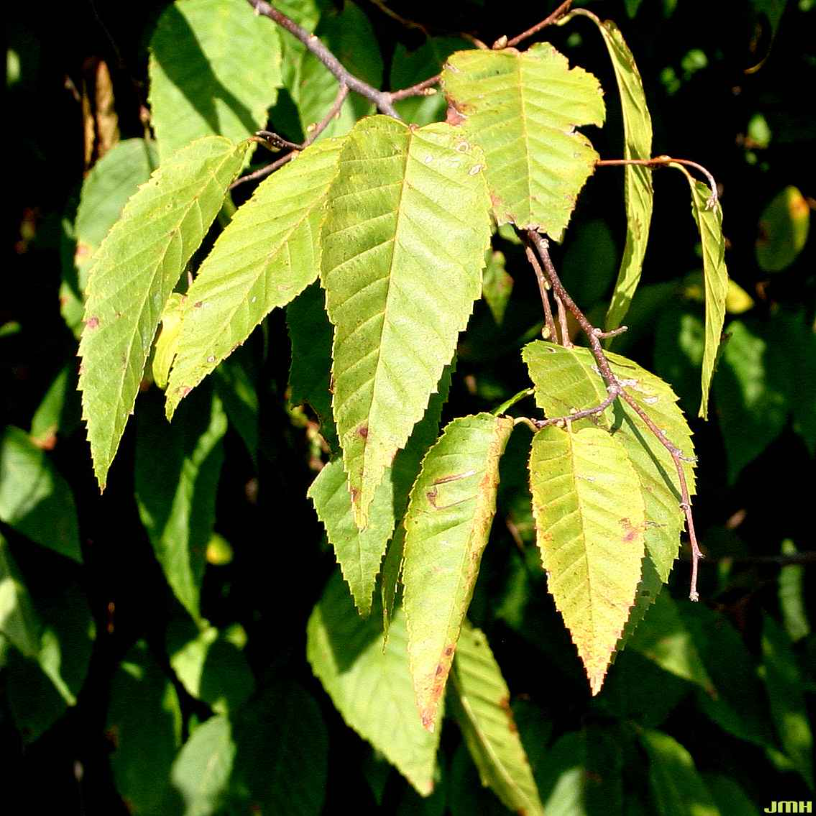
- Leaf Identification: Ovate (oval ending in a point) with serrated edges, shiny, 3’’ to 6’’ long
Description
The American hornbeam is native to Eastern North America and is usually found in forests, swamps, and floodplains. This tree is given the common name muscle tree because of the fluted, muscle-like texture of its trunk. The flowers of the American hornbeam are replaced by husked nutlets, which are distributed by the wind. This tree is native to Huntington County.
Horticulture Tips
American hornbeams prefer full sun exposure to grow successfully, but they can also be tolerant to part shade environments. They also prefer medium water supply and moist, well-drained soil. This tree can be confused for young American beech trees but can be distinguished through the toothed edges of the leaves, as American hornbeam leaves have more teeth.
Benefits
The American hornbeam is used as a landscaping tree in lawns, as it is typically attractive because of its globular shape. It can also be used as a shade tree or as a small hedge in some cases. The wood of this tree has a horn-like polish when cut and used correctly, and this is how it was given its name. Another common name given to the American hornbeam is ironwood. This is because the wood of the American hornbeam is extremely dense and was used by Native Americans to make tools. It is still used today to make tools that require dense wood, like hammer handles.
The nutlets and buds of the American hornbeam are eaten by the wood duck and ruffed grouse. The wood of this tree is used by beavers as a source of food and for construction materials. The gray squirrel and fox squirrel are known to eat the nutlets as well. The wood thrush builds branches in this tree’s branches, and chickadees use the cavities in mature trees for nesting.
References
- Chicago Botanic Garden
- Go Botany Native Plant Trust
- Illinois Wildflowers
- Index of Trees - Purdue University Fort Wayne
- Leopold, Donald J.; Trees of the Central Hardwood Forests of North America: An Identification and Cultivation Guide. Timber Press, 1998, pp. 127-129.
- Missouri Botanical Garden
- Morton Arboretum Photo Copyrights
- Silvics of North America
- Weeks, Sally S., et al.; Native Trees of the Midwest: Identification, Wildlife Values, and Landscaping Use, Purdue University Press, West Lafayette, IN, 2005, pp. 110-111.
American sycamore (Platanus occidentalis)
- Family: Platanaceae
- Type: Deciduous
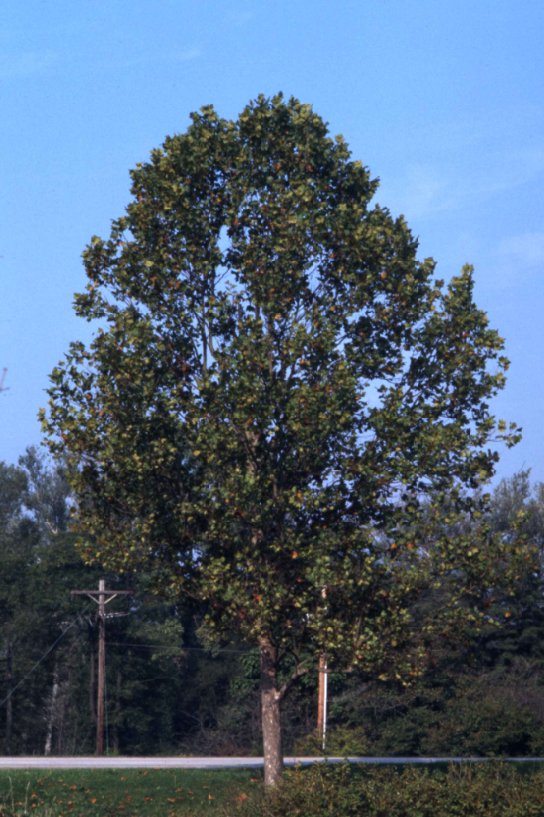
- Average Height: 75' to 100'
- Average Width: 75' to 90'
- Native Range: Eastern North America
- Average Years to Maturity: 50
- Average Lifespan in Years: 200
- Bark Identification: Brown, thin, flaky outer bark scales that expose white inner bark with age
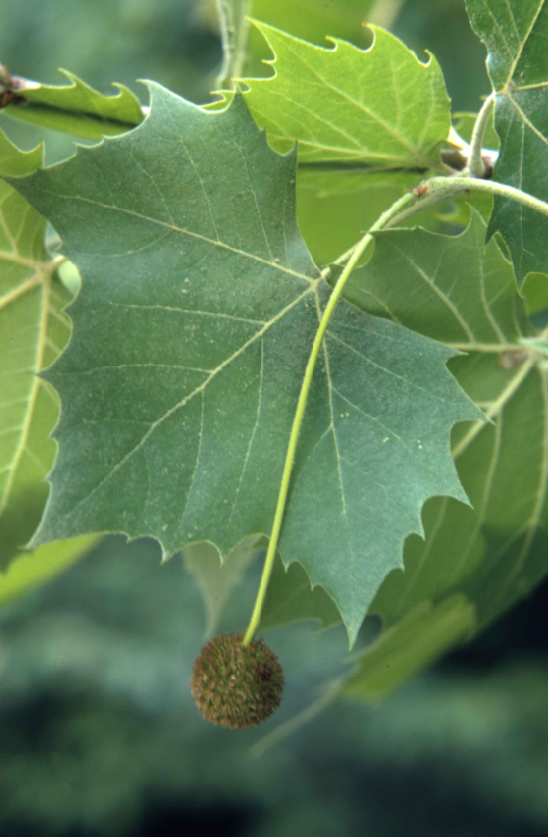
- Leaf Identification: 3 to 5 lobes, triangular, leathery, 5" to 8" long, reminiscent of a maple leaf, only larger
Description
The sycamore tree is typically found in floodplains, shores, and swamps. The sycamore tree is known for being one of the largest deciduous tree species in Eastern North America. It is distinguishable for its bark, which peels in plates to reveal creamy white inner bark. The tallest sycamore tree in Indiana was recorded at 122’ in 2015 in Johnson County. This tree species was given its common name because European settlers said that the leaves resembled the sycamore in the British Isles, which is Acer pseudoplatanus and is actually a maple. The female flowers of the sycamore are followed by fuzzy, spherical balls that are made of tiny seed-like fruits. These seed balls are why the sycamore tree is also given the common name buttonball tree. This tree species is native to Huntington County.
Horticulture Tips
The sycamore tree requires full sun exposure. It also prefers medium to wet water supply and medium to wet, well-drained soil. This tree species is long-lived. The sycamore tree sheds its bark in sheets, which can be messy for homeowners if planted as a street tree.
Benefits
The sycamore tree is commonly used as a landscaping or shade tree for large areas. It is not commonly used as a street tree because of its size. A sycamore in Worthington, Indiana was reportedly measured at 42’ in circumference. The wood of the sycamore tree is used to make furniture, cabinets, crates and butcher blocks. Native Americans used sycamore trunk sections for dugout canoes. Pioneers used cross-sections of large trunks as cart wheels.
The wood and leaves of the sycamore tree are used as a food source by insects like the sycamore heart borer and the sycamore tussock moth. Birds like the purple finch, blackcapped chickadee, and Carolina chickadee eat the seeds. As this tree species matures, cavities in its trunk are used by owl species, like the barred owl and the screech owl, for nesting. These cavities can become so large that black bears can use them as shelter
References
- Chicago Botanic Garden
- Go Botany Native Plant Trust
- Illinois Wildflowers
- Indiana Department of Natural Resources
- Leopold, Donald J.; Trees of the Central Hardwood Forests of North America: An Identification and Cultivation Guide. Timber Press, 1998, pp. 294-296.
- Missouri Botanical Garden
- Morton Arboretum Photo Copyrights
- Purdue University Fort Wayne Tree Index
- Silvics of North America
- Weeks, Sally S., et al.; Native Trees of the Midwest: Identification, Wildlife Values, and Landscaping Use, Purdue University Press, West Lafayette, IN, 2005, pp. 154-155.
American yellowwood (Cladrastis kentukea)
- Family: Fabaceae
- Type: Deciduous
- Average Height: 30' to 60'
- Average Width: 40' to 55'
- Native Range: Central North America
- Average Years to Maturity: 15
- Average Lifespan in Years: 75
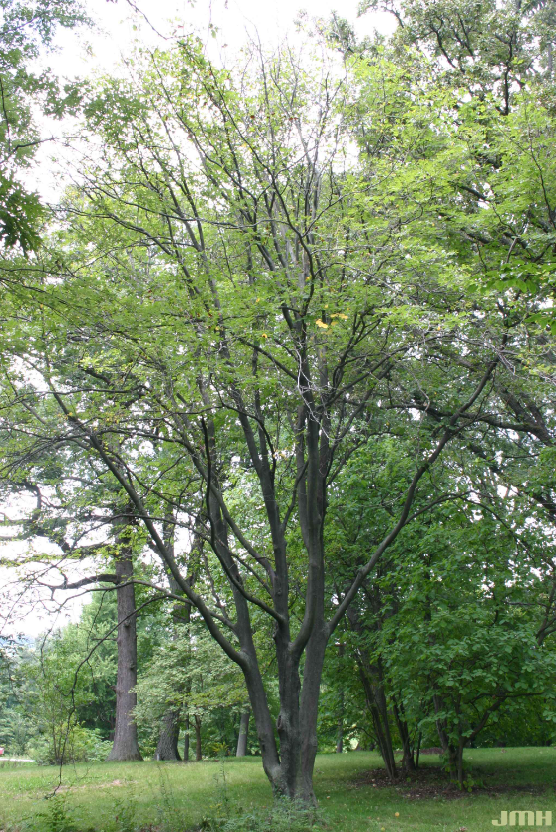
- Bark Identification: Gray to dark gray, smooth
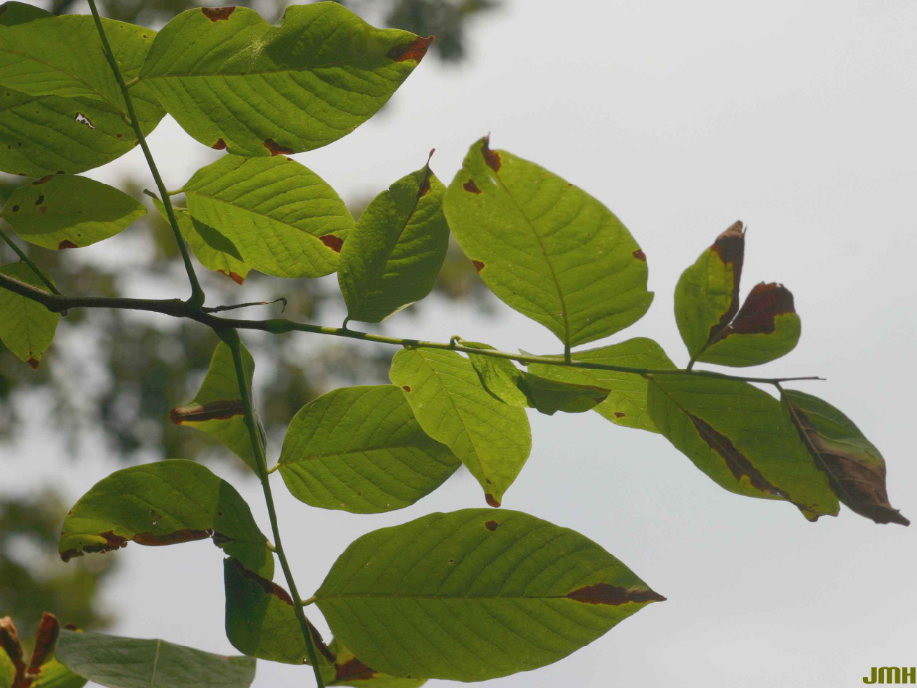
- Leaf Identification: Compound with 7 to 9 ovalshaped leaflets (4’’ long) per leaf (8’’ to 12’’ long)
Description
The American yellowwood is usually found in man-made habitats and forest edges. This tree is known for its yellow stained wood. It is also known for its attractive spring flowers, which are white and droop in bunches, typically 10’’ to 15’’ long. These pea-shaped blossoms bloom every 2 or 3 years, which makes this tree species unique. This tree species’ bark looks similar to the American beech. However, the American Yellowwood can be identified because its leaves are compound, and it does not grow as large as the American beech. The American yellowwood is not native to Huntington County but is found in southern Indiana. This tree species is the only Cladrastis species that is native to North America.
Horticulture Tips
The American yellowwood requires full sun exposure environments. They also require a medium water supply and well-drained, medium soil. The American yellowwood can be found in nurseries. This tree should be pruned in the summertime, or else it will bleed.
Benefits
The American yellowwood is used as a landscaping tree in parks and yards for its attractive white flowers in the spring. It can also be used as a shade tree. The wood of this tree has a yellow dye in it that can be used as a stain, which is how this tree species was named. This dye was used by early settlers to dye clothing and other items. The wood becomes light brown after being cut and dried, and it is typically used to make gunstocks. The branches and twigs of this tree can be fragile and easily damaged by harsh weather. The genus name comes from this attribute, coming from the Greek “klados” meaning branch and “thraustos” meaning fragile.
References
- Chicago Botanic Garden
- Go Botany Native Plant Trust
- Illinois Wildflowers
- Leopold, Donald J.; Trees of the Central Hardwood Forests of North America: An Identification and Cultivation Guide. Timber Press, 1998, pp. 167-169.
- Missouri Botanical Garden
- Morton Arboretum Photo Copyrights
- Weeks, Sally S., et al. Native Trees of the Midwest: Identification, Wildlife Values, and Landscaping Use, Purdue University Press, West Lafayette, IN, 2005, pp. 268-269.
Bald-cypress (Taxodium distichum)
- Family: Cupressaceae
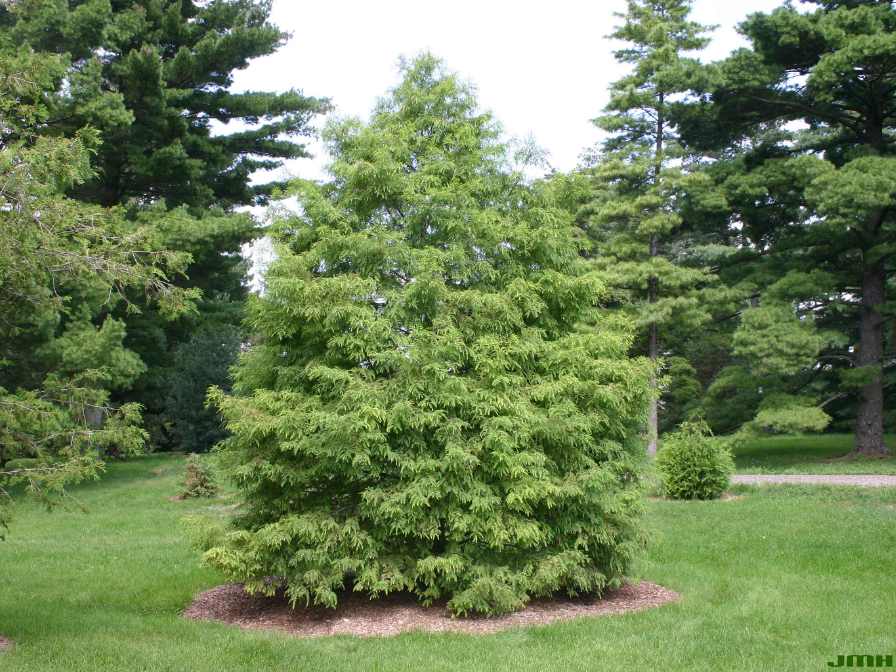
- Type: Deciduous conifer
- Average Height: 50' to 75'
- Average Width: 20' to 45'
- Native Range: Southeastern United States
- Average Years to Maturity: 50
- Average Lifespan in Years: 200
- Bark Identification: Reddish brown, shredded texture
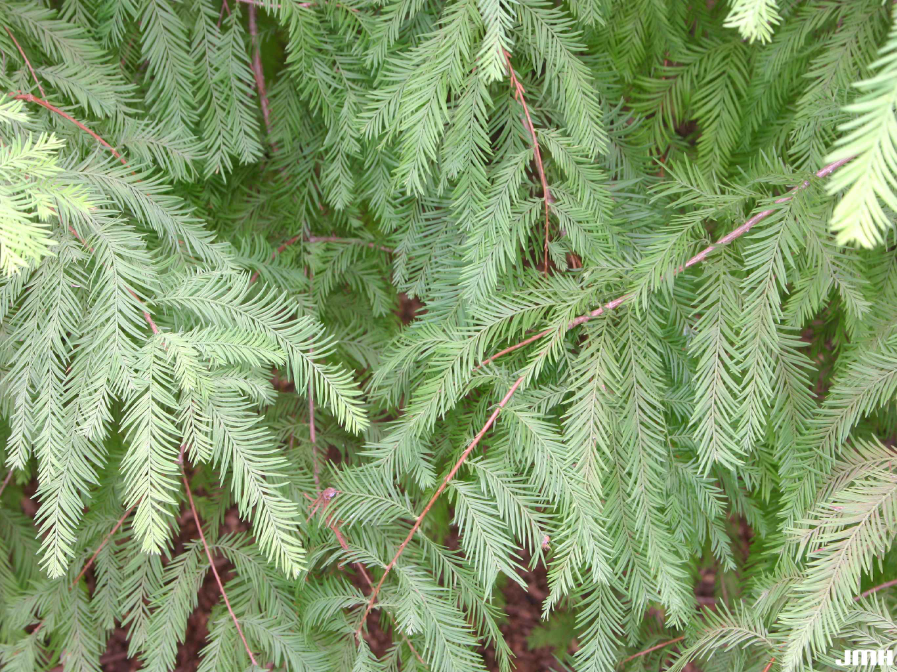
- Leaf Identification: Flattened, soft needles, yellow green, typically 1/2’’ in length
Description
The Bald-cypress is found in bottomlands and swamps in the Southeastern United States. Since this tree is deciduous, it drops its needles (which turn yellow brown) in the fall, which is where the name “bald” comes from. Since this tree grows in areas that are moist, the bottom of its trunk becomes swollen and has buttresses. The bald-cypress also has pneumatophores, commonly called “knees,” which are structures that form above the roots. It is used for gas exchanges. The cones of the bald cypress are golf-ball shaped and turn purple when they are ripe in the fall. The bald cypress is not native to Huntington County.
Horticulture Tips
Bald-cypress’ require full sun exposure to grow successfully. They also require medium water supply and well-drained, moist soil, which makes them perform well in the Southeast. The bald cypress has a slow growth rate and is known for being one of the longest living tree species.
Benefits
The bald-cypress is best planted in a large yard, where it can be used as an ornamental or wind-shielding tree. In its native range this tree is known for its height, reaching up to 150’. However, it does not reach these heights in Indiana. So, the bald-cypress makes for an ideal street tree because of its fall color and curb appeal. The wood of this tree is used for building construction, flooring, and cabinetry because of its usual resistance to rot.
Several insects, like the forest tent caterpillar and the flat-headed bald cypress borer bore into the bald cypress’ bark and use this tree as a food source. Birds like the wood duck and wild turkey eat its seeds, and the bald eagle and pileated woodpecker use it as a nesting site.
References
- Indiana Department of Natural Resources Tree Species Information
- Illinois Wildflowers
- Leopold, Donald J.; Trees of the Central Hardwood Forests of North America: An Identification and Cultivation Guide. Timber Press, 1998, pp. 408-410.
- Weeks, Sally S., et al.; Native Trees of the Midwest: Identification, Wildlife Values, and Landscaping Use, Purdue University Press, West Lafayette, IN, 2005, pp. 42–43.
- Missouri Botanical Garden
- Morton Arboretum Photo Copyrights
- Silvics of North America
Bitternut hickory (Carya cordiformis)
- Family: Juglandaceae
- Type: Deciduous
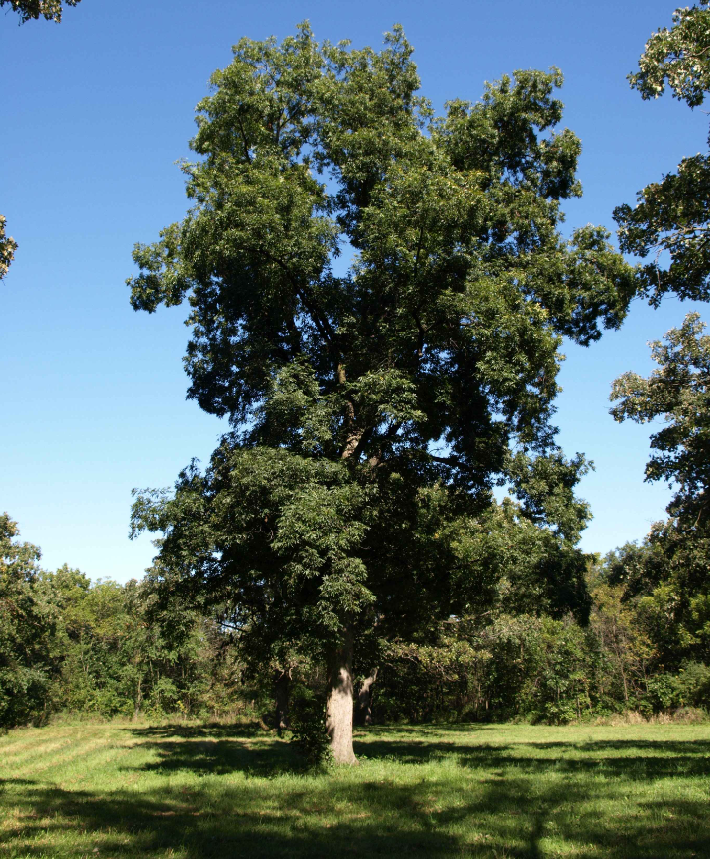
- Average Height: 50' to 80'
- Average Width: 30' to 50'
- Native Range: Eastern North America
- Average Years to Maturity: 30
- Average Lifespan in Years: 150
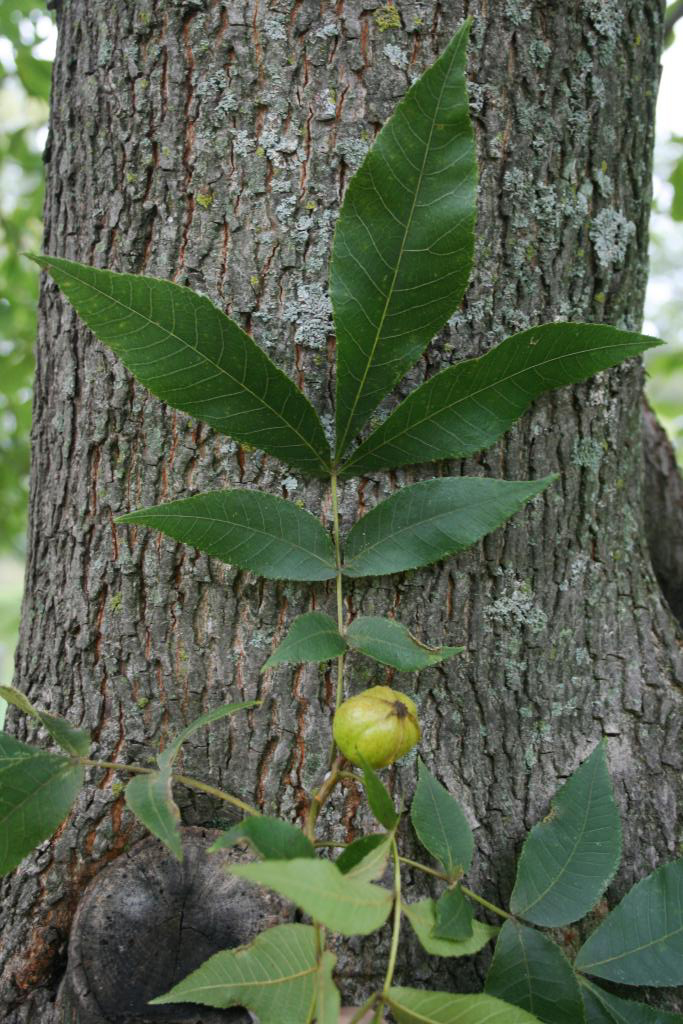
- Bark Identification: Gray, narrow and flat ridges with shallow fissures, scaly with maturity
- Leaf Identification: Seven to 11 leaflets per leaf, yellow to green, smooth, serrated edges
Description
The Bitternut hickory is typically found in forests, bottomlands, riparian forests, and swamps. The bitternut hickory was given its common name because settlers found the nuts to be bitter to the taste because of its high tannin content, which is a complex chemical that comes from phenolic acid. However, settlers found that they could use the nuts to make oil to burn in lamps. The bitternut hickory can be distinguished from other hickory species because of its bright yellow buds. This tree species is native to Huntington County.
Horticulture Tips
The bitternut hickory prefers full sun exposure but can grow successfully in part shade environments. It also prefers medium to wet water supply and medium to wet, welldrained soil. The bitternut hickory is relatively short-lived compared to other hickory species.
Benefits
The bitternut hickory is commonly used as a landscaping tree or shade tree in large yards, streets, or parks. With yellow fall foliage, the bitternut hickory is typically an attractive ornamental tree. The specific epithet cordiformis comes from the Latin word cordata, which means heart shaped. This is in reference to the shape of the fruit husks. The wood of the bitternut hickory is strong and has been used to make yokes, wagon wheels, tool handles, and furniture.
Since the nuts of the bitternut hickory are bitter, few mammals and bird species use them as a food source. White-tailed deer and cottontail rabbits eat the seedlings and twigs of this tree species. Beavers use the branches to build their dams.
References
- Chicago Botanic Garden
- Go Botany Native Plant Trust
- Illinois Wildflowers
- Leopold, Donald J.; Trees of the Central Hardwood Forests of North America: An Identification and Cultivation Guide. Timber Press, 1998, pp. 132-134.
- Missouri Botanical Garden
- Morton Arboretum Photo Copyrights
- Purdue University Fort Wayne Tree Index
- Silvics of North America
- Weeks, Sally S., et al.; Native Trees of the Midwest: Identification, Wildlife Values, and Landscaping Use, Purdue University Press, West Lafayette, IN, 2005, pp. 250-251.
Black cherry (Prunus serotina)
- Family: Rosaceae
- Type: Deciduous
- Average Height: 50' to 80'
- Average Width: 30' to 60'
- Native Range: Eastern North America
- Average Years to Maturity: 30
- Average Lifespan in Years: 100
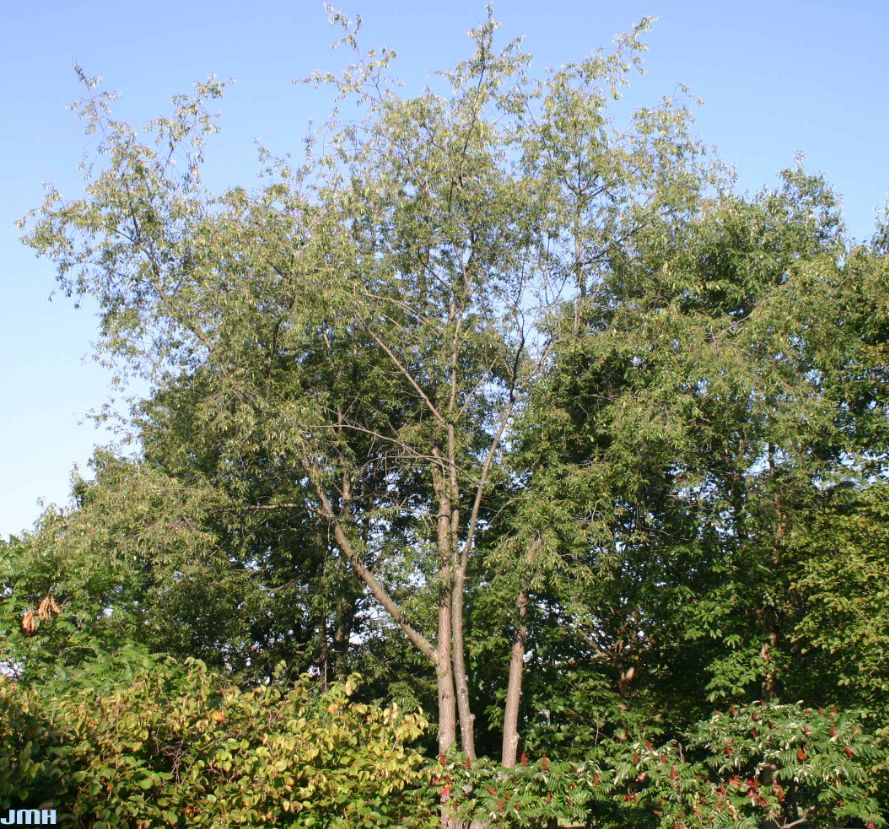
- Bark Identification: Red to brown, smooth in young age, thick and dark scales in maturity
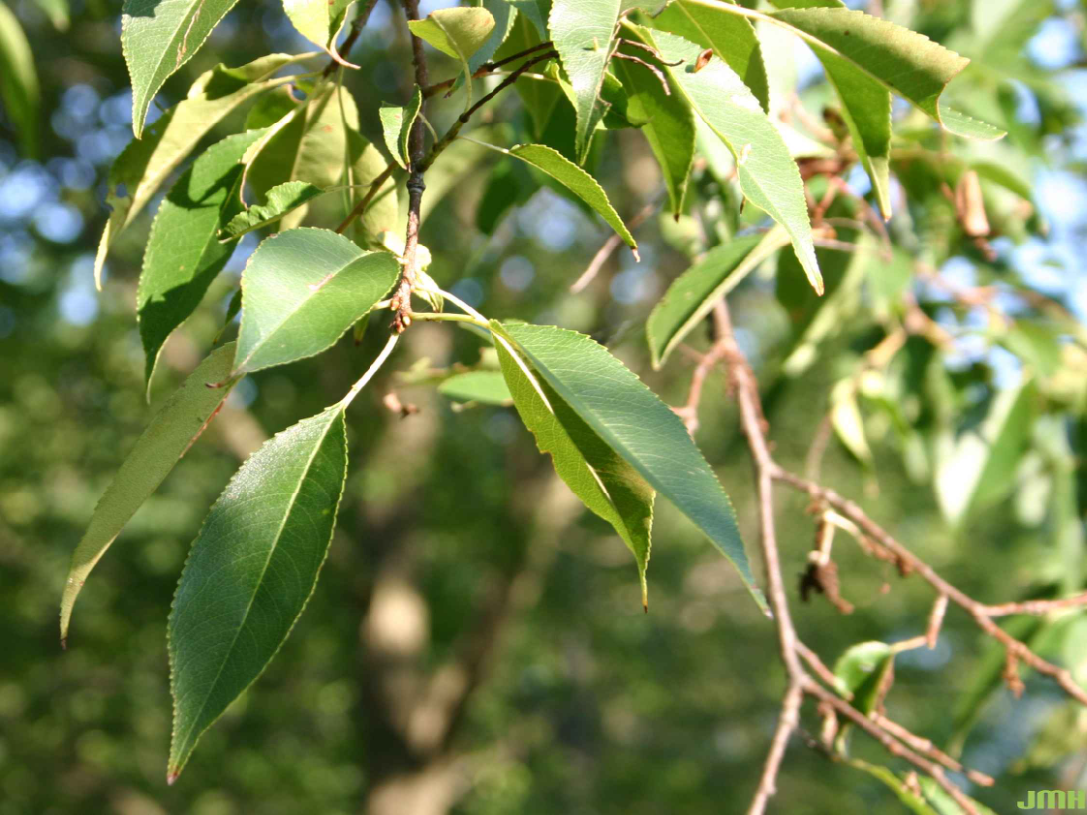
- Leaf Identification: Glossy, serrated edges, oblong-ovate (oval-shaped), 5’’ long
Description
The black cherry is typically found in woodlands, forests, and fields. The black cherry is known for its attractive white spring flowers, which bloom in 6’’ long clusters. These flowers are followed by small, dark red cherries, which are inedible directly from the tree. However, they can be used to make jams and jellies. The bark, roots, and leaves all contain toxic cyanogenic compounds, which give off a bitter almond smell, and the wilted leaves contain cyanide. This tree species is native to Huntington County.
Horticulture Tips
The black cherry prefers full sun exposure but can be in part shade environments. It also prefers medium water supply and medium, well-drained soil.
Benefits
The black cherry can be used as a landscaping tree or a shade tree for yards and streets. However, black knots, which is a fungal disease that causes hard, black galls to grow on the branches of black cherry trees, can be unattractive for landscaping. The specific epithet serotina comes from the Latin word for “late,” which refers to the late flowering of this tree species compared to other cherry species. The fruit of the black cherry is used to flavor rums and whiskeys, which is how the common name wild rum cherry was given. Native Americans used the inner bark for cough medicines and cold remedies. The wood of the black cherry is red-brown and polishes well, which makes it ideal for making furniture, veneers, cabinets, and musical instruments.
Caterpillars of the butterflies the tiger swallowtail and the red spotted purple, as well as the honeybee and the bumblebee, use the nectar, pollen, and foliage of the black cherry as a food source. The cherries are eaten by mammals like the raccoon, black bear, gray fox, and red fox, and bird species like the catbird, cedar waxwing, Northern cardinal, and several woodpecker species.
References
- Go Botany Native Plant Trust
- Illinois Wildflowers
- Leopold, Donald J.; Trees of the Central Hardwood Forests of North America: An Identification and Cultivation Guide. Timber Press, 1998, pp. 314-317.
- Missouri Botanical Garden
- Morton Arboretum Photo Copyrights
- Purdue University Fort Wayne Tree Index
- Silvics of North America
- Weeks, Sally S., et al.; Native Trees of the Midwest: Identification, Wildlife Values, and Landscaping Use, Purdue University Press, West Lafayette, IN, 2005, pp. 174-175.
Black oak (Quercus velutina)
- Family: Fagaceae
- Type: Deciduous
- Average Height: 50' to 60'
- Average Width: 50' to 60'
- Native Range: Eastern North America
- Average Years to Maturity: 50
- Average Lifespan in Years: 100
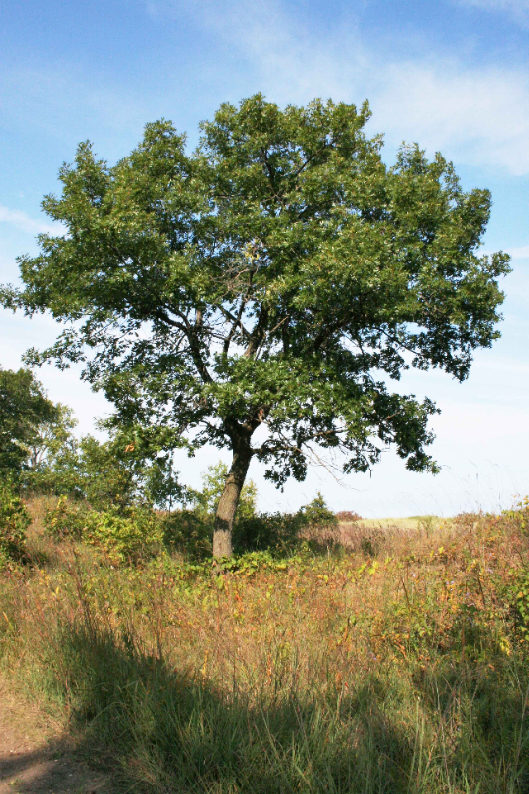
- Bark Identification: Dark gray to black, horizontal fissures, creating blocky and vertical ridges, yellow inner bark
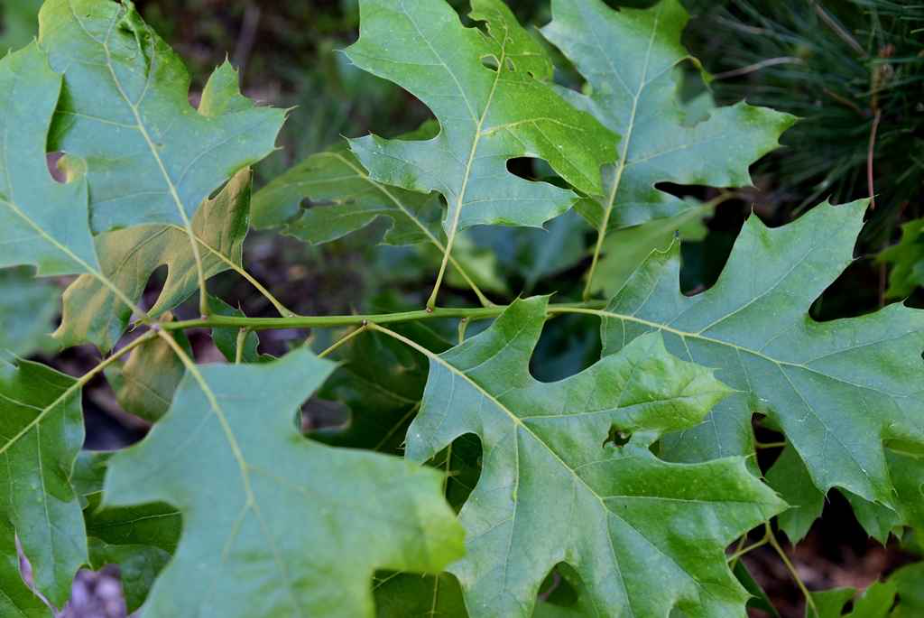
- Leaf Identification: 5 to 7 shallow lobes, thick and dark green, 5" to 9" long, bristle tipped
Description
The black oak is typically found in forests and woodlands. The common name for the black oak comes from the color of its bark when it is mature. This tree species is a member of the red oak group and produces acorns every 2 or 3 years. The black oak can be confused for the red oak but is distinguished by the fine hairs on its buds, the long, fringed cups of its acorns, and its yellow inner bark. This tree species is native to Huntington County.
Horticulture Tips
The black oak requires full sun exposure. It also prefers medium to dry water supply and dry, well-drained soil. After 20 years of growth, the black oak typically begins producing acorns.
Benefits
The black oak is commonly used as a shade tree for parks, lawns, and streets. The specific epithet velutina comes from the Latin word for fleece, velvety or hairy, which refers to the hairs that are found on the buds and young leaves of this tree species. The yellow inner bark of the black oak was used as dye for clothing by weavers and for the leather and tanning process. The other common names yellow oak and yellow bark oak are given to the black oak for this reason. The black oak is generalized as “red oak wood” in the lumber indsutry and has heavy, hard wood, which can be used to make furniture, flooring, and interior finishing.
The spiny oak worm and the oak web worm, as well as other insect species, use the leaves and bark of the black oak as a food source. The acorns of the black oak are eaten by birds like the wild turkey, ruffed grouse, blue jay, brown thrasher, and several songbirds. Mammals like the white-tailed deer, several squirrel species, black bear, opossum, and raccoon also eat the acorns. The cavities in the trunks of older black oaks are used by both mammals and birds as nesting and shelter sites.
References
- Chicago Botanic Garden
- Go Botany Native Plant Trust
- Illinois Wildflowers
- Indiana Department of Natural Resources
- Leopold, Donald J.; Trees of the Central Hardwood Forests of North America: An Identification and Cultivation Guide. Timber Press, 1998, pp. 367-369.
- Missouri Botanical Garden
- Morton Arboretum Photo Copyrights
- Purdue University Fort Wayne Tree Index
- Silvics of North America
- Weeks, Sally S., et al.; Native Trees of the Midwest: Identification, Wildlife Values, and Landscaping Use, Purdue University Press, West Lafayette, IN, 2005, pp. 218-219.
Black walnut (Juglans nigra)
- Family: Juglandaceae
- Type: Deciduous
- Average Height: 75' to 100'
- Average Width: 75' to 100'
- Native Range: Eastern North America
- Average Years to Maturity: 20
- Average Lifespan in Years: 200
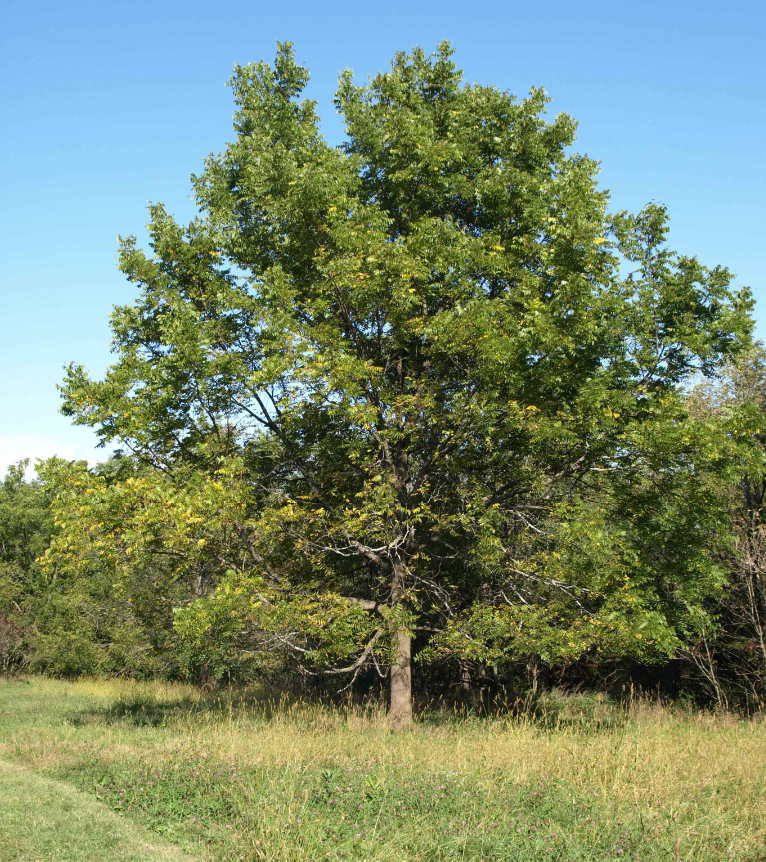
- Bark Identification: Gray to brown, fissured and darkened with maturity
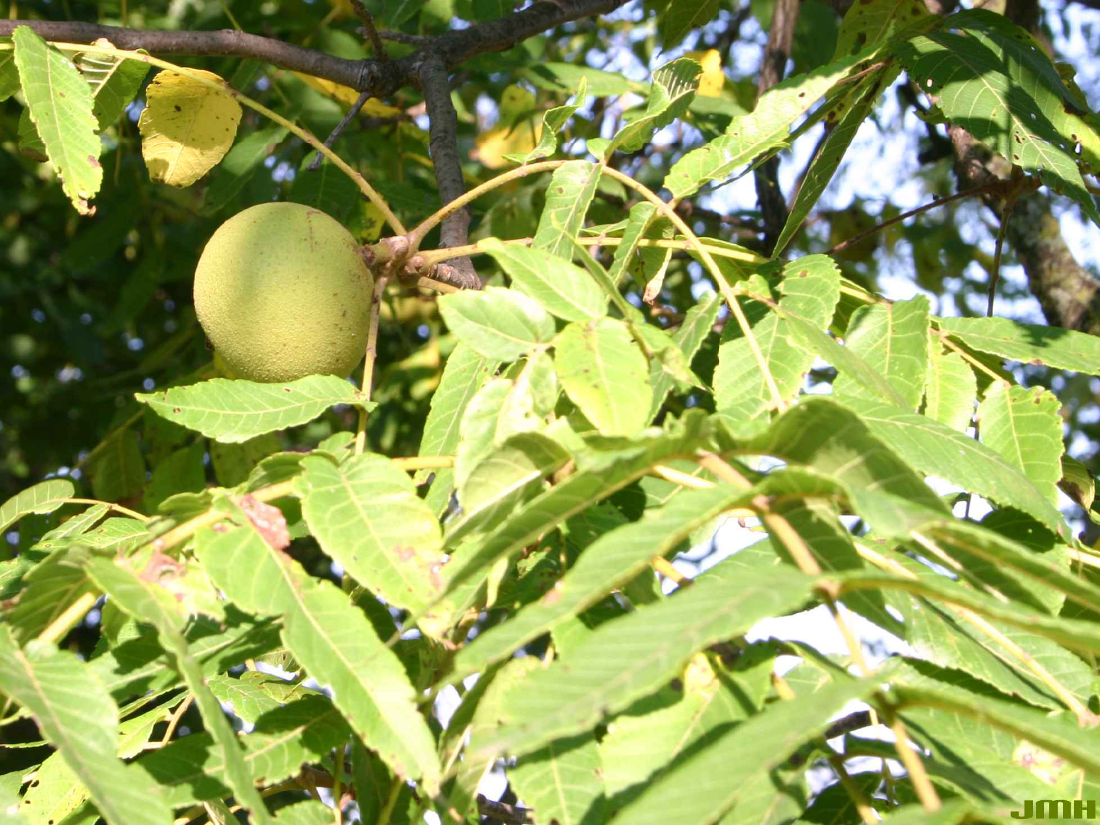
- Leaf Identification: 15 to 25 leaflets (3’’ long) per leaf (1’ to 2’ long), serrated edges
Description
The black walnut is typically found in manmade habitats, bottomlands, forests, meadows, and fields. The black walnut is known for its edible nuts that are encased in a green husk. When the green husk rots away, the kernels within the nuts can be harvested to eat. These kernels have a strong smell and are said to have a good flavor. The common name black walnut comes from the darkening of the bark that happens with maturity for this tree species. This tree species is native to Huntington County.
Horticulture Tips
The black walnut requires full sun exposure. It also prefers medium water supply and moist, well-drained soil. The rotting, black husks of the nut can stain sidewalks and skin if held. The black walnut produces a chemical called juglone, which is toxic to many plant species. Black walnuts should not be planted near garden plants or landscaping.
Benefits
The black walnut is typically used as a landscaping tree for large lawns. It is not commonly used as a street tree because of its large size. The wood is highly valued and expensive and is used to make cabinets, veneer, furniture, and gunstocks. Native Americans used the nuts for food and boiled the tree sap of this tree species for syrup. It is also said that they threw the husks of the nuts into water sources to poison fish, making them easier to catch.
Insect species, like the larvae of the long-horned beetle and stink bugs, eat the foliage of the black walnut. The nuts of the black walnut are eaten by mammals like the gray squirrel, fox squirrel, and red squirrel. As these nuts are commonly buried by squirrels, they help with the distribution of the black walnut.
References
- Go Botany Native Plant Trust
- Illinois Wildflowers
- Indiana Department of Natural Resources
- Leopold, Donald J.; Trees of the Central Hardwood Forests of North America: An Identification and Cultivation Guide. Timber Press, 1998, pp. 226-228.
- Missouri Botanical Garden
- Morton Arboretum Photo Copyrights
- Purdue University Fort Wayne Tree Index
- Silvics of North America
- Weeks, Sally S., et al.; Native Trees of the Midwest: Identification, Wildlife Values, and Landscaping Use, Purdue University Press, West Lafayette, IN, 2005, pp. 278-279.
Box elder maple (Acer negundo)
- Family: Sapindaceae
- Type: Deciduous
- Average Height: 30' to 60'
- Average Width: 30' to 50'
- Native Range: North America
- Average Years to Maturity: 20
- Average Lifespan in Years: 75
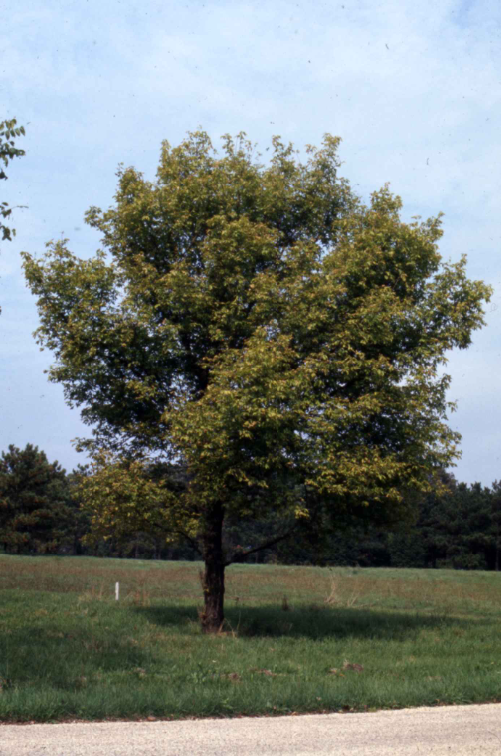
- Bark Identification: Light brown to gray, shallow fissures
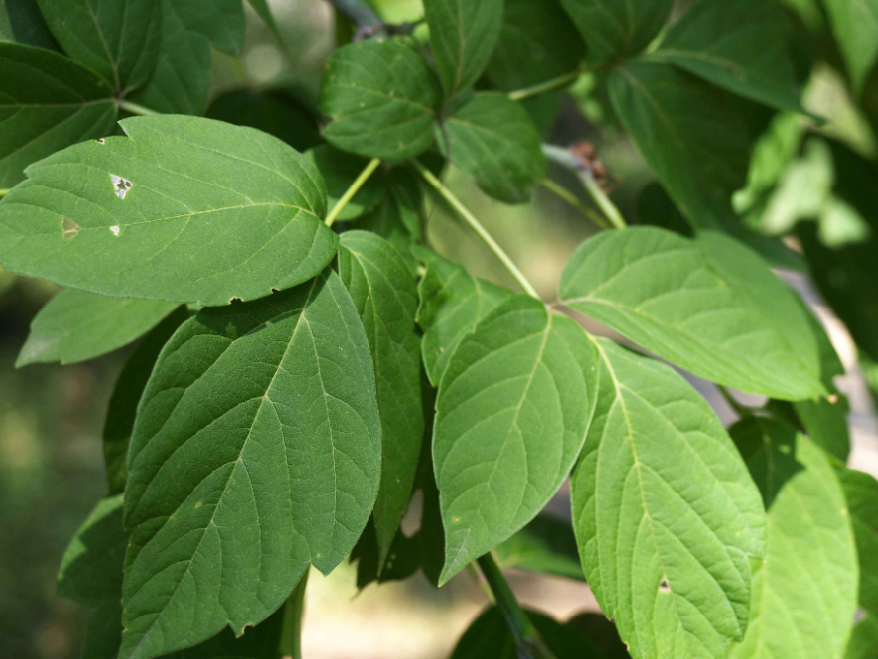
- Leaf Identification: Compound with three to seven lobed leaflets (each 2’’ to 4’’ long) per leaf (typically 6’’ long)
Description
The box elder maple is native to and widely distributed in North America. This tree is usually found in forests, man-made habitats and floodplains. This tree stands out among other maples because it has compound leaves, meaning that there are two or more leaflets that make up a leaf. Most maple leaves are not compound on other maple species. As the leaves of this tree look similar to those of ash trees, the box elder maple is sometimes called by another common name: ash-leaved maple. The box elder maple is classified as a soft maple. Compared to other maple species in the area surrounding Huntington County, this tree is fast growing, short and somewhat messy in appearance. This tree species is native to Huntington County.
Horticulture Tips
Box elder maples prefer full sun exposure to grow successfully, but they can also be tolerant to light shade environments. They also prefer medium water supply and moist soil. This tree is known for its fast growth in its youth and is a short-lived tree compared to similar deciduous tree species.
Benefits
The box elder maple is used as a landscaping tree, windbreak tree, or a shade tree in yards or along residential streets. The wood of the box elder maple is often used to make wooden crates and boxes, which is where it derives the first part of its common name. The second part, “elder,” was given to this tree because its leaves are similar to those of elderberry trees. Because of its fast growth while it is maturing, the wood of this tree can be weak. The pink markings in the wood make it prized by wood turners to make bowls and cups. The sap can be used to make syrup, but it is typically not as sweet as sugar maple sap.
Insects like the box elder bug and the box elder aphid use the box elder maple as a source of food. This tree is also used by the purple finch and the pine grosbeak for a food source, and several warblers forage for insects that bore in the box elder maple. White-tailed deer and the American moose are known to eat the twigs and branches of this tree. Bat species like the evening bat and the hoary bat use it as a roosting site because box elder maples are cavity-prone in their older age.
References
- Go Botany Native Plant Trust
- Illinois Wildflowers
- Index of Trees - Purdue University of Fort Wayne
- Leopold, Donald J.; Trees of the Central Hardwood Forests of North America: An Identification and Cultivation Guide. Timber Press, 1998, pp. 72-74.
- Missouri Botanical Garden
- Morton Arboretum Photo Copyrights
- Purdue University Fort Wayne Tree Index
- Silvics of North America
- Weeks, Sally S., et al.; Native Trees of the Midwest: Identification, Wildlife Values, and Landscaping Use, Purdue University Press, West Lafayette, IN, 2005, pp. 64-65.
Bur oak (Quercus macrocarpa)
- Family: Fagaceae
- Type: Deciduous
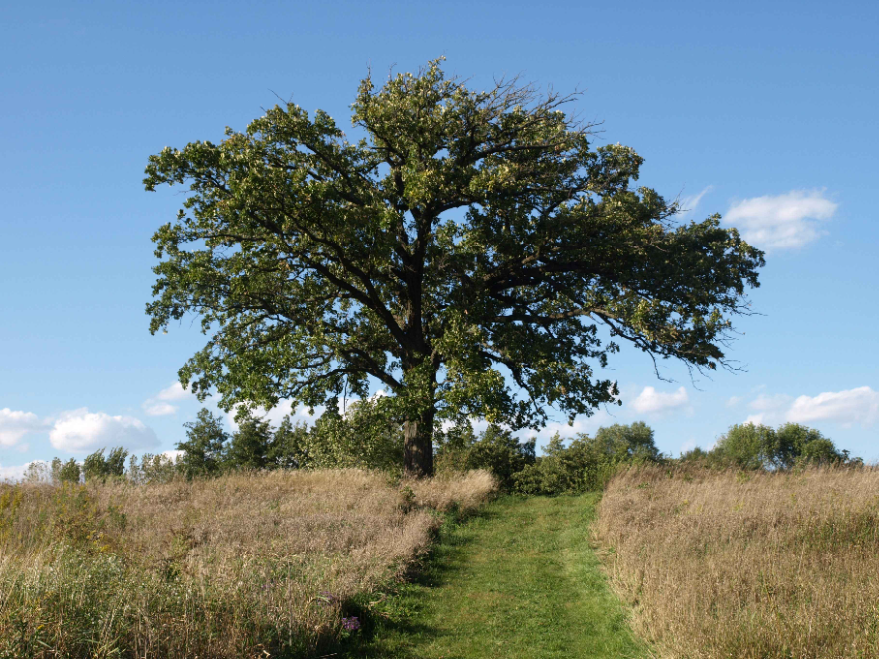
- Average Height: 60' to 80'
- Average Width: 60' to 80'
- Native Range: Central North America
- Average Years to Maturity: 30
- Average Lifespan in Years: 200
- Bark Identification: Dark gray or brown, vertical ridges, deep furrows
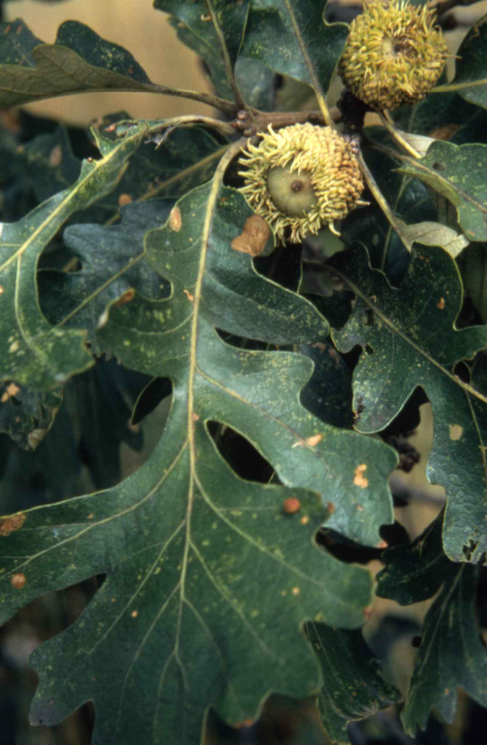
- Leaf Identification: 5 to 7 rounded but irregular lobes, 2 deep sinuses (spaces between lobes), 4" to 12" long
Description
The bur oak is typically found in floodplains, prairies, and forests. This tree species is known for its acorn cups, which are covered in a mossy scale or bur near the rim. This is how the bur oak got its common name, as well as its other common name mossycup oak. The acorns are also one of the largest oak species and can be up to 1.5’’ long. As the bur oak comes from the white oak group, its acorns are produced every year. The bur oak can also be distinguished by the corky ridges on its branches and the deep sinuses between the lobes on its leaves. This tree species is native to Huntington County.
Horticulture Tips
The bur oak requires full sun exposure. It also prefers medium to dry water supply and medium to dry, well-drained soil. The bur oak is a slow growing tree and can take up to 35 years to reach maturity. However, this tree species is typically long living.
Benefits
The bur oak is commonly used as a shade tree or landscaping tree for large lawns and parks. The specific epithet macrocarpa is Latin for large fruit, relating to the size of the acorns. The wood of the bur oak is valued because of its hardiness and is used as commercial lumber. It is used to build cabinets, ships, and fence posts. Settlers also used the wood of the bur oak to build their homes because the thick bark was more resistant to prairie fires.
The acorns of bur oak are eaten by several bird species, such as the mallard duck, ringnecked pheasant, bobwhite quail, and wild turkey. The raccoon, several squirrel species, and the Eastern chipmunk also eat the acorns. White-tailed deer, cottontail rabbits, and cattle browse on the twigs, leaves, and acorns of the bur oak.
References
- Chicago Botanic Garden
- Go Botany Native Plant Trust
- Illinois Wildflowers
- Indiana Department of Natural Resources
- Leopold, Donald J.; Trees of the Central Hardwood Forests of North America: An Identification and Cultivation Guide. Timber Press, 1998, pp. 344-346.
- Missouri Botanical Garden
- Morton Arboretum Photo Copyrights
- Purdue University Fort Wayne Tree Index
- Silvics of North America
- Weeks, Sally S., et al.; Native Trees of the Midwest: Identification, Wildlife Values, and Landscaping Use, Purdue University Press, West Lafayette, IN, 2005, pp. 194-195.
Chinkapin oak (Quercus muehlenbergii)
- Family: Fagaceae
- Type: Deciduous
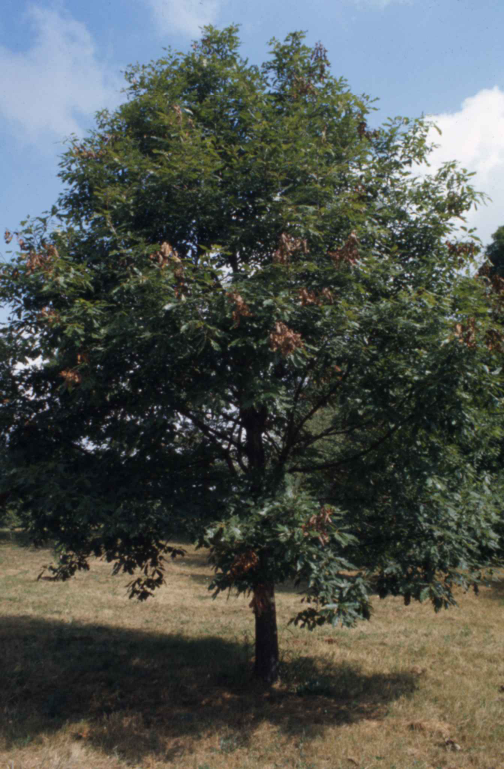
- Average Height: 40’ to 60’
- Average Width: 40’ to 60’
- Native Range: Eastern North America
- Average Years to Maturity: 50
- Average Lifespan in Years: 150
- Bark Identification: Ashy gray, square scales that are separated by shallow fissures, easily broken off
- Leaf Identification: Ovate (oval ending in a point) with toothed edges ending in points, 7 to 15 pairs of shallow lobes, 4" to 6" long
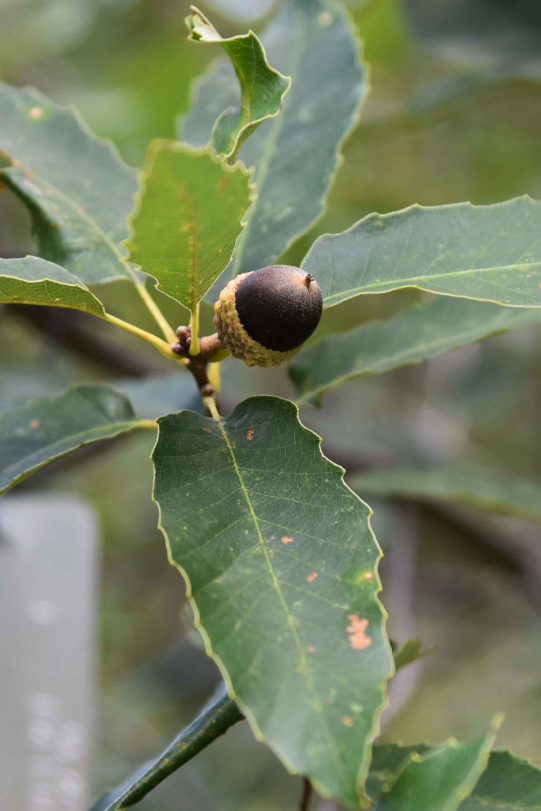
Description
The Chinkapin Oak is typically found in forests, ridges, and rocky slopes. This tree species has leaves that resemble the leaves of the chestnut tree. The nuts of the chestnut tree are called chinquapins, which is where the chinkapin oak’s common name comes from. The chinkapin oak belongs to the white oak group, which means its acorns are produced annually. This tree species is native to Huntington County.
Horticulture Tips
The chinkapin oak requires full sun exposure. It also prefers medium to dry water supply and medium, well-drained soil. This tree species is slow growing and long living.
Benefits
The chinkapin oak is commonly used as a shade tree in large lawns and parks. The specific epithet muehlenbergii comes from Gotthilf Henry Ernest Muhlenberg, who was a Lutheran minister and botanist from Pennsylvania. Another common name, yellow chestnut oak, is given to the chinkapin oak because of its yellow foliage in the fall. The wood of this tree species is commonly generalized in the lumber industry as “white oak wood” and is hard and durable, making it ideal to be used for construction and building furniture.
Insects like the southern oak dagger moth and the oak stump borer moth, along with several other species, use the leaves and acorns of the chinkapin oak as a food source. The acorns are also eaten by bird species like the wild turkey, tufted titmouse, bobwhite quail, and the white-breasted nuthatch. Black bears, raccoons, and several species of squirrels feed on the chinkapin oak’s acorns. The trunks of older chinkapin oaks have cavities, which are used by species of woodpeckers and mammals like tree squirrels, bats, and raccoons, as nesting and shelter sites. The acorns of this tree species are also eaten by humans and are said to be the sweetest acorn.
References
- Chicago Botanic Garden
- Go Botany Native Plant Trust
- Illinois Wildflowers
- Indiana Department of Natural Resources
- Leopold, Donald J.; Trees of the Central Hardwood Forests of America: An Identification and Cultivation Guide; Timber Press, 1998, pp. 350-351.
- Missouri Botanical Garden
- Purdue University Fort Wayne Tree Index
- Silvics of North America
- Weeks, Sally S., et al.; Native Trees of the Midwest: Identification, Wildlife Values, and Landscaping Use, Purdue University Press, West Lafayette, IN, 2005, pp. 202-203.
Cockspur hawthorn (Crataegus crus-galli)
- Family: Rosaceae
- Type: Deciduous
- Average Height: 20' to 30'
- Average Width: 20' to 35'
- Native Range: Eastern North America
- Average Years to Maturity: 20
- Average Lifespan in Years: 75
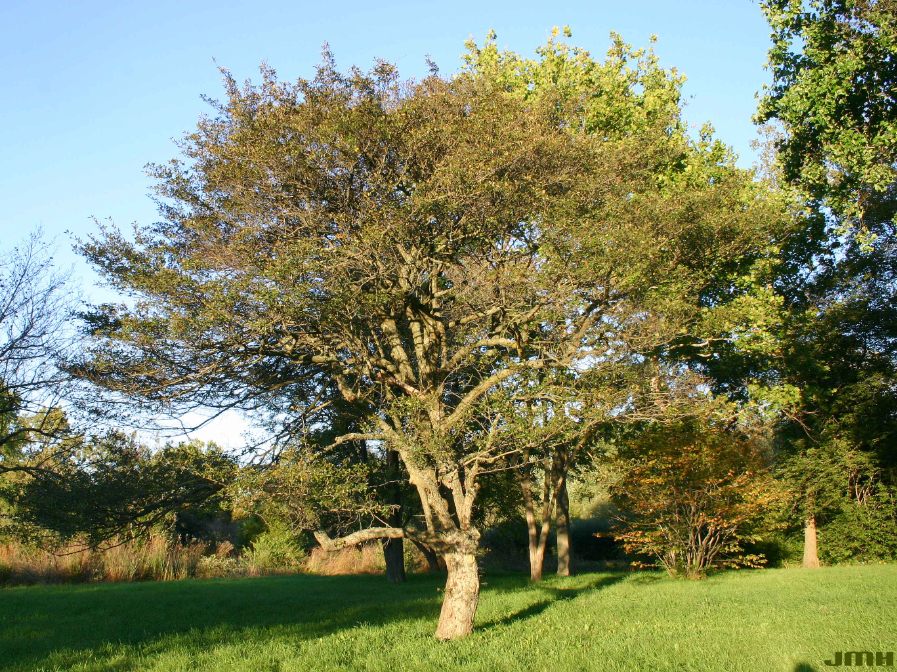
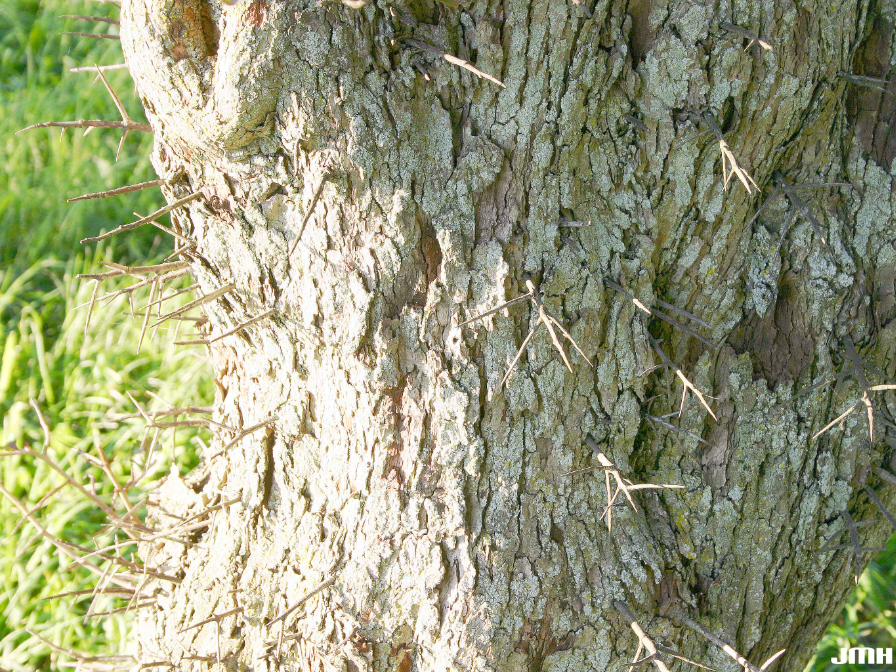
- Bark Identification: Brown or gray, thin, peeling vertical scales with branched 4’’ long thorns
- Leaf Identification: Obovate (oval taping to a point at the base), 4’’ long
Description
The cockspur hawthorn is typically found in man-made habitats, floodplains, thickets, forests, and meadows. This tree species is known for its horizontal growth pattern and its white blossoms that appear for 7 to 10 days in the spring. These blossoms have stalks that are proportionally longer, creating a flat top, and they are known to have a musky, unpleasant smell. The cockspur hawthorn is also known for its 4’’ long thorns that grow on its trunk and the stems of its leaves. This tree species is not native to Huntington County.
Horticulture Tips
Cockspur hawthorns require full sun exposure. They also prefer moderate to dry water supply and moderate to dry soil. When planting this tree species, be cautious of the fact that sharp thorns grow from the trunk. These thorns can be dangerous for young children and can also cause pruning to be difficult.
This tree species is also known for being susceptible to cedar-hawthorn and cedar-quince rusts, which happens when a cockspur hawthorn is planted near a red cedar. This rust is a fungal virus that needs two hosts to complete its life cycle. Red cedars will have round galls, which are small, 2’’ in diameter spheres that produce bright orange, tentacle-like, gummy fungus. Cockspur hawthorns will have pinkish aecia, or structures that produce fungal spores, on their thorns and fruit. The infection that is caused by the produced fungal spores causes cankers, which are dead sections of bark on the trunk and branches of this tree species. To avoid this, do not plant cockspur hawthorns near red cedars.
Benefits
The cockspur hawthorn is used as a landscaping tree because of its attractive white blossoms in spring. If planted in a residential area, a variety of this tree species without thorns is usually used. It can also be used as a barrier tree for properties. The leaves, berries, and flowers of the cockspur hawthorn are used for cardiovascular health in herbal medicine. The wood of this tree species is tough and heavy. The genus name crus-galli means “leg of a cock” in Latin. This is in reference to the thorns, which are said to be similar looking to a rooster’s spurs.
The nectar and pollen of the flowers of this tree species attract honeybees, bumblebees, and several butterflies. The fruit, or haw, of the cockspur hawthorn is consumed by birds like the Northern cardinal, cedar waxwing, and Northern mockingbird. Cockspur hawthorns also provide nesting for the brown thrasher and yellow-breasted chat because of its horizontal branching structure.
References
Cottonwood (Populus deltoides)
- Family: Salicaceae
- Type: Deciduous
- Average Height: 50' to 80'
- Average Width: 30' to 60'
- Native Range: Eastern North America
- Average Years to Maturity: 20
- Average Lifespan in Years: 100
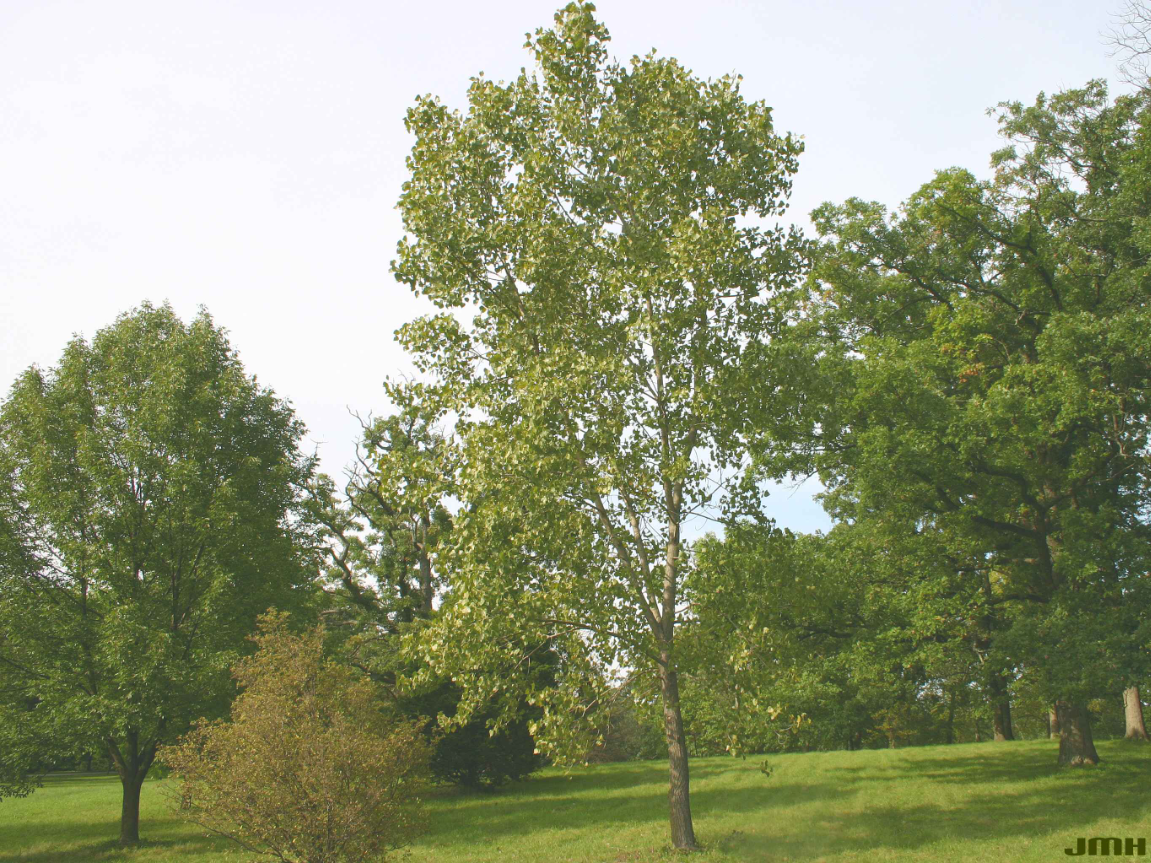
- Bark Identification: Dark gray, deeply ridged
- Leaf Identification: Triangular, toothed edges, glossy, 5’’ long
Description
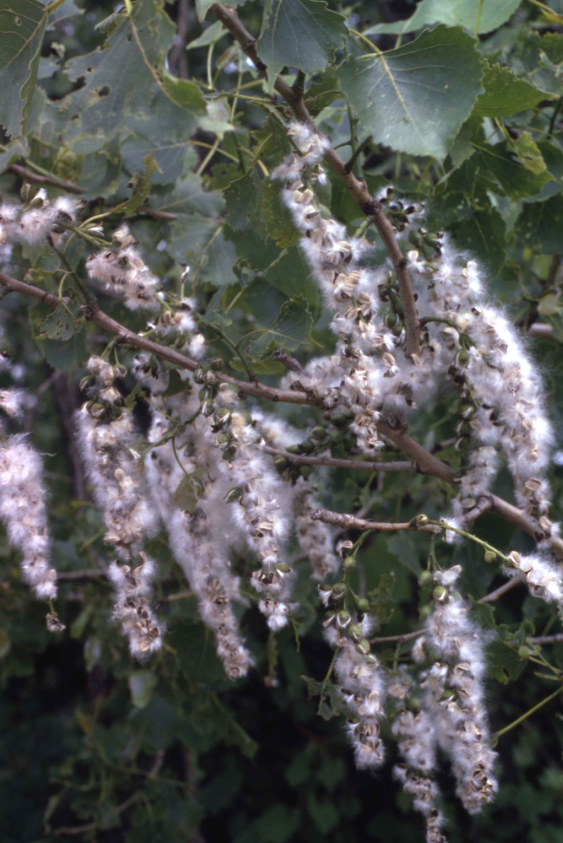
The cottonwood is typically found in manmade habitats, bottomlands, woodlands, and along rivers and lakes. Since the fluffy white seeds of the cottonwood are easily carried by wind and water, the waterside habitats of the cottonwood create ideal environments for growth and repopulation. The seeds of this tree species are surrounded by silky, white hairs that resemble cotton as they are carried by the wind, which is how the common name cottonwood was given. This tree species is native to Huntington County.
Horticulture Tips
The cottonwood requires full sun exposure. It also prefers medium to wet water supply and medium to wet, acidic soil. The cottonwood is a fast-growing tree species.
Benefits
The cottonwood is not commonly used as a landscaping tree because of its messy seeds and its weak wood, which creates foliage litter in yards and parks. However, the male only cultivars of this tree species do not produce the cotton-like seeds and are planted as street trees or lawn trees. The specific epithet deltoides refers to the triangular or deltoid shape of the leaves of this tree species. The wood of the cottonwood is weak and warps easily. While it is not used in commercial lumber, it is used to make crates and plywood.
Birds like the ruffed grouse, prairie chicken, and purple finch eat the buds of the cottonwood. The cavities of this tree species provide nesting for birds like the Baltimore oriole, Northern parula, and yellow warbler. White-tailed deer and the cottontail rabbit eat the twigs and foliage. Beavers use the wood as a food source and as construction materials for their dams.
References
- Chicago Botanic Garden
- Go Botany Native Plant Trust
- Illinois Wildflowers
- Leopold, Donald J.; Trees of the Central Hardwood Forests of North America: An Identification and Cultivation Guide. Timber Press, 1998, pp. 300-302.
- Missouri Botanical Garden
- Morton Arboretum Photo Copyrights
- Silvics of North America
- Weeks, Sally S., et al.; Native Trees of the Midwest: Identification, Wildlife Values, and Landscaping Use, Purdue University Press, West Lafayette, IN, 2005, pp. 160-161.
Crabapple (Malus sp.)
- Family: Rosaceae
- Type: Deciduous
- Average Height: 15' to 30'
- Average Width: 15' to 25'
- Native Range: Asia, North America
- Average Years to Maturity: 15
- Average Lifespan in Years: 50
- Bark Identification: Dark gray or brown, thin fissures separated by scaly ridges, red inner bark, thorns on the branches
- Leaf Identification: Pointed tip, ovate (ovalshaped), serrated edges, shallow lobes, 2’’ to 3’’ long
Description
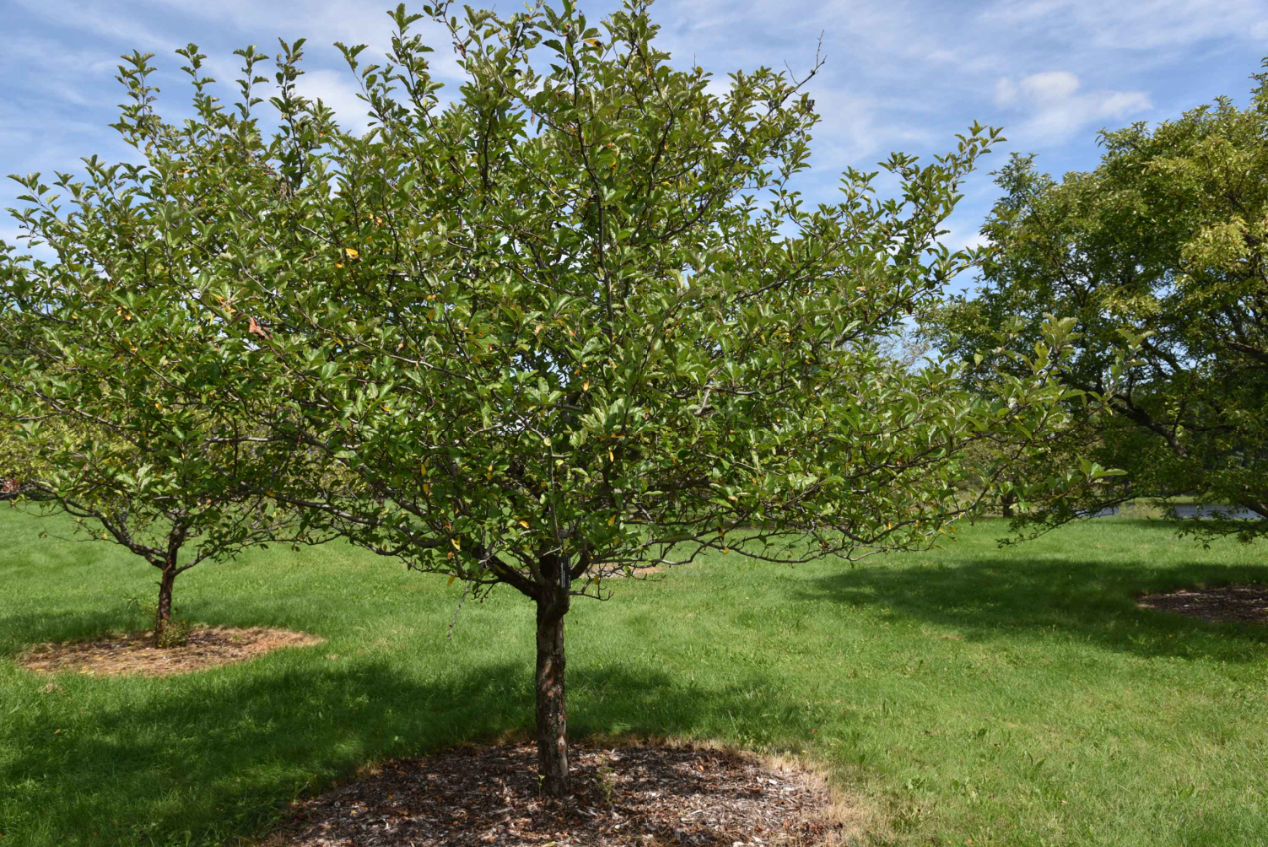
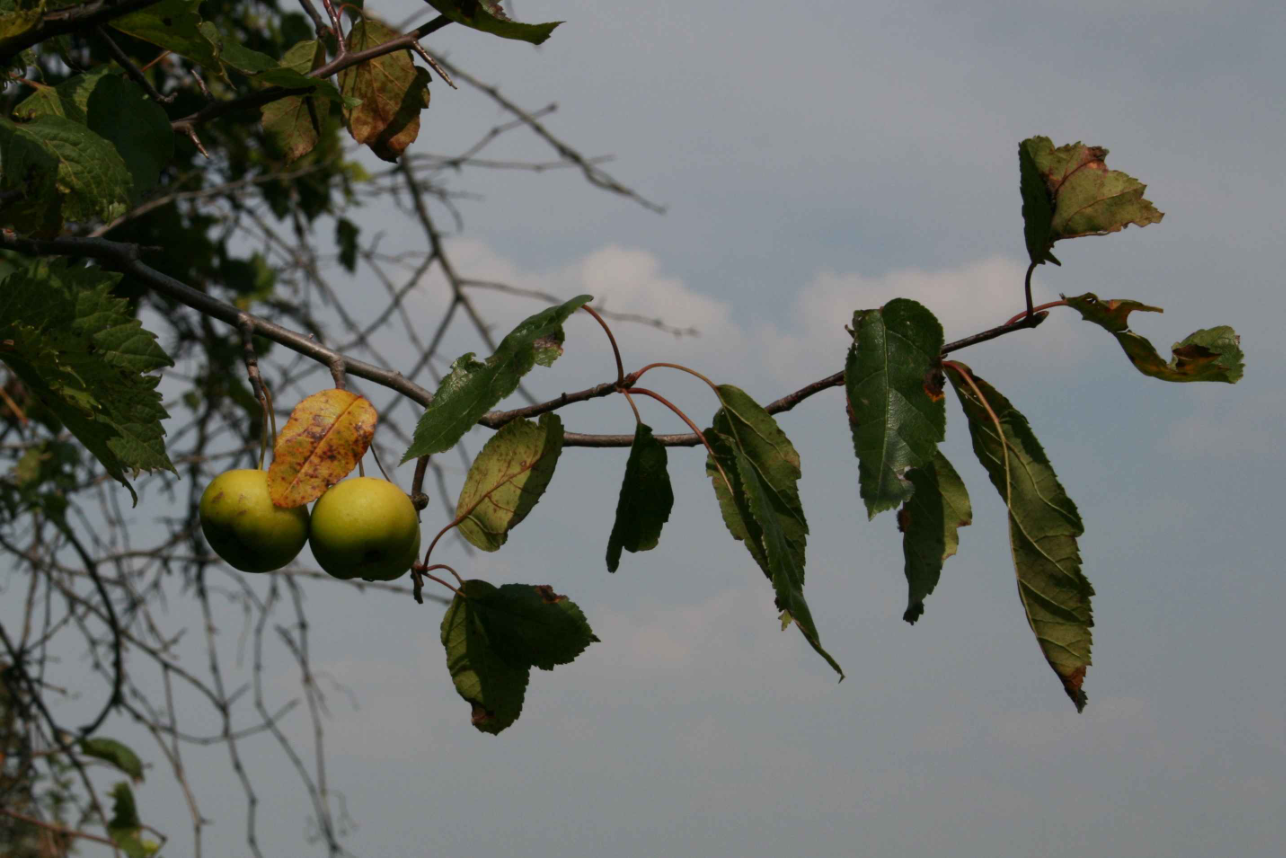
The crabapple is found in abandoned fields, forests, and thickets. Crabapples are native to Asia and were introduced to the United States in the 18th century. This tree species is known for its fruit, which are miniature green or red apples. The fruit is usually 1 ½’’ in diameter and is waxy, hard, and sour. Depending on the variation and cultivar of the crabapple, the leaves and flowers can be different in size, shape, and color. This tree species is found in Huntington County.
Horticulture Tips
The crabapple requires full sun exposure. They also prefer medium water supply and medium to dry, well-drained, acidic soil. The crabapple is a host for cedar apple rust, which is a fungus that requires both red cedar trees and crabapple trees to complete its life cycle. When this disease occurs, the crabapple will have brown spots on their leaves and fruit. To avoid this, do not plant red cedars near crabapple trees. The crabapple is fast-growing and short-lived.
Benefits
The crabapple is used as a landscaping tree because of its attractive, fragrant spring flowers. The small size of the crabapple makes it ideal for small yards. Malus is a genus of about 35 species of deciduous trees and shrubs from Europe, Asia, and North America. The genus name comes from the Latin word for apple. There are many hybrids and cultivars of the general crabapple species. The cultivars are often thornless, have resistance to cedar apple rust, or have sweeter fruit. While the fruit of the crabapple is often sour, it can be used to make jams and jellies.
The fruit of the crabapple is eaten by mammal species like the white-tailed deer, several fox species, and raccoons. As the fruit falls in late autumn and softens, birds like the ruffed grouse and wild turkeys eat the soft pulp of the fruit. This tree species is densely branched, which is ideal for nesting habitats for birds like the yellow-breasted chat, song sparrow, and orchard oriole.
References
- Go Botany Native Plant Trust
- Illinois Wildflowers
- Leopold, Donald J.; Trees of the Central Hardwood Forests of North America: An Identification and Cultivation Guide. Timber Press, 1998, pp. 252-256.
- Missouri Botanical Garden
- Morton Arboretum Photo Copyrights
- SFGate Gardening and Landscaping
- Weeks, Sally S., et al.; Native Trees of the Midwest: Identification, Wildlife Values, and Landscaping Use, Purdue University Press, West Lafayette, IN, 2005, pp. 140-141.
Eastern redbud (Cercis canadensis)
- Family: Fabaceae
- Type: Deciduous
- Average Height: 20' to 30'
- Average Width: 25' to 35'
- Native Range: Eastern North America
- Average Years to Maturity: 20
- Average Lifespan in Years: 75
- Bark Identification: Brown, scaly outer bark that often sheds, showing the dark red inner bark
- Leaf Identification: Heart-shaped, 5’’ long
Description
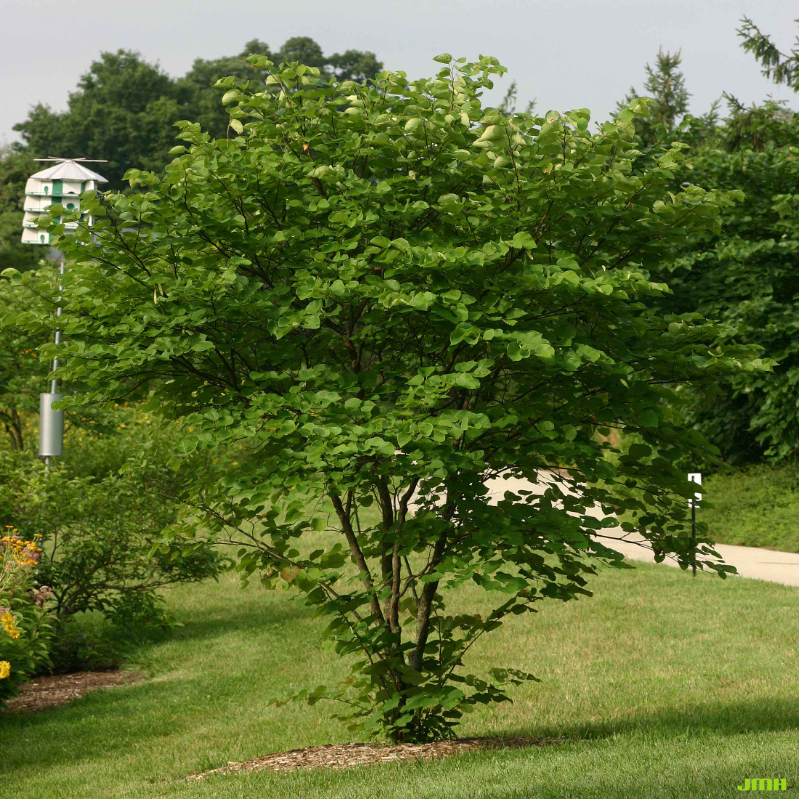
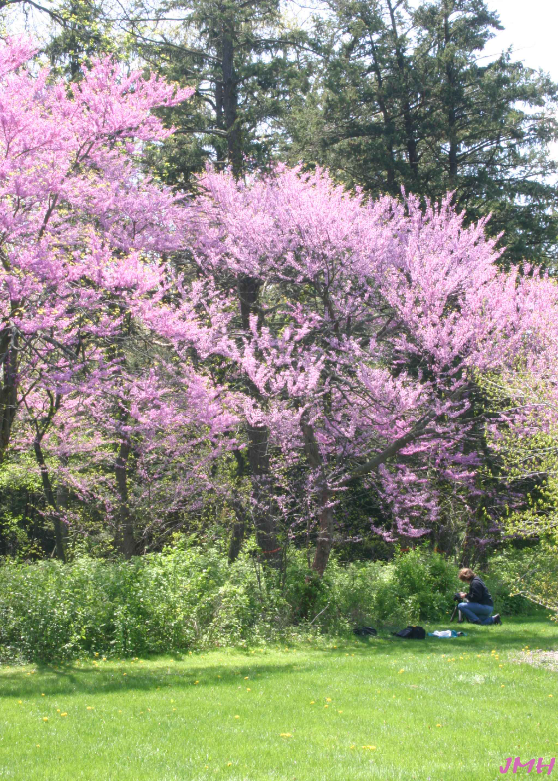
The eastern redbud is usually found in forests and at the edge of forests. This tree is recognizable for its pea-like, purple-pink flowers that bloom in early spring. These flowers are unique because they last typically a month longer than most other flowers do on other tree species. This tree is native to Huntington County.
Horticulture Tips
Eastern redbuds prefer full sun exposure but can also perform well in part shade environments. They also require a medium water supply and well-drained, medium moist soil. The Eastern redbud is typically available in nurseries. This tree does not transplant well because of its root system and should be planted young. The Eastern redbud is susceptible to a disease called canker, which is a fungal infection that causes dead spots on the trunk and branches of the tree.
Benefits
The Eastern redbud can be used as a landscaping tree along streets or in yards, as its flowers are attractive. It can also be used as a border for properties or yards. The Eastern redbud is the state tree of Oklahoma. Native Americans used the bark of this tree, which is rich in antioxidants, to make tea to cure common ailments. It was also said that Eastern redbuds were a favorite tree of George Washington. The flowers are edible and taste like cucumbers or snow peas.
The flowers of the Eastern redbud are pollinated by honeybees and bumblebees. These bee species are attracted to the nectar and pollen of the tree. The seeds of this tree are eaten by birds like the Northern cardinal and the rose-breasted grosbeak.
References
- Chicago Botanic Garden
- Illinois Wildflowers
- Leopold, Donald J.; Trees of the Central Hardwood Forests of North America: An Identification and Cultivation Guide. Timber Press, 1998, pp. 163-165.
- Missouri Botanical Garden
- Morton Arboretum Photo Copyrights
- Purdue University Fort Wayne Tree Index
- Silvics of North America
- Weeks, Sally S., et al.; Native Trees of the Midwest: Identification, Wildlife Values, and Landscaping Use, Purdue University Press, West Lafayette, IN, 2005, pp. 118-119.
Eastern white pine (Pinus strobus)
- Family: Pinaceae
- Type: Evergreen conifer
- Average Height: 50' to 80'
- Average Width: 20' to 40'
- Native Range: Eastern North America
- Average Years to Maturity: 50
- Average Lifespan in Years: 200
- Bark Identification: Gray or brown, has furrows, ridges, and rectangular scales with age
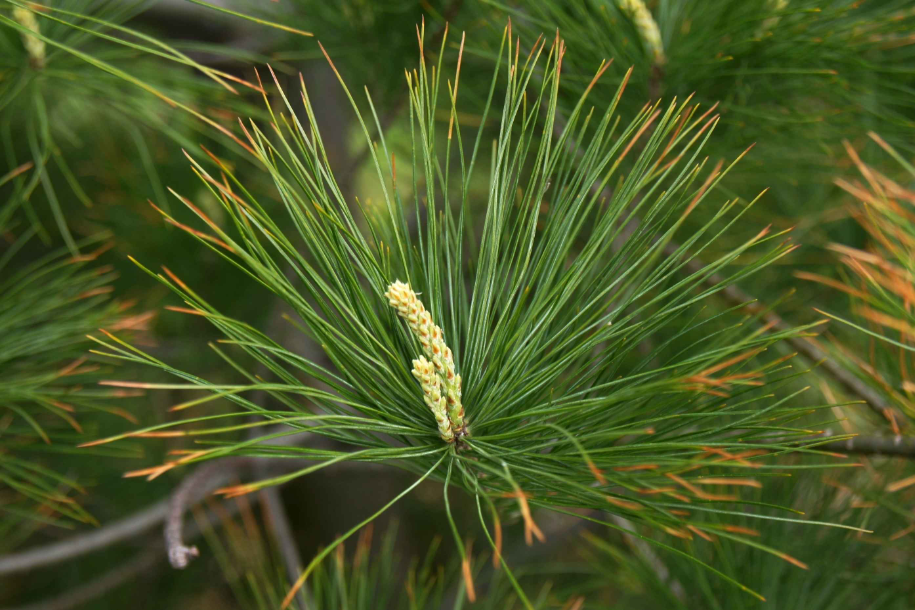
- Leaf Identification: Evergreen needles in bunches of 5, 6’’ long with lines of white dots on them
Description
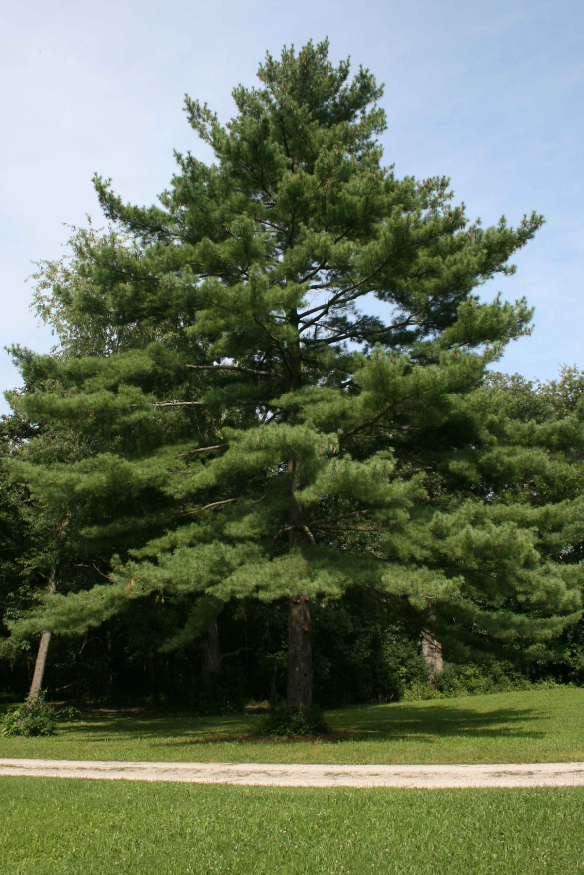
The Eastern white pine is found in swamps, forests, and man-made habitats. The pinecones of the Eastern white pine are 4’’ to 8’’ long when mature and do not have prickles. The needles of this tree species are unique because they are clusters of 5, and most other conifers in our region have clusters of 2 or 3 needles. These needles have a lot of Vitamin C in them. This tree is not native to Huntington County, as it is found primarily further north in the Great Lakes region and in the Appalachian Mountains. Naturally, it is found only in a few scattered populations in Indiana, but it is planted widely throughout the state.
Horticulture Tips
The Eastern white pine prefers full sun exposure, but it can also grow in part shade environments. They require moderate water supply and well drained, acidic, medium to moist soil. The pH that is preferred is 5.5. With these requirements, they perform well across much of the eastern half of North America.
Benefits
The Eastern white pine is best planted in a large yard, where it can be used as an ornamental tree. Also, this tree species can be planted as a fencing tree because it can be sheared regularly, making it into a shrub. There are several parts of the Eastern white pine that have been used throughout history. The wood of this tree is lightweight and was used frequently in New England for making ship masts because of its height. This wood was so popular that it was a major lumber species in the late 1800’s. Additionally, the inner bark was used as a flour source by Native Americans.
Several insects, like the pine tree cricket, use this tree as a food source. Birds like the pine warbler, yellow-throated warbler, and bald eagle use this tree for nesting. The red squirrel, gray squirrel, white-tailed deer, and cottontail rabbit all eat the seeds, branches, and needles of the Eastern white pine.
The Eastern white pine is the tallest tree east of the Mississippi. It is the state tree of Maine and Michigan.
References
- Go Botany Native Plant Trust
- Indiana Department of Natural Resources Tree Species Information
- Illinois Wildflowers
- Leopold, Donald J.; Trees of the Central Hardwood Forests of North America: An Identification and Cultivation Guide. Timber Press, 1998, pp. 286-288.
- Missouri Botanical Garden
- Morton Arboretum Photo Copyrights
- Silvics of North America
- Weeks, Sally S., et al.; Native Trees of the Midwest: Identification, Wildlife Values, and Landscaping Use, Purdue University Press, West Lafayette, IN, 2005, pp. 30-31.
Freeman maple (Acer x freemanii)
- Family: Sapindaceae
- Type: Decidious
- Average Height: 40' to 55'
- Average Width: 30' to 40'
- Native Range: Eastern North America
- Average Years to Maturity: 20
- Average Lifespan in Years: 100
- Bark Identification: Gray, smooth, thin, furrows with maturity
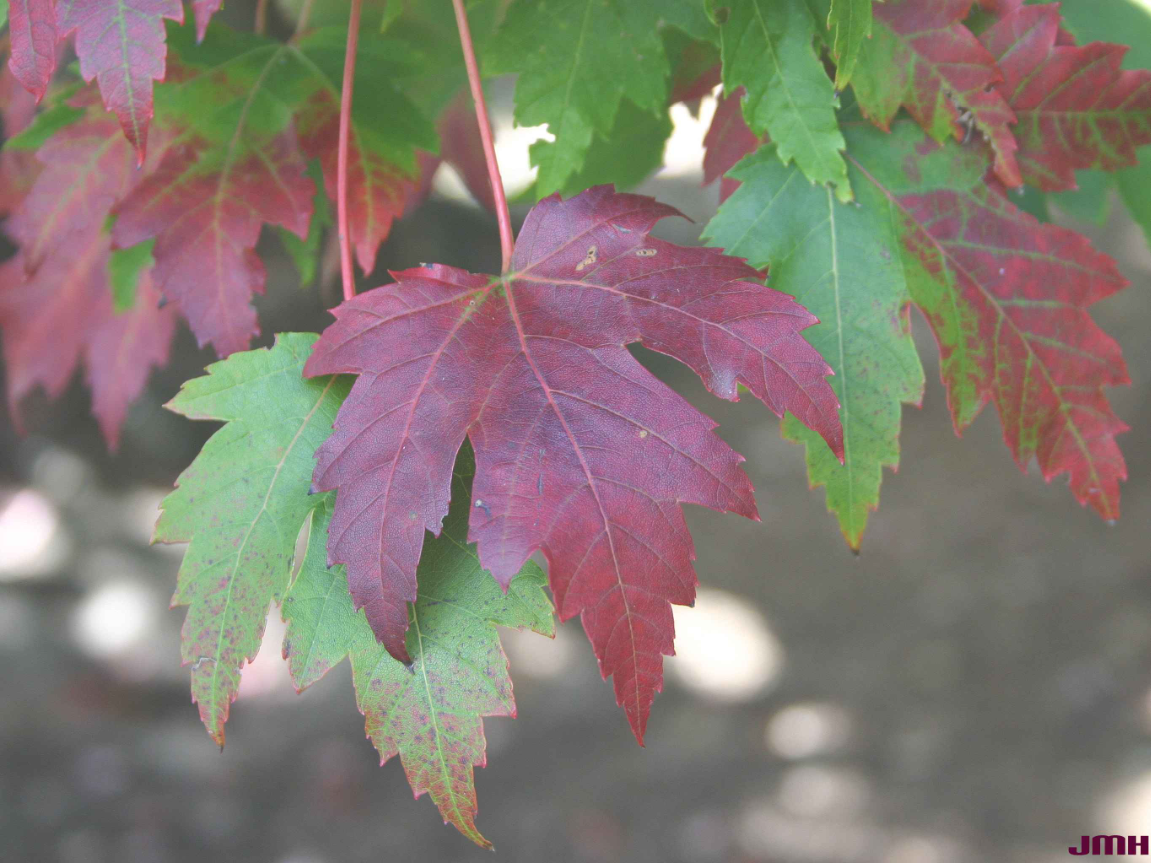
- Leaf Identification: 5 pointed lobes, toothed edges, narrow sinuses (spaces between lobes), 4" to 6" long
Description
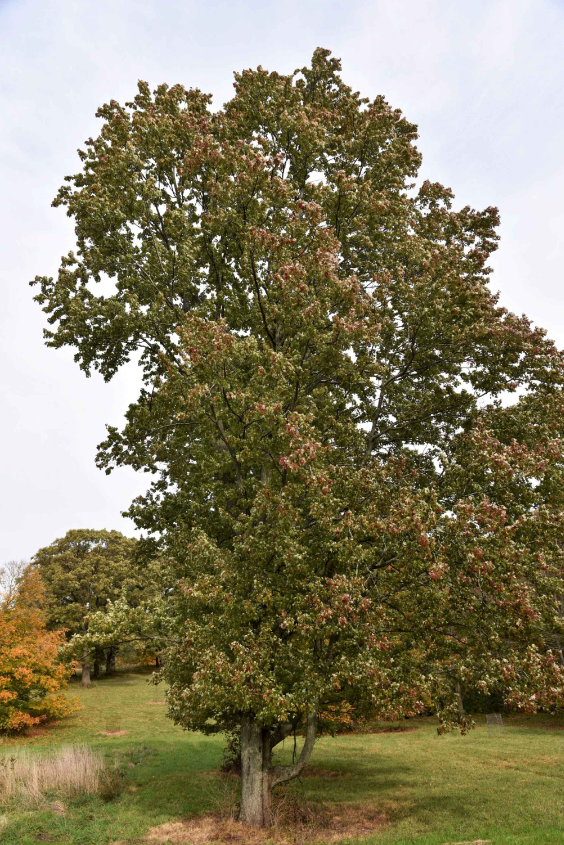
The freeman maple is typically found in floodplains and forests. This tree species is a hybrid of the silver maple and the red maple. From the red maple, the freeman maple inherits its form and red fall foliage. The freeman maple’s rapid growth habit comes from the silver maple. The freeman maple can be distinguished from other maple species because of the narrow sinuses in between its lobes, as opposed to the wider sinuses in between the lobes of other maples. This tree species is found in Huntington County.
Horticulture Tips
The freeman maple prefers full sun exposure but can grow successfully in part shade environments. It also prefers medium to wet water supply and moist, well-drained soil. The freeman maple is a fast-growing tree species.
Benefits
The freeman maple is commonly used as a landscaping or shade tree for lawns, streets, and parks. There are several cultivars of the freeman maple. Oliver M. Freeman, from whom the specific epithet freemanii comes, grew the first freeman maple at the U.S. National Arboretum in 1933.
The seeds and buds of the freeman maple are eaten by birds like the Northern cardinal, ruffed grouse, rose-breasted grosbeak, purple finch, and American robin. Mammals like the black bear, raccoon, and several squirrel species eat the seeds.
References
- Missouri Botanical Garden
- Morton Arboretum Photo Copyrights
Hackberry (Celtis occidentalis)
- Family: Cannabaceae
- Type: Deciduous
- Average Height: 50' to 70'
- Average Width: 40' to 60'
- Native Range: Eastern North America
- Average Years to Maturity: 25
- Average Lifespan in Years: 150
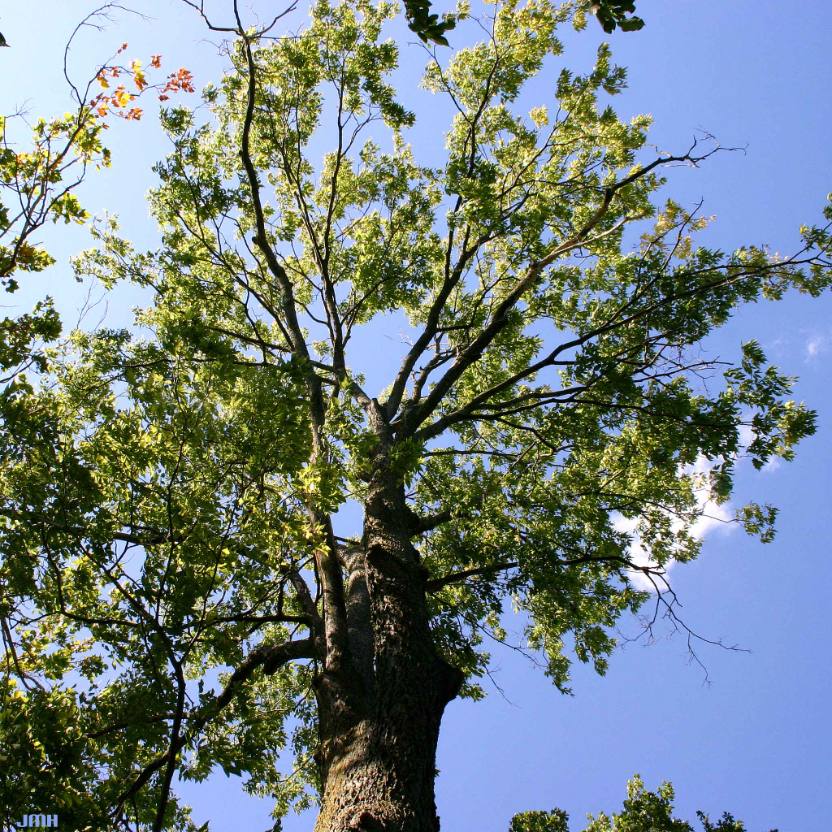
- Bark Identification: Gray and smooth when young, warts with aging, ridged and scaled in maturity
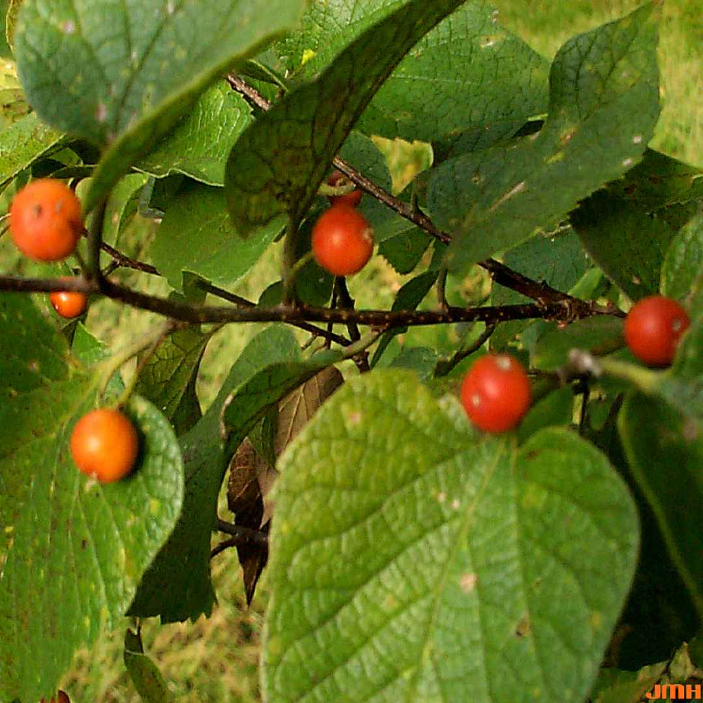
- Leaf Identification: Ovate (oval ending in a point) with toothed edges, 2’’ to 5’’ long, pointed, or hooked tip, often covered in galls (plant growths caused by insects)
Description
The hackberry is usually found in floodplains, forests, and meadows. This tree is often identified by the nipple galls on its leaves, which are abnormal growths that are caused by insects. The hackberry is related to elm species, as shown by the asymmetrical base of its leaves. This tree is often confused with the closely related sugarberry, which is also native to Eastern North America. However, the hackberry can be distinguished because it has serrated edges on its leaves, and the sugarberry only has a few teeth on its leave’s edges. This tree is native to Huntington County.
Horticulture Tips
Hackberries prefer full sun exposure but can also perform well in shade environments. They also require a medium water supply and well-drained, moist soil. The hackberry is also known to have witches’ broom, which is a cluster of twigs at the end of branches. These growths do not cause harm to the tree and are a response to mites and fungus.
Benefits
The hackberry is an ideal shade tree. It can also serve as a landscaping tree in yards or residential streets. The wood of this tree can be used to make furniture, plywood, and for flooring. The berries of this tree are what the tree is named for, and birds like American robins and cedar waxwings eat them. Native Americans used the berries to add flavor to their food, and they used the bark to treat sore throats and other diseases. The hackberry was given its common name because according to Scottish immigrants, it resembled the hagberry tree in Scotland.
The hackberry is used as a host plant for many butterfly species like the hackberry emperor and the snout butterfly. The hackberry psyllid is an insect that feeds on the hackberry, but it causes nipple galls. The hackberry mite causes the witches’ broom feature of this tree. While the gray squirrel and several deer species feed on the twigs, seedlings, and nuts of the hackberry, it is not a popular food source because it has low protein value.
References
- Chicago Botanic Garden
- Go Botany Native Plant Trust
- Illinois Wildflowers
- Leopold, Donald J.; Trees of the Central Hardwood Forests of North America: An Identification and Cultivation Guide. Timber Press, 1998, pp. 158-160.
- Missouri Botanical Garden
- Morton Arboretum Photo Copyrights
- Silvics of North America
- Weeks, Sally S., et al.; Native Trees of the Midwest: Identification, Wildlife Values, and Landscaping Use, Purdue University Press, West Lafayette, IN, 2005, pp. 116-117.
Honey Locust (Gleditsia triacanthos)
- Family: Fabaceae
- Type: Deciduous
- Average Height: 60' to 80'
- Average Width: 60' to 80'
- Native Range: Eastern and Central North America
- Average Years to Maturity: 30
- Average Lifespan in Years: 125
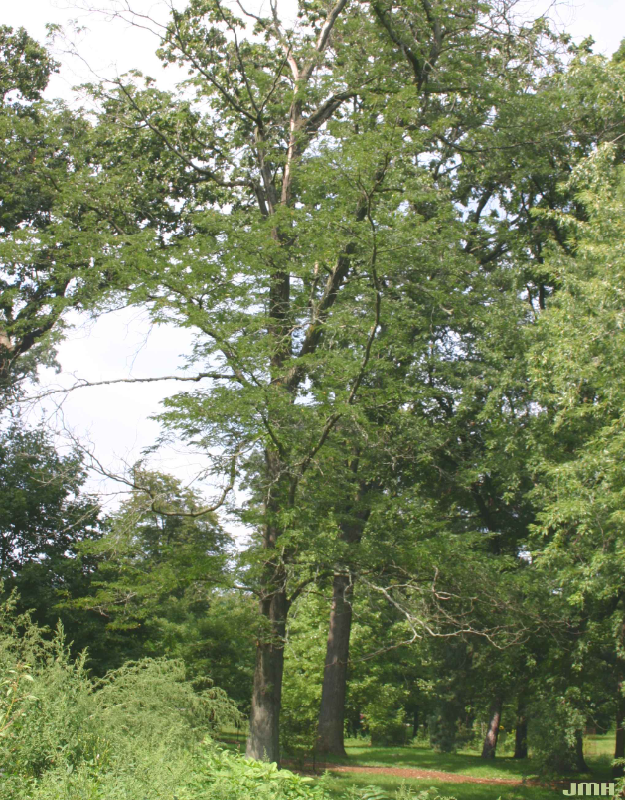
- Bark Identification: Smooth, gray, narrow peeling strips, typically have 3 branched thorns
- Leaf Identification: 9 to 14 leaflets (½" to 1 ½" long) per leaf (6" to 10"’ long), yellow green

Description
The honey locust is typically found in bottomlands, thickets, and prairies. The honey locust is given its common name because of the sweet pulp that surrounds the seeds within flat, long seed pods. This pulp is favored by cows as a food source. The honey locust is also given the common name thorny-locust because of the branching thorns on its trunk. This tree species is native to Huntington County.
Horticulture Tips
The honey locust prefers full sun exposure but can grow successfully in part shade environments. It also prefers medium to wet water supply and medium to wet, well-drained soil.
Benefits
The honey locust is not typically used as a street tree because of its thorns. However, thornless cultivars are available and can be lawn trees or street trees. The specific epithet triacanthos comes from the Greek words tri and acantha, which means three and thorn, which refers to the three-branched thorns on the trunks of honey locusts. These thorns were used by settlers to card wool.
The seed pods of the honey locust, which can reach up to 1’ in length, are eaten by mammal species like cattle, sheep, goats, deer, and opossums. This tree species has been said to have been a food source of the American mastodon and giant ground sloths during the last ice age, which is where the evolution of the thorny bark is thought to have come from as a defense mechanism.
References
- Go Botany Native Plant Trust
- Illinois Wildflowers
- Leopold, Donald J.; Trees of the Central Hardwood Forests of North America: An Identification and Cultivation Guide. Timber Press, 1998, pp. 207-209.
- Missouri Botanical Garden
- Morton Arboretum Photo Copyrights
- Purdue University Fort Wayne Tree Index
- Silvics of North America
- Weeks, Sally S., et al. Native Trees of the Midwest: Identification, Wildlife Values, and Landscaping Use, Purdue University Press, West Lafayette, IN, 2005, pp. 272-273.
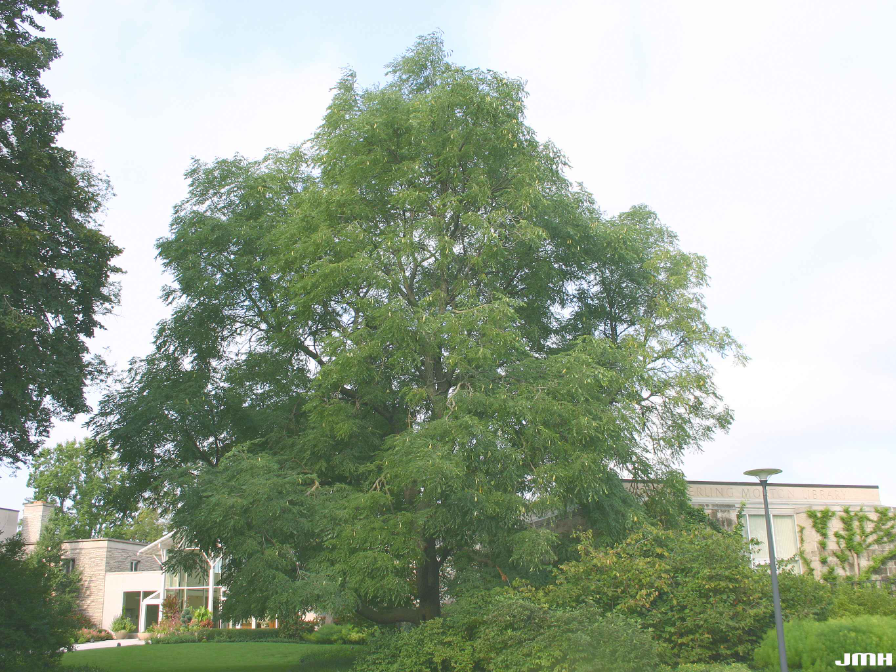
Kentucky coffeetree (Gymnocladus dioicus)
- Family: Fabaceae
- Type: Deciduous
- Average Height: 50' to 90'
- Average Width: 40' to 55'
- Native Range: Eastern North America
- Average Years to Maturity: 50
- Average Lifespan in Years: 150
- Bark Identification: Gray or gray-brown, scaly peeling ridges, red to orange inner bark
- Leaf Identification: Ovate (oval ending in a point), Compound with up to 70 leaflets (1’’ to 3’’ long) per leaf (1’ to 3’ long) Horticulture Tips
Description
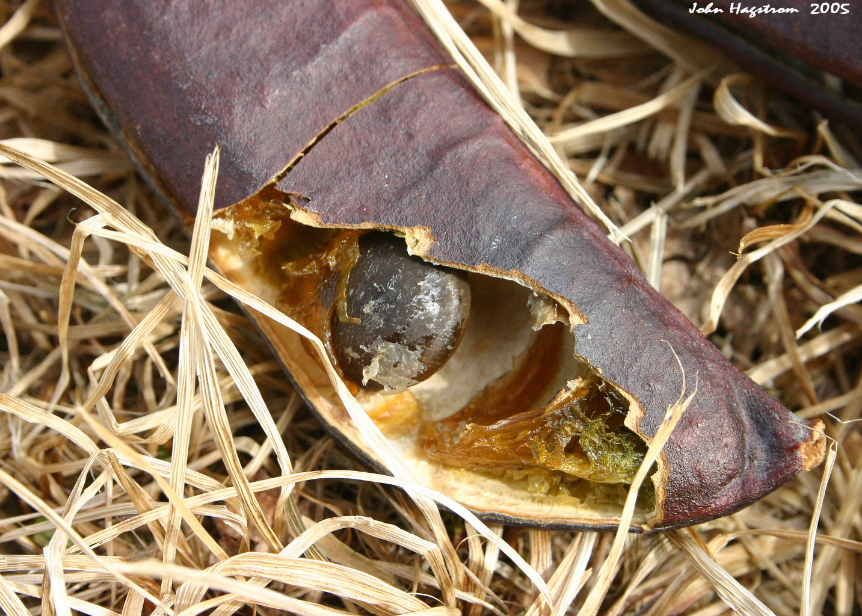
The Kentucky coffeetree is typically found in man-made habitats, forests, and forest edges. Individual Kentucky coffeetrees are male or female, with each tree possessing only male or only female flowers. Male flowers form in clusters that are typically 4” long. Female flowers form panicles, or a loose branching of clusters, up to 12” long. The fertilized female flowers develop into reddish brown pods, typically 10’’ long, which contain the seeds of the tree. These brown pods resemble large bean pods because the Kentucky coffeetree is a member of the legume family. This tree species is native to Huntington County.
Horticulture Tips
The Kentucky coffeetree requires full sun exposure. It also prefers medium water supply and moist, well-drained soil. The Kentucky coffeetree sheds its leaves a few weeks earlier than most tree species, and its leaves come back in the spring a few weeks later than most tree species.
Benefits
The Kentucky coffeetree is commonly used as a landscaping tree in large yards or parks. It is also used as a shade tree. Native Americans and early American settlers in the Appalachian area roasted and ground the seeds of this tree species to brew a coffee-like drink, which is how this tree species was given its common name. The seeds are toxic if not roasted and should not be eaten directly off the tree. However, the pulp within the pod, which is sticky and lime green, is edible with a sweet flavor. The scientific name dioicus means that this tree species has distinct male and female trees.
The female flowers of the Kentucky coffeetree are pollinated by bumblebees, longhorned bees, and ruby-throated hummingbirds. Since the seeds and leaves are toxic, mammals and birds avoid using this tree species as a food source.
References
- Chicago Botanic Garden
- Go Botany Native Plant Trust
- Illinois Wildflowers
- Indiana Department of Natural Resources
- Leopold, Donald J.; Trees of the Central Hardwood Forests of North America: An Identification and Cultivation Guide. Timber Press, 1998, pp. 274-276.
- Missouri Botanical Garden
- Morton Arboretum Photo Copyrights
- Purdue University Fort Wayne Tree Index
- Weeks, Sally S., et al.; Native Trees of the Midwest: Identification, Wildlife Values, and Landscaping Use, Purdue University Press, West Lafayette, IN, 2005, pp. 210-211.
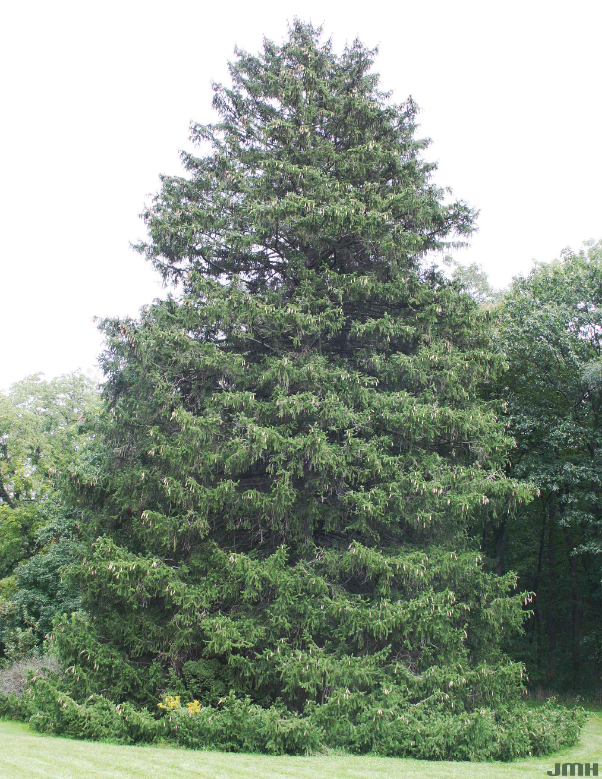
Norway spruce (Picea abies)
- Family: Pinaceae
- Type: Evergreen conifer
- Average Height: 40' to 60'
- Average Width: 25' to 30'
- Native Range: Europe
- Average Years to Maturity: 30
- Average Lifespan in Years: 150
- Bark Identification: Gray with rough texture, often spotted with resin
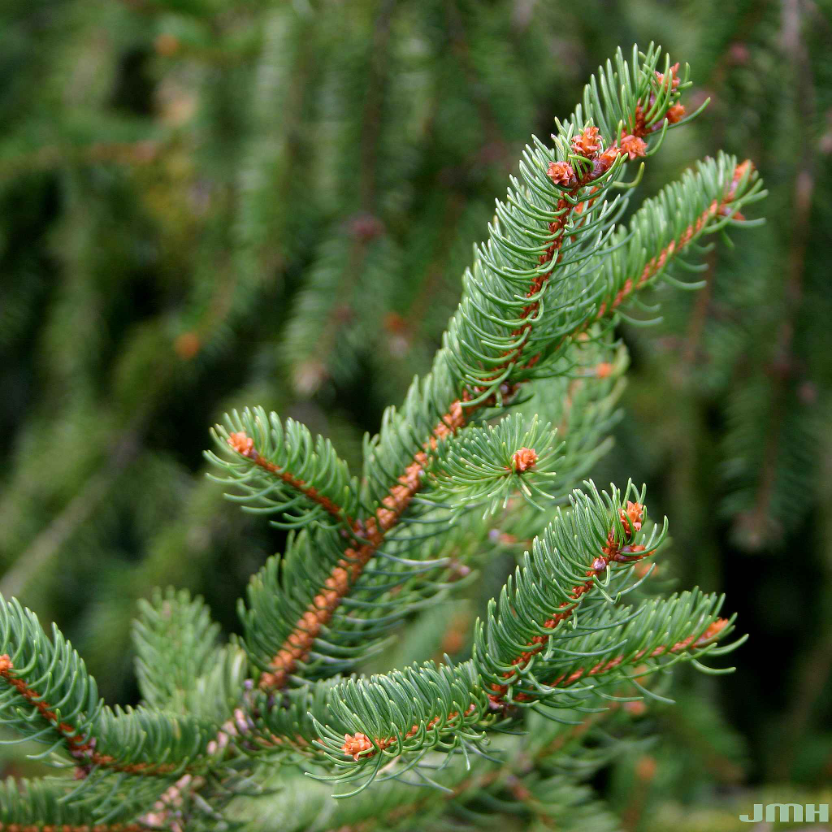
- Leaf Identification: Single evergreen needles, about ½" to 1" long
Description
The Norway spruce naturally grows in Europe but has been introduced to eastern parts of the United States. This tree is usually found in man-made habitats, since they rarely reproduce successfully in North America by themselves. The pinecones of the Norway spruce are brown and wood-scaled cones. Each scale of a pinecone holds two winged seeds, and these seeds are distributed through the wind. The cones of this tree are unique because their length ranges from 4" to 7", which is longer than most conifer’s cones. The cones of the Norway spruce also dangle off the branches. This tree species is not native to Huntington County.
Horticulture Tips
Norway spruces require full sun exposure to grow successfully. They also require medium water supply and well-drained, moist soil, which makes them perform well in the Midwest. The Norway spruce is commonly found in nurseries for sale. These trees are low maintenance and provide winter color in yards, as most conifers do.
Benefits
With long branches that cause the total spread of the tree to be 25’ to 30’, the Norway spruce is best planted in a large yard, where it can be used as a screening tree or a landscaping tree. The Norway spruce is also commonly used for cultivation, as it can be used as an option for a Christmas tree. The wood is lightweight and soft, which makes it ideal for building furniture and musical instruments.
Despite being non-native, the Norway spruce is used by several native species as a housing and food source. Several insects, like the caterpillars of moths, like the spruce budworm and the spruce needle miner, bore into its bark and use this plant as a food source. Since the Norway spruce has dense branches and ample covering, birds like the golden-crowned kinglet, blackburnian warbler, and red-breasted nuthatch use the tree for nesting.
References
Pagoda dogwood (Cornus alternifolia)
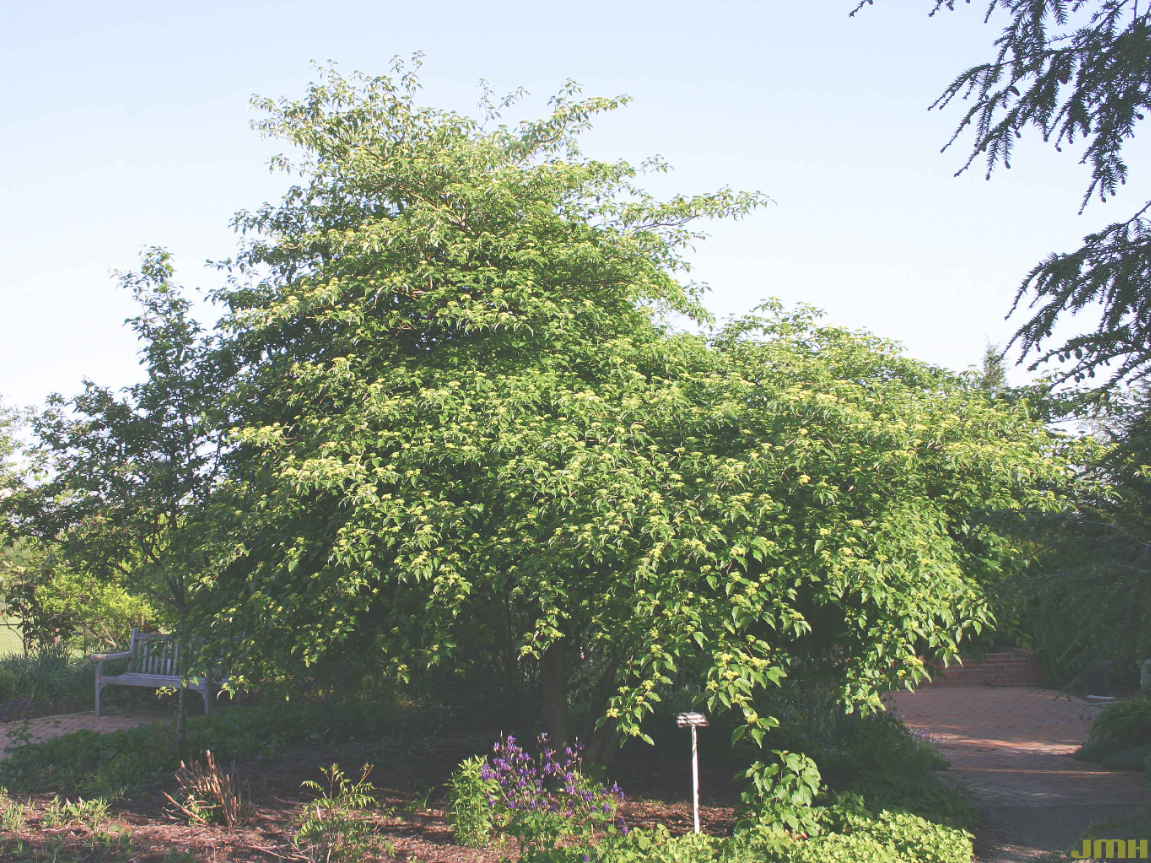
- Family: Cornaceae
- Type: Deciduous
- Average Height: 15' to 30'
- Average Width: 20' to 30'
- Native Range: Eastern North America
- Average Years to Maturity: 15
- Average Lifespan in Years: 100
- Bark Identification: Light gray and smooth in younger trees, scaly and gray or brown with small blocks in maturity
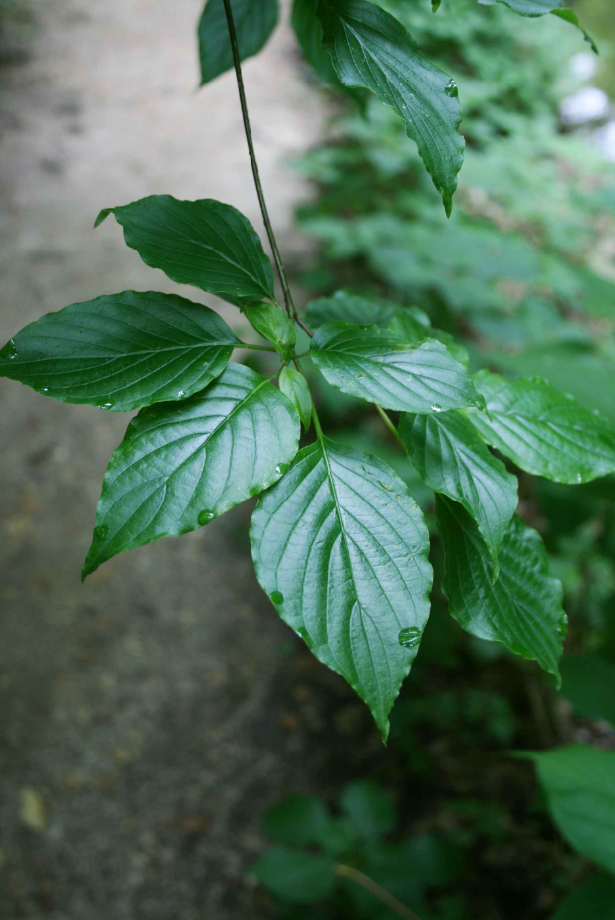
- Leaf Identification: Elliptically shaped, 2" to 5" long, prominent veins
Description
The pagoda dogwood is usually found in shrublands, thickets, and forests. This tree is named because its leaves form horizontal tiers when mature, which resemble the roofs of a pagoda. The pagoda dogwood is unique from other dogwoods because its leaves are alternate, while most dogwoods have opposite leaves. The appearance of the leaves of the pagoda dogwood also makes it distinguishable from other dogwoods. This tree has 5 to 6 bold veins, while other dogwoods have fewer veins. Also, the berries of the pagoda dogwood are dark blue, while those of other dogwoods are typically white, red, or pale blue. This tree is native to Huntington County.
Horticulture Tips
Pagoda dogwoods prefer full sun exposure but can be successful in shade environments. They also require a medium water supply and well-drained, acidic (5.5 to 6.5 pH), medium soil. The pagoda dogwood is a slow growing tree.
Benefits
The pagoda dogwood is used as a landscaping tree for lawns and streets. It can also be used in bird gardens, as it attracts several bird species and butterfly species. The genus name of this tree comes from the Latin word “cornu,” which means horn. This is in reference to the strength of the wood. The second part of the scientific name, “alternifolia,” references the alternate-leaf pattern that the pagoda dogwood has.
Insects like the dogwood sawfly and long-horned beetle feed on the leaves and wood of this tree. The nectar and pollen of the white blossoms attract long-tongued and shorttongued bees in springtime. Birds like the cedar waxwing, wood thrush, rose-breasted grosbeak, and American robin eat the berries of the pagoda dogwood. White-tailed deer and cottontail rabbits eat twigs and leaves, and beavers eat the branches.
References
- Chicago Botanic Garden
- Go Botany Native Plant Trust
- Illinois Wildflowers
- Missouri Botanical Garden
- Morton Arboretum Photo Copyrights
- Purdue University Fort Wayne Tree Index
Pin oak (Quercus palustris)
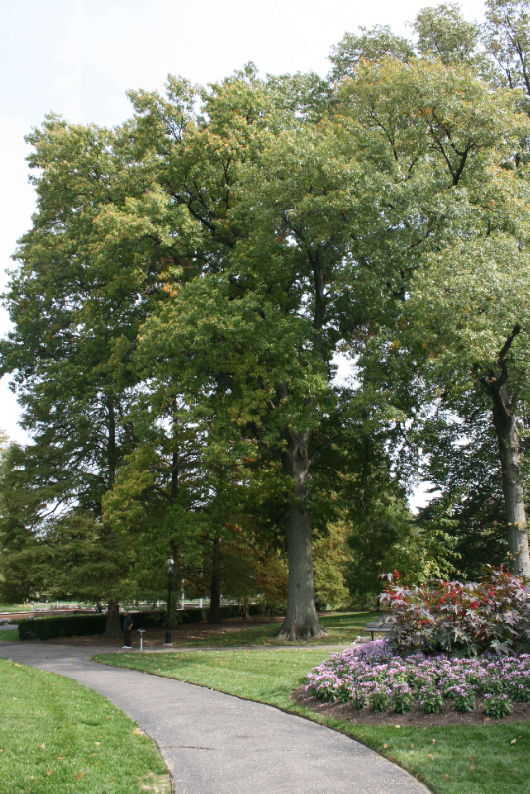
- Family: Fagaceae
- Type: Deciduous
- Average Height: 50' to 70'
- Average Width: 40' to 60'
- Native Range: Eastern North America
- Average Years to Maturity: 30
- Average Lifespan in Years: 100
- Bark Identification: Gray brown, broad ridges separated by shallow fissures with maturity
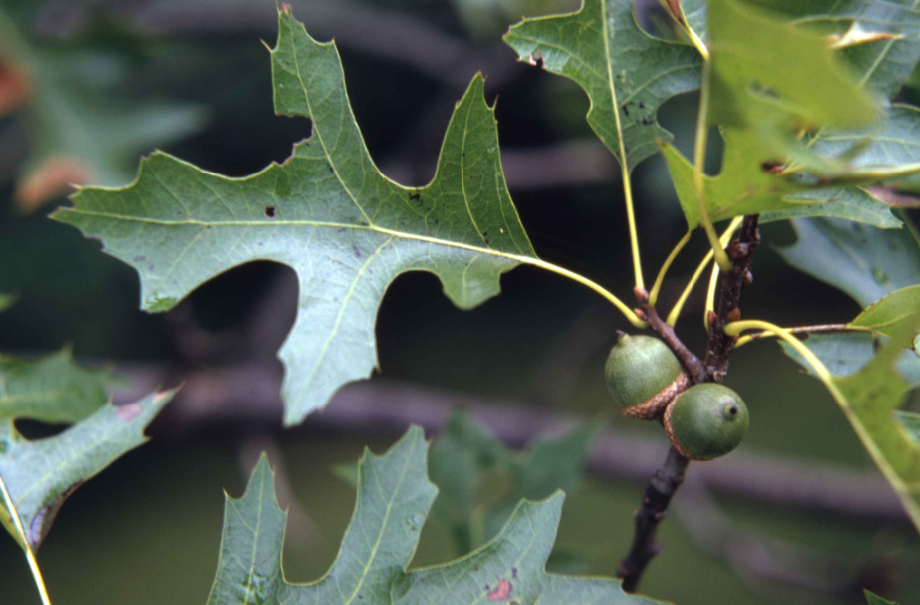
- Leaf Identification: Elliptically shaped, 5 to 7 bristle-tipped lobes, deep sinuses (spaces between lobes), 3" to 5" long
Description
The pin oak is typically found in floodplains, forests, and swamps. The pin oak is a member of the red oak group, which means its acorns are produced biennially. The lower branches of this tree species have a unique form compared to other oak species. The branches of the pin oak typically bend downwards, while most oak species have horizontal branches. These lower branches are often blocked from sunlight, which causes them to break off. These broken branches resemble pins and are how the common name was given to the pin oak. This tree species is known for the deep sinuses in between the lobes on its leaves, which are redder in the fall than the typical yellow foliage of other oak species. The pin oak is unique because of its small, 1/3" to 1/2" long acorns. This tree species is native to Huntington County.
Horticulture Tips
The pin oak requires full sun exposure. It also prefers medium to wet water supply and medium to wet, acidic, well-drained soil. The pin oak is intolerant to alkaline soil. The pin oak is fast growing, which is atypical for the oak species.
Benefits
The pin oak is commonly used as a shade tree for lawns, streets, and parks. This tree species can be used as a landscaping tree because of its attractive fall foliage. The specific epithet palustris comes from the Latin word for marsh, which is a common habitat of this tree species. This is also where another common name for the pin oak, swamp oak, comes from. The wood of the pin oak is commonly generalized as “red oak wood” in the lumber industry and is hard and heavy, which makes it ideal for construction.
Several insects, like the spiny oak worm and the acorn moth, use the leaves and wood of the pin oak as a food source. The small acorns of this tree species are typically a popular food source for bird species like the wood duck, blue jay, and tufted titmouse. The pin oak also provides nesting sites for herons, egrets, and other wetland birds since this oak typically grows near water.
References
- Chicago Botanic Garden
- Go Botany Native Plant Trust
- Illinois Wildflowers
- Indiana Department of Natural Resources
- Leopold, Donald J.; Trees of the Central Hardwood Forests of North America: An Identification and Cultivation Guide. Timber Press, 1998, pp. 355-356.
- Missouri Botanical Garden
- Morton Arboretum Photo Copyrights
- Purdue University Fort Wayne Tree Index
- Silvics of North America
- Weeks, Sally S., et al.; Native Trees of the Midwest: Identification, Wildlife Values, and Landscaping Use, Purdue University Press, West Lafayette, IN, 2005, pp. 206-207.
Quaking aspen (Populus tremuloides)
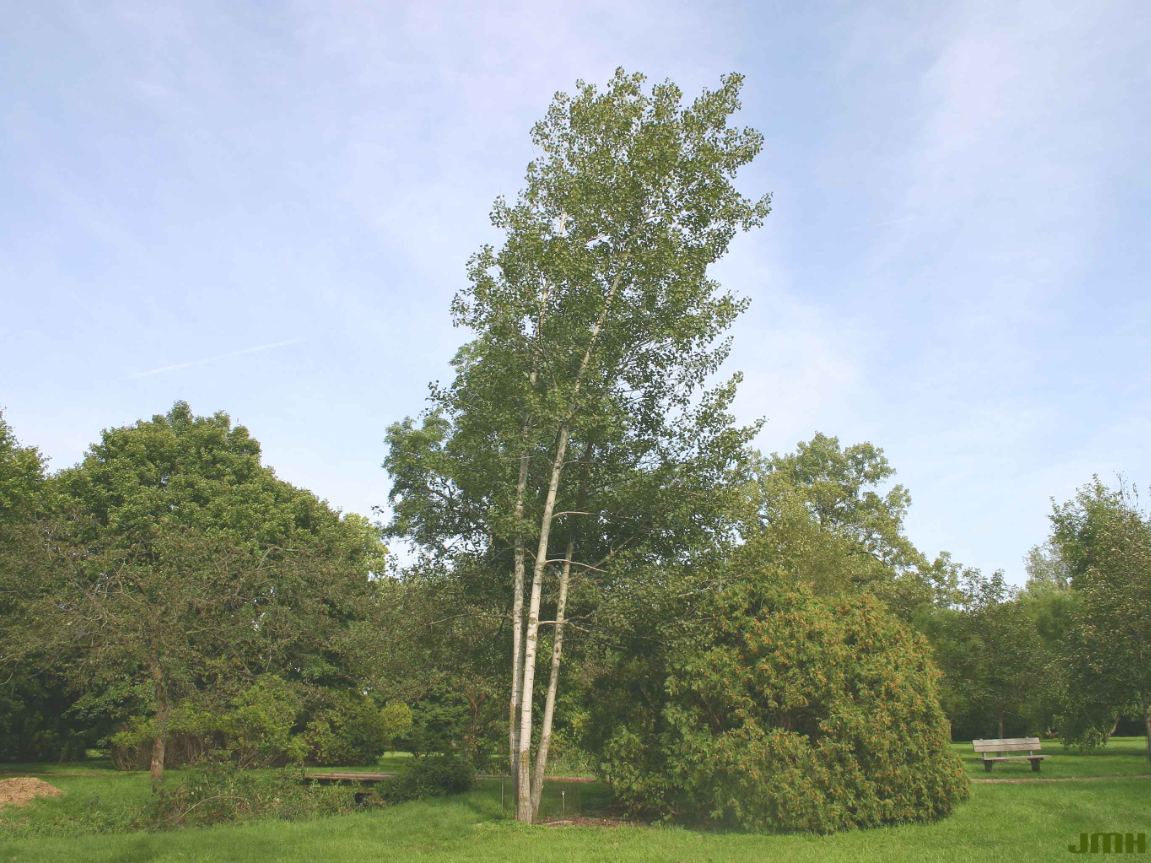
- Family: Salicaceae
- Type: Deciduous
- Average Height: 20' to 50'
- Average Width: 10' to 30'
- Native Range: North America
- Average Years to Maturity: 15
- Average Lifespan in Years: 75
- Bark Identification: Smooth and white to gray when young, developing deep, horizontal furrows with age
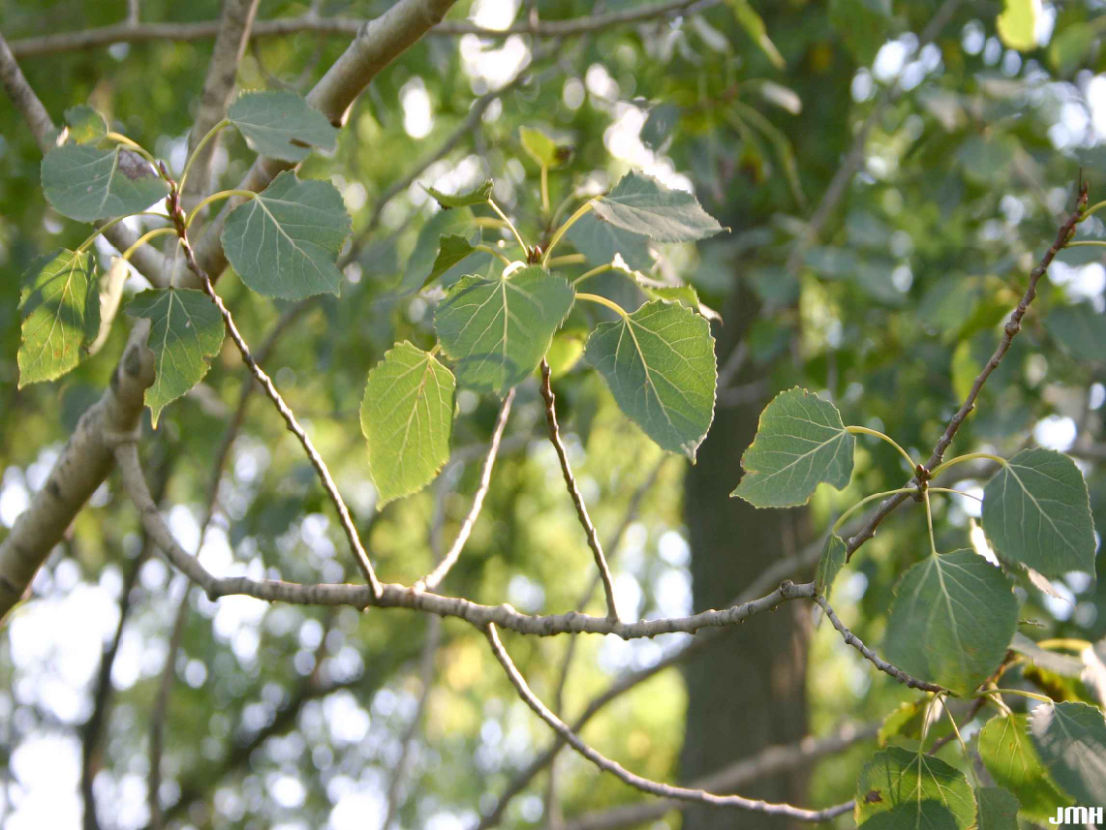
- Leaf Identification: Round, triangular, finely toothed edges, smooth, 3’’ long
Description
The quaking aspen is typically found in forests, meadows and fields, shrublands or thickets, and woodlands. The common name for the quaking aspen comes from twisting and twirling of the leaves when it is windy. This is also why the tree is given the other common name trembling aspen. This “quaking” happens because of the flattened leaf stalks of the quaking aspen, which causes the leaves to move easier in wind. The quaking aspen repopulates clonally from its roots, which causes large colonies of multiple trunks to form. This tree species is native to Huntington County.
Horticulture Tips
The quaking aspen requires full sun exposure. It also prefers medium water supply and rich, moist, well-drained soil. The quaking aspen is a fast-growing tree species.
Benefits
The quaking aspen is sometimes used as a landscaping tree in yards and streets. The common name golden aspen is given to the quaking aspen because of the attractive yellow fall foliage. The quaking aspen is a softwood species. It has been used to make pulp for paper and for plywood. The wood does not splinter easily, which makes it ideal for making toothpicks and sauna benches.
Insects like the aspen leaf beetle and the cottonwood leaf beetle eat the leaves and wood of the quaking aspen. The yellow-bellied sapsucker drills through the bark to eat the sap of this tree, and the ruffed grouse and purple finch eat the buds. Whitetailed deer, cattle, muskrats, and beavers are mammals that also eat the foliage of the quaking aspen.
References
- Chicago Botanic Garden
- Go Botany Native Plant Trust
- Illinois Wildflowers
- Leopold, Donald J.; Trees of the Central Hardwood Forests of North America: An Identification and Cultivation Guide. Timber Press, 1998, pp. 307-309.
- Missouri Botanical Garden
- Morton Arboretum Photo Copyrights
- Silvics of North America
- Weeks, Sally S., et al.; Native Trees of the Midwest: Identification, Wildlife Values, and Landscaping Use, Purdue University Press, West Lafayette, IN, 2005, pp. 166-167.
Red cedar (Juniperus virginiana)
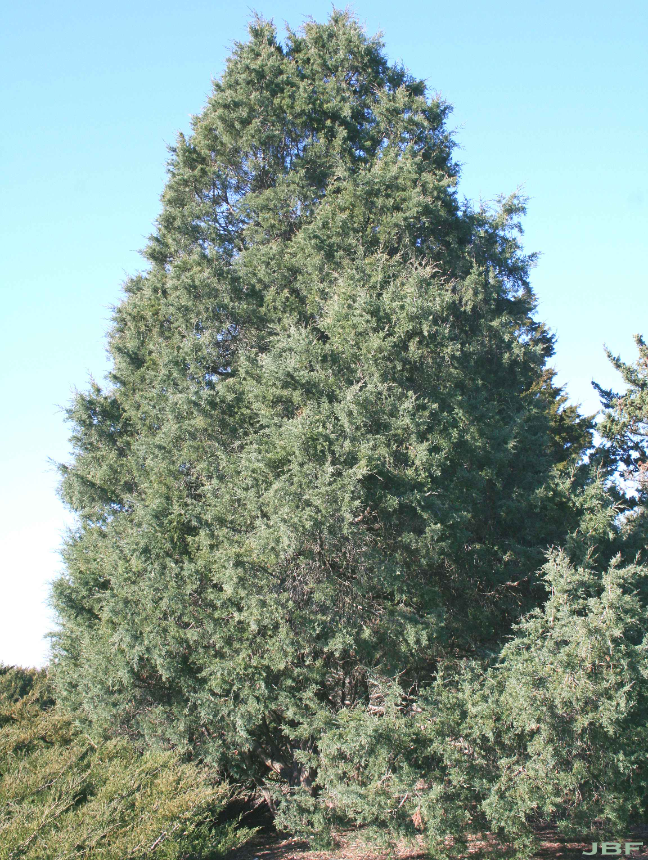
- Family: Cupressaceae
- Type: Evergreen conifer
- Average Height: 30' to 60'
- Average Width: 8' to 25'
- Native Range: Eastern North America
- Average Years to Maturity: 50
- Average Lifespan in Years: 150
- Bark Identification: Reddsih-brown, shredded texture
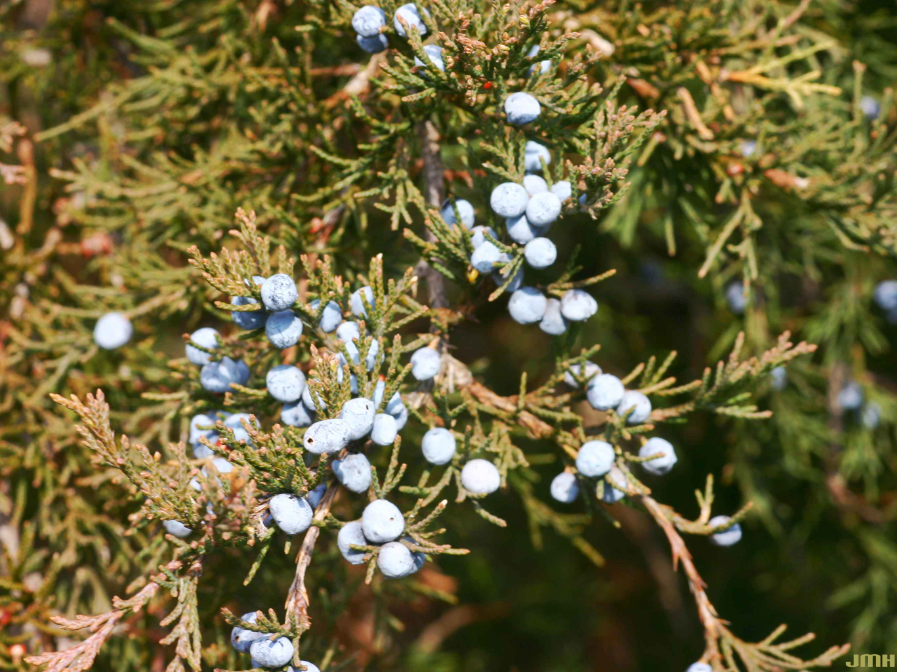
- Leaf Identification: Two types of leaves: needle-like, sharp leaves in young trees, 1/8" to 1/2"; scale-like, flat and overlapping leaves in mature trees, 1/16" to 1/8"
Description
The red cedar is usually found in forests, old fields, meadows, and woodlands. The seed cones of the red cedar are pale blue, fleshy, and waxy. The pollen cones are yellow brown, covered in scales, and are about 1/8’’ long. This tree is not a cedar, as there are no native cedars in North America; it is in the juniper family, which typically consists of shrubs. However, this makes the red cedar distinguishable from other conifers because of its unique berry-like cones. It is distinguishable from other junipers because of its height. The red cedar is the only conifer species native to Huntington County.
Horticulture Tips
Red cedars require full sun exposure to grow successfully. They also require a dry to moderate water supply and well-drained, dry to moist soil. The red cedar is a host for cedar apple rust, which is a fungus that requires both red cedars and apple or crabapple trees to complete its life cycle. When this disease occurs, apple trees surrounding red cedars will have brown spots on their leaves and fruit. The red cedars will have round galls, which are small, 2’’ in diameter spheres that produce bright orange, tentacle-like, gummy fungus. To avoid this, do not plant red cedars near apple trees.
Benefits
The red cedar can be planted in a variety of habitats and would be an ideal addition to a residential area for landscaping purposes. This tree can be underappreciated as a landscape tree because of its needle’s messy appearance when it is maturing. The wood has a fragrant smell, which makes it ideal for building furniture. The wood was commonly used to build cedar chests, which kept moths from destroying clothing.
Several insects, like the Eastern juniper bark beetle and the Northern cedar bark beetle use this plant as a food source. The fruit-like seed cones of the red cedar are eaten frequently by cedar waxwings, whose name originates from the red cedar. Other birds, like the American robin, song sparrow, several owl species, and the house finch use the red cedar for nesting. Large mammals, like white-tailed deer, gray fox, and black bear eat the cones and twigs of this tree.
References
- Go Botany Native Plant Trust
- Illinois Wildflowers
- Leopold, Donald J.; Trees of the Central Hardwood Forests of North America: An Identification and Cultivation Guide. Timber Press, 1998, pp. 229-230.
- Missouri Botanical Garden
- Morton Arboretum Photo Copyrights
- Silvics of North America
- Weeks, Sally S., et al.; Native Trees of the Midwest: Identification, Wildlife Values, and Landscaping Use, Purdue University Press, West Lafayette, IN, 2005, pp. 14-15.
Red maple (Acer rubrum)
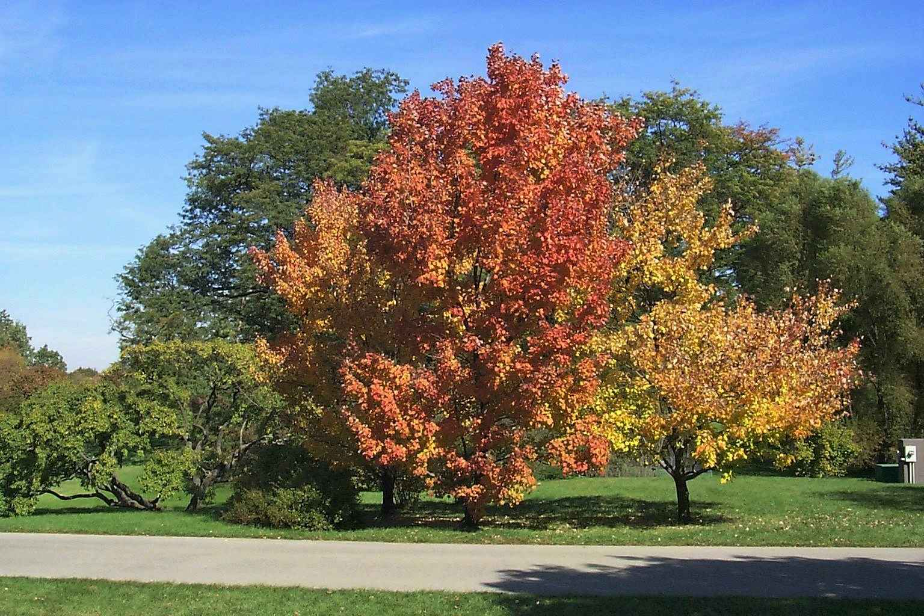
- Family: Sapindaceae
- Type: Decidious
- Average Height: 40' to 70'
- Average Width: 30' to 50'
- Native Range: Eastern North America
- Average Years to Maturity: 70
- Average Lifespan in Years: 130
- Bark Identification: Gray and rough-scaled for mature trees, light gray and smoother for younger trees
- Leaf Identification: three pointed lobes, typically 3" to 4" long, serrated edges
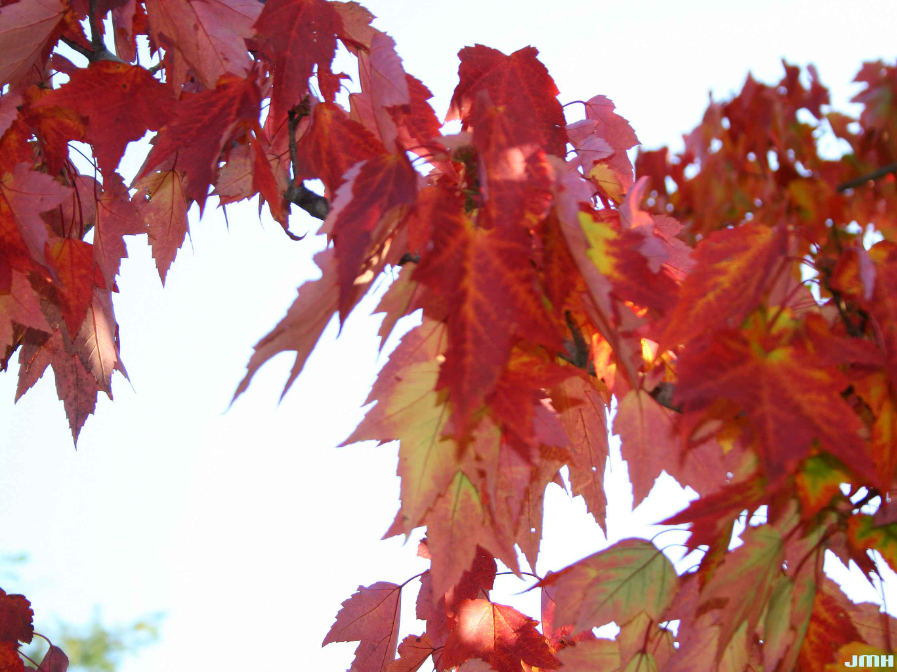
Description
The red maple is native to Eastern North America. This tree is usually found in forests and near wetlands in the northeastern states and in slightly drier environments in the southeastern United States. The flowers of the red maple bloom during early spring for about 1 to 2 weeks, which is earlier than most other trees. The silver maple, which looks like the red maple, is one of the only other trees that blooms in early spring. These attributes make the red maple stand out amongst other trees, making it popular in landscaping. This tree species is native to Huntington County.
Horticulture Tips
Red maples prefer full sun exposure to grow successfully but can also do well in part shade environments. They also prefer medium water supply and well drained, medium to wet soil, but can survive in drier soil environments, which makes them adaptable to grow in almost any environment.
Benefits
The red maple is used as a landscaping tree in parks or yards. Rubrum means red everywhere in evidence, and fittingly the red maple is known for its bright red color in the fall and is used for decoration. The wood and sap of the red maple can be used, but the wood is less strong, and the sap quantity is smaller when compared to the sugar maple.
The larvae of several moths and gall flies use the red maple as a source of food, eating the leaves and wood. It is also a preferred host tree for the larvae of the maple looper moths and lesser maple spanworm moths. The ruffed grouse and red-breasted nuthatch are known to eat the seeds and buds of the red maple, and the cavities in older trees are used by screech owls, wood ducks, gray squirrels, and red squirrels as nesting sites. White-tailed deer and elk are known to eat the twigs; however, red maple leaves are toxic to cattle and horses.
References
- Go Botany Native Plant Trust
- Illinois Wildflowers
- Leopold, Donald J.; Trees of the Central Hardwood Forests of North America: An Identification and Cultivation Guide. Timber Press, 1998, pp. 78-80.
- Missouri Botanical Garden
- Morton Arboretum Photo Copyrights
- Silvics of North America
- Weeks, Sally S., et al.; Native Trees of the Midwest: Identification, Wildlife Values, and Landscaping Use, Purdue University Press, West Lafayette, IN, 2005, pp. 52-53.
Red oak (Quercus rubra)
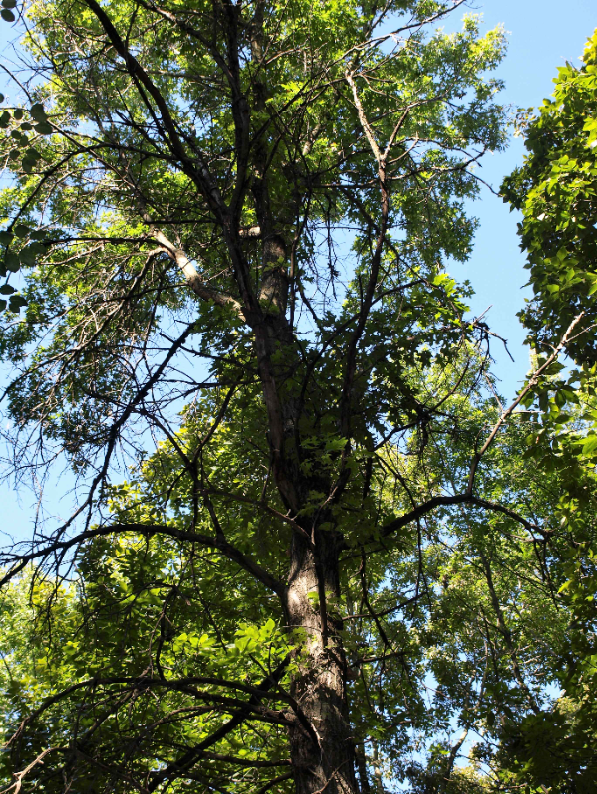
- Family: Fagaceae
- Type: Deciduous
- Average Height: 50' to 70'
- Average Width: 50' to 70'
- Native Range: Eastern North America
- Average Years to Maturity: 50
- Average Lifespan in Years: 200
- Bark Identification: Dark brown to gray, wide ridges known as "ski tracks"
- Leaf Identification: Seven to 11 bristle-tipped lobes, shiny, shallow sinuses (spaces between lobes), 5" to 9" long
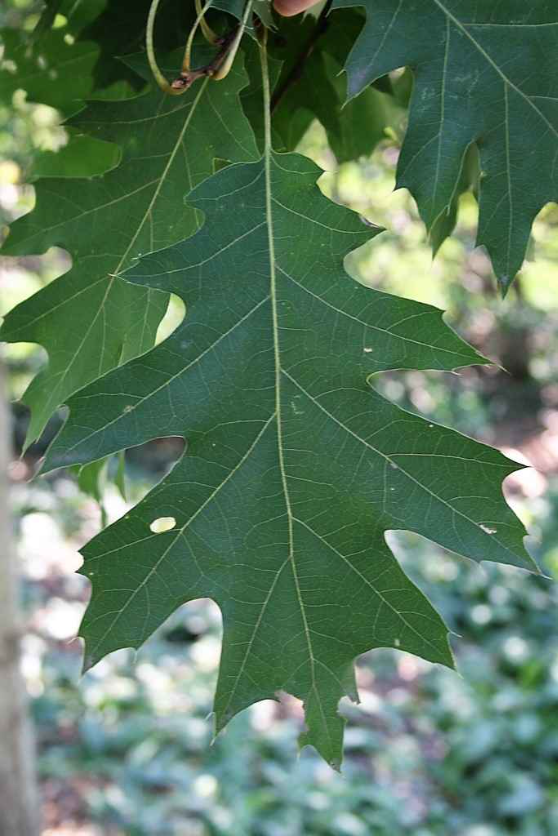
Description
The red oak is typically found in forests and woodlands. This tree species is known for its red wood, which is where its common name comes from. The fall foliage can also rage from yellow to brown. The red oak can be distinguished from other oak species because of the shallower sinuses between the lobes on its leaves and its flatter acorn cup. As a red oak, this tree species produces acorns every two years once it is mature. This tree species is native to Huntington County.
Horticulture Tips
The red oak requires full sun exposure. It also prefers medium to dry water supply and medium to dry, acidic soil. The red oak is a fast-growing tree species.
Benefits
The red oak is commonly used as a landscaping and shade tree for lawns, golf courses, and streets. The wood of this tree species is hard and heavy, but it is less durable than wood from the white oak group. The wood is frequently used for furniture, cabinets, and flooring because of its attractive red and white coloring. It can also be used for firewood and pulp for paper.
Insects like the red oak borer and the oak branch pruner, as well as several others, use the leaves and wood of the red oak as a food source. Mammals like the black bear, white-tailed deer, raccoon, wild hogs, and several squirrel species eat the large, 1-1/2" long acorns of this tree species. Bird species such as the wood duck, wild turkey, bobwhite, and ruffed grouse also eat the acorns of the red oak and use its branches as nesting sites.
References
- Chicago Botanic Garden
- Go Botany Native Plant Trust
- Illinois Wildflowers
- Indiana Department of Natural Resources
- Leopold, Donald J.; Trees of the Central Hardwood Forests of North America: An Identification and Cultivation Guide. Timber Press, 1998, pp. 360-363.
- Missouri Botanical Garden
- Morton Arboretum Photo Copyrights
- Purdue University Fort Wayne Tree Index
- Silvics of North America
- Weeks, Sally S., et al.; Native Trees of the Midwest: Identification, Wildlife Values, and Landscaping Use, Purdue University Press, West Lafayette, IN, 2005, pp. 210-211.
River birch (Betula nigra)
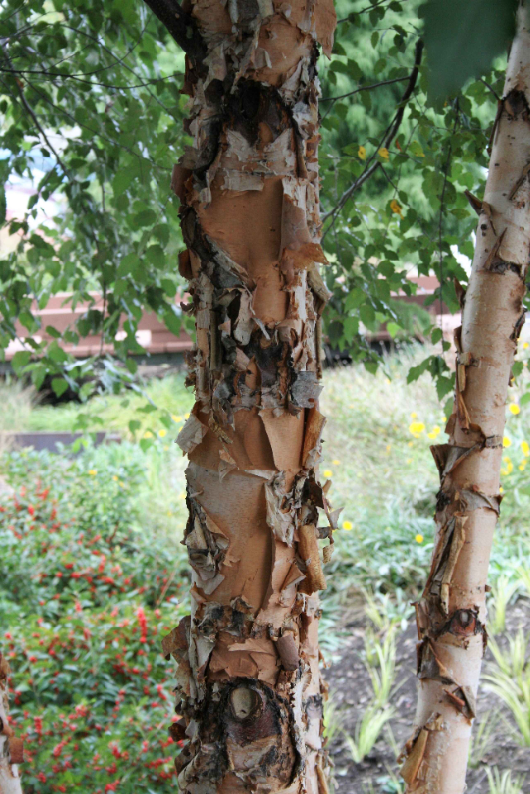
- Family: Betulaceae
- Type: Deciduous
- Average Height: 40' to 70'
- Average Width: 40' to 70'
- Native Range: Eastern North America
- Average Years to Maturity: 40
- Average Lifespan in Years: 150
- Bark Identification: Brown, thin outer bark peels to reveal creamy white inner bark
- Leaf Identification: Triangular-shaped, toothed edges, glossy, typically 3’’ long
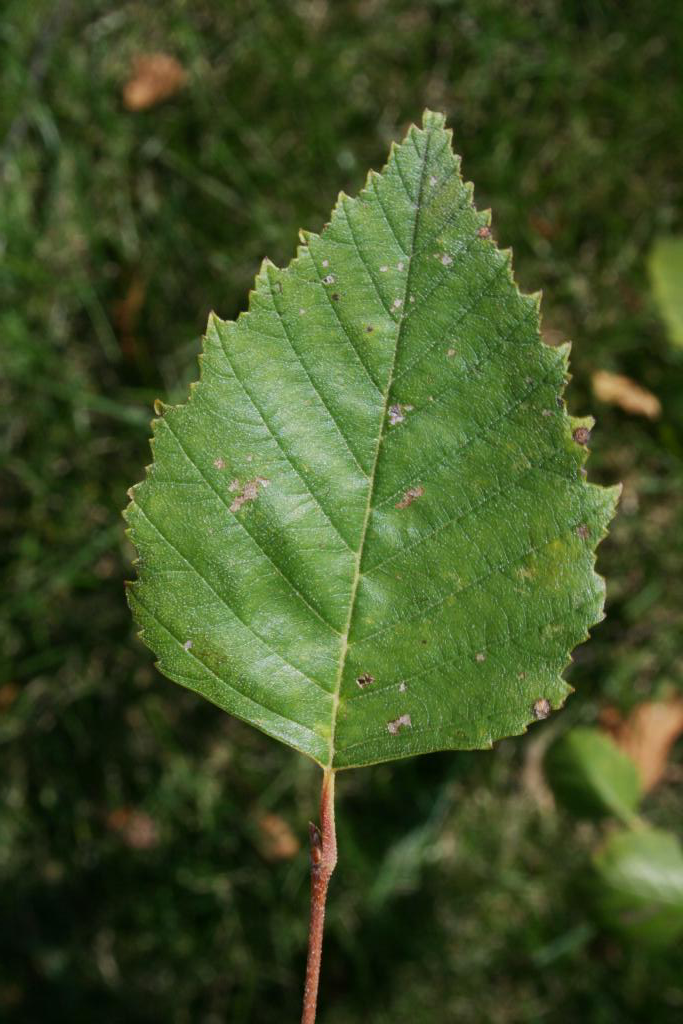
Description
The river birch is typically found in floodplains, forests, and the shores of lakes and rivers. The river birch is known for its peeling bark. The river birch can be grown as a single trunk tree or as a multi-trunked tree. As a single trunk tree, the river birch has a rounded shape. With multi-trunked trees, the shape of the tree is more irregular. This growth pattern is typically considered the superior growth habit. This tree species is not native to Huntington County but is native to northwestern and southwestern Indiana.
The cultivar ‘Heritage’ is a fast-growing, medium-sized variety of the river birch species. It can be grown as either a single trunk or multi-trunked tree. This variety was found by Earl Cully in St. Louis, Missouri and is known to grow well in moist, humid environments. ‘Heritage’ is extremely resistant to the bronze birch borer, which is a common nuisance to the birch species.
Horticulture Tips
The river birch prefers full sun exposure but can grow successfully in part shade environments. It also prefers medium to wet water supply and medium to wet soil.
Benefits
The river birch is commonly used as a landscaping tree for lawns and parks. The river birch gets its common name from its successful growth in wetland environments. The river birch can be distinguished from other birch species because of the extreme difference between its outer peeling bark and inner bark. The river birch also extends further south in the United States than other birch species do. The specific epithet nigra means black, in reference to the darkening of the trunk that occurs with maturity.
Insects like the larvae of the birch dagger moth and several leaf beetles eat the leaves and wood of the river birch. Bird species such as the ruffed grouse, purple finch, and the black-capped chickadee eat the seeds and buds of this tree species. Also, beavers feed on the wood and bark of the river birch and use the branches for their dams.
References
- Chicago Botanic Garden
- Go Botany Native Plant Trust
- Illinois Wildflowers
- Indiana Department of Natural Resources
- Leopold, Donald J.; Trees of the Central Hardwood Forests of North America: An Identification and Cultivation Guide. Timber Press, 1998, pp. 116-118.
- Missouri Botanical Garden
- Morton Arboretum Photo Copyrights
- Purdue University Fort Wayne Tree Index
- Silvics of North America
- Weeks, Sally S., et al.; Native Trees of the Midwest: Identification, Wildlife Values, and Landscaping Use, Purdue University Press, West Lafayette, IN, 2005, pp. 102-103.
Serviceberry (Amelanchier x grandiflora)
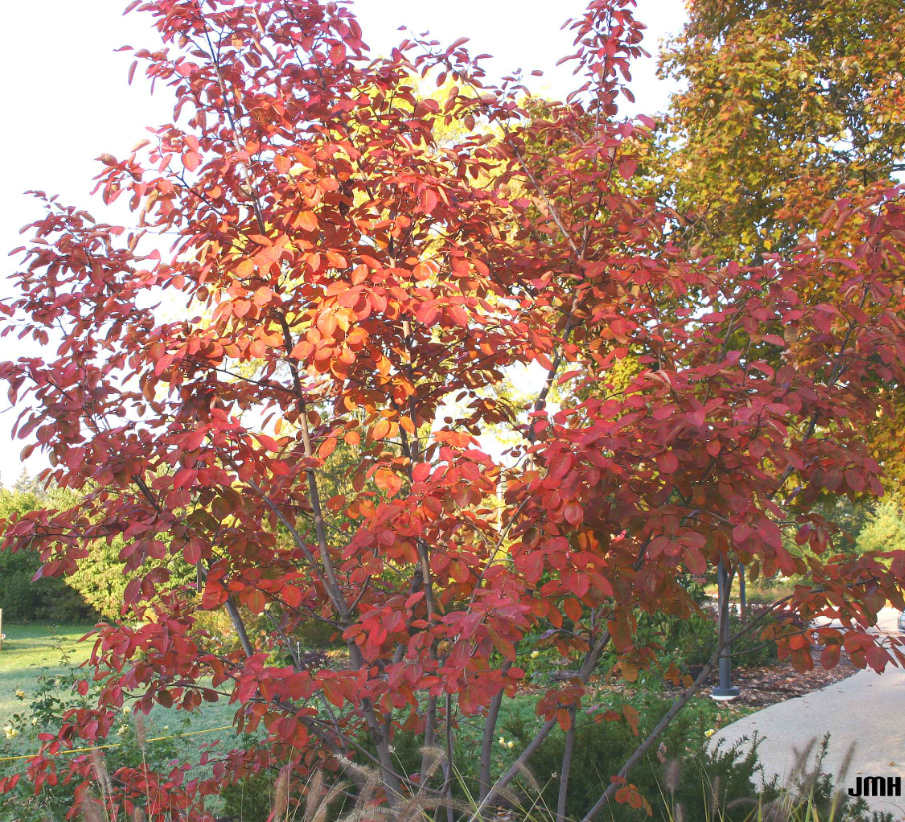
- Family: Rosaceae
- Type: Deciduous
- Average Height: 15' to 25'
- Average Width: 15' to 20'
- Native Range: Eastern North America
- Average Years to Maturity: 15
- Average Lifespan in Years: 60
- Bark Identification: Gray to dark gray, smooth, thin, usually spotted with lichen
- Leaf Identification: Fine-toothed, serrated edges, ovate (oval ending in a point), 2’’ to 4’’ long
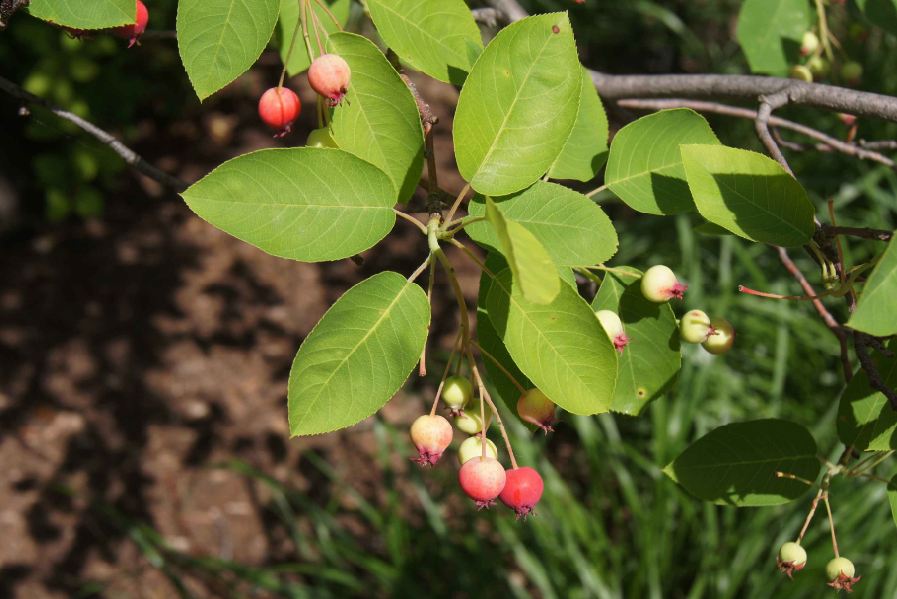
Description
The serviceberry hybrid Amelanchier x grandiflora is a hybrid cross between the downy serviceberry and the Allegheny serviceberry. This tree species is known for its attractive reddish orange fall foliage, which is how it was given the cultivar name ‘Autumn Brilliance.’ This tree species is also known for its white flowers which are followed by blueberry-like berries that are said to taste similar to blueberries, which are used for jams, jellies, and pies. The serviceberry is typically found in manmade habitats and forests. The serviceberry is native to Huntington County.
Horticulture Tips
The serviceberry prefers full sun exposure but can grow successfully in part shade environments. It also prefers medium water supply and medium to moist, well-drained soil. The serviceberry ‘Autumn Brilliance’ is known to be extremely resistant to common diseases that plague serviceberry species, such as canker, rust, and powdery mildew.
Benefits
The serviceberry is commonly used as a screening hedge or shrub because of its small height. It is also commonly used as a landscaping tree in lawns and gardens to attract songbirds. The specific epithet grandiflora is Latin for “large flowers” in reference to the clusters of white flowers that bloom in springtime on this tree species. The berries of the serviceberry were mixed with dried meat and tallow by Native Americans to make pemmican.
References
- Chicago Botanic Garden
- Illinois Wildflowers
- Leopold, Donald J.; Trees of the Central Hardwood Forests of North America: An Identification and Cultivation Guide. Timber Press, 1998, pp. 104-106.
- Missouri Botanical Garden
- Morton Arboretum Photo Copyrights
- Weeks, Sally S., et al.; Native Trees of the Midwest: Identification, Wildlife Values, and Landscaping Use, Purdue University Press, West Lafayette, IN, 2005, pp. 92-93.
Shagbark hickory (Carya ovata)
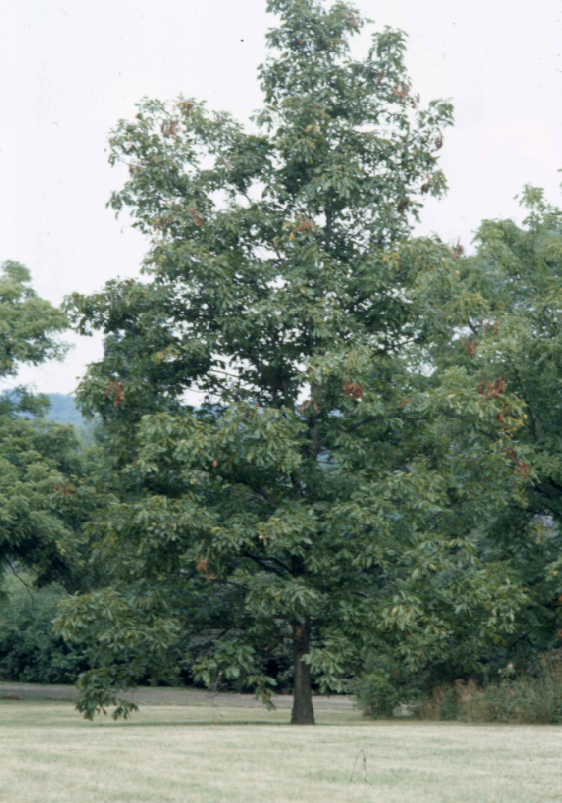
- Family: Juglandaceae
- Type: Decidious
- Average Height: 60' to 80'
- Average Width: 50' to 70'
- Native Range: Eastern North America
- Average Years to Maturity: 50
- Average Lifespan in Years: 250
- Bark Identification: Gray, peels into long plates that curl, giving it a shaggy appearance
- Leaf Identification: Compound with 5 leaflets (3" to 7" long) per leaf (8" to 16" long), tips and undersides of leaflets have tufts of fine hair
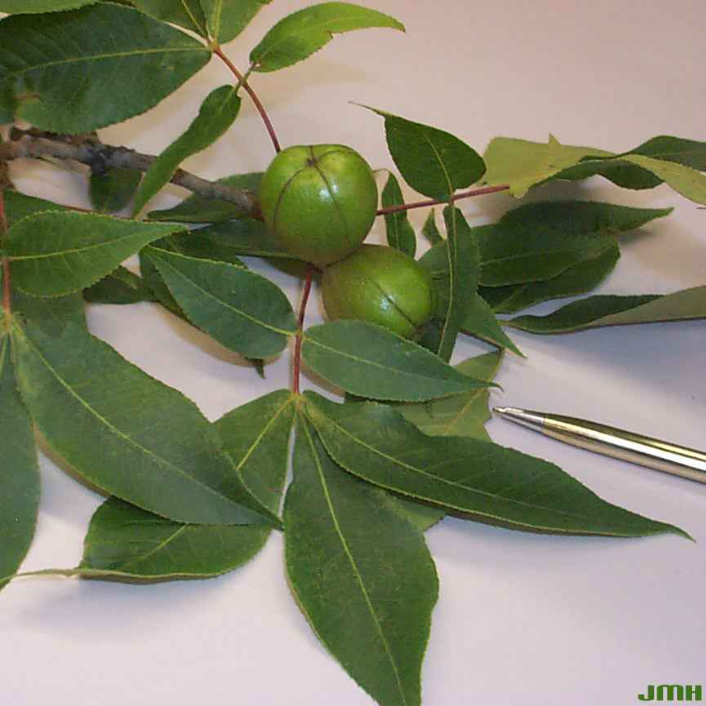
Description
The shagbark hickory is usually found in forests, bottomlands, and woodlands. The nuts of this tree are sheltered by a thick, 4 sectioned green husk is, which usually 1/4" to 1/2" thick. The nuts are sweet, which makes it a common food source for several animals. As mentioned in the bark identification, the name “shagbark” refers to the peeling strips of bark on the trunk of the tree, giving it a shaggy appearance. This tree is native to Huntington County.
Horticulture Tips
Shagbark hickories prefer full sun exposure but can also perform well in part shade environments. They also require a medium water supply and well-drained, wet soil. These trees have deep roots which make them hard to transplant.
Benefits
The shagbark hickory can be used as a landscaping tree or a shade tree in large yards. The wood of this tree is commonly used to smoke and cure meat. It is also a hard wood, making it ideal for building furniture, baseball bats, and tools. Andrew Jackson, the seventh president of the United States, was nicknamed “Old Hickory” because of his tough character.
Caterpillars like the hickory hairstreak and banded hairstreak eat the wood and foliage of the shagbark hickory. The gray squirrel, black bear, raccoon, and Eastern chipmunk eat the nuts of this tree. The crevices between the peeling bark of the tree are used as housing by the brown creeper and as a roosting site for the Indiana bat.
References
- Chicago Botanic Garden
- Go Botany Native Plant Trust
- Illinois Wildflowers
- Indiana Department of Natural Resources
- Leopold, Donald J.; Trees of the Central Hardwood Forests of North America: An Identification and Cultivation Guide. Timber Press, 1998, pp. 141-143.
- Missouri Botanical Garden
- Morton Arboretum Photo Copyrights
- Purdue University Fort Wayne Tree Index
- Silvics of North America
- Weeks, Sally S., et al.; Native Trees of the Midwest: Identification, Wildlife Values, and Landscaping Use, Purdue University Press, West Lafayette, IN, 2005, pp. 260-261.
Shingle oak (Quercus imbricaria)
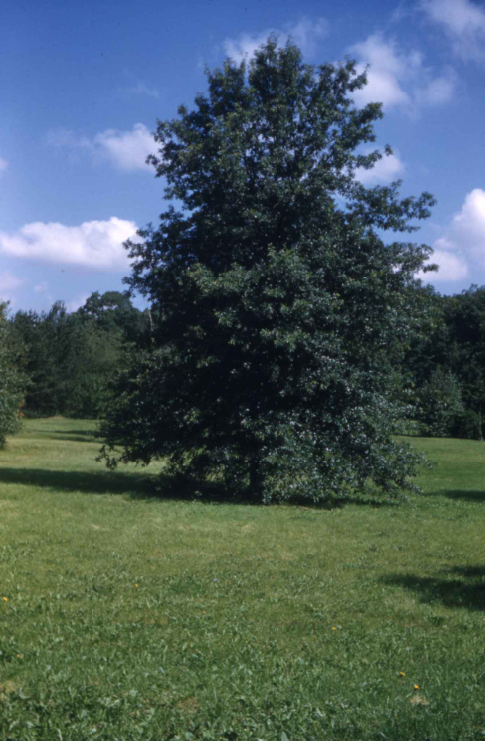
- Family: Fagaceae
- Type: Deciduous
- Average Height: 40' to 60'
- Average Width: 40' tp 60'
- Native Range: Eastern North America
- Average Years to Maturity: 75
- Average Lifespan in Years: 200
- Bark Identification: Dark gray or brown, ridges separated by shallow fissures
- Leaf Identification: Ovate (oval ending in a point), not lobed, thick and leathery, bristle-tipped, 4" to 6" long
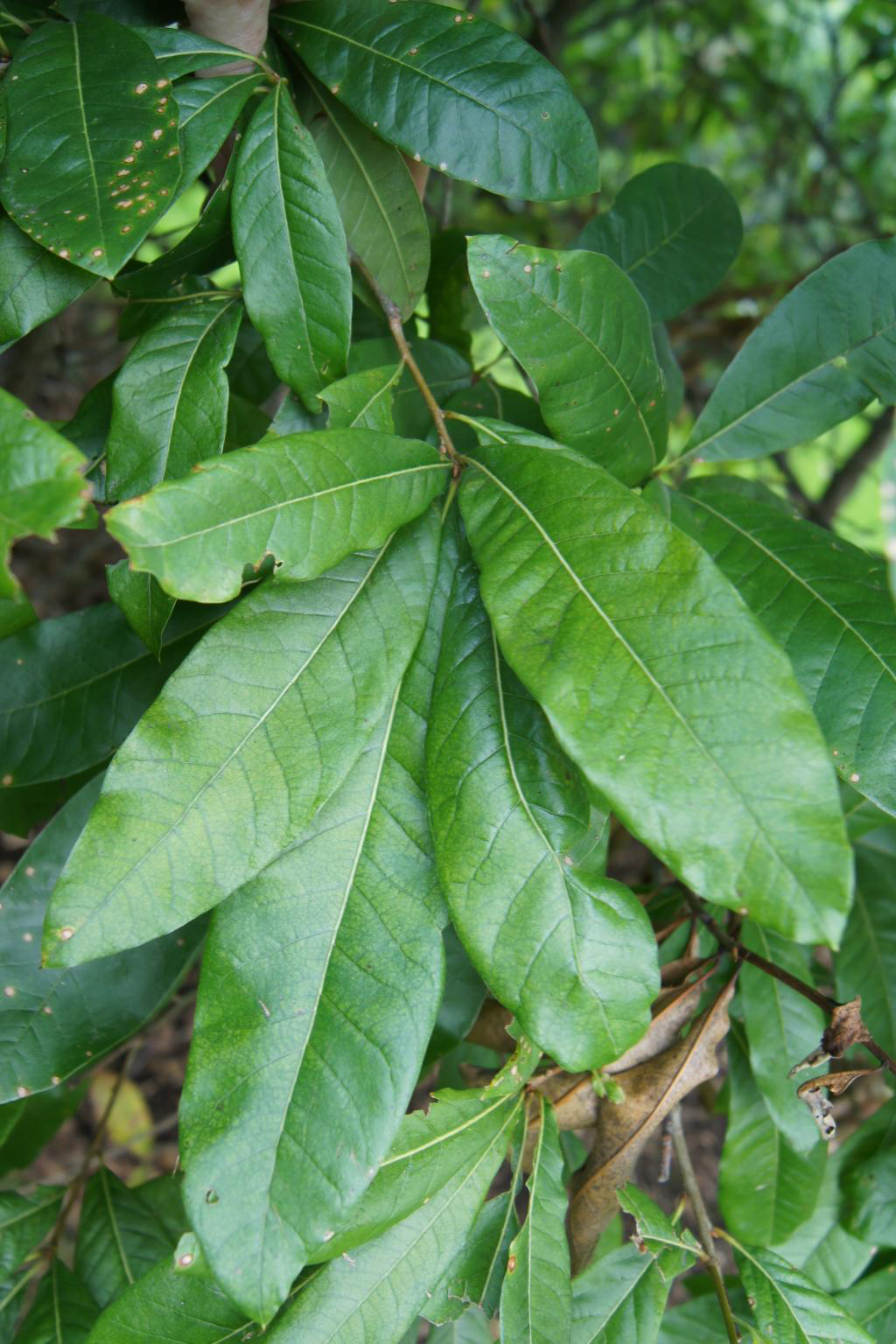
Description
The shingle oak is typically found in man-made habitats and forests. The shingle oak is known for its unlobed, shiny green leaves, which distinguish it from the typical lobed leaves of other oak species. The shingle oak also has rounded acorns that have scaly, long cups which cover up to 1/2 of the acorn itself. These acorns are produced every two years because the shingle oak is a member of the red oak group. This tree species is not native to Huntington County but is native to counties surrounding Huntington.
Horticulture Tips
The shingle oak requires full sun exposure. It also prefers medium water supply and medium, rich, well-drained soil. The shingle oak is intolerant to shade environments.
Benefits
The shingle oak is commonly used as a screening tree for streets, large lawns, and parks. With its attractive fall colors ranging from yellow to dark red, this tree species is used for landscaping. This tree species was given its common name because settlers would use the wood of this tree species for shingles as the wood is easy to split. The specific epithet imbricaria is Latin for placing in an overlapping order, as with tile or shingles. The shingle oak is also given the common name laurel oak because of its leaves, which resemble laurel oak tree leaves.
The acorns of the shingle oak are eaten by birds like the wild turkey, blue jay, and tufted titmouse. Mammals including the black bear, opossum, chipmunk, and several squirrel species also eat the shingle oak’s acorns. As this tree species matures, cavities in its trunk are used by many mammal and bird species as nesting sites and shelter.
References
- Chicago Botanic Garden
- Go Botany Native Plant Trust
- Illinois Wildflowers
- Indiana Department of Natural Resources
- Leopold, Donald J.; Trees of the Central Hardwood Forests of North America: An Identification and Cultivation Guide. Timber Press, 1998, pp. 340-342.
- Missouri Botanical Garden
- Morton Arboretum Photo Copyrights
- Purdue University Fort Wayne Tree Index
- Weeks, Sally S., et al.; Native Trees of the Midwest: Identification, Wildlife Values, and Landscaping Use, Purdue University Press, West Lafayette, IN, 2005, pp. 190-191.
Shumard oak (Quercus shumardii)
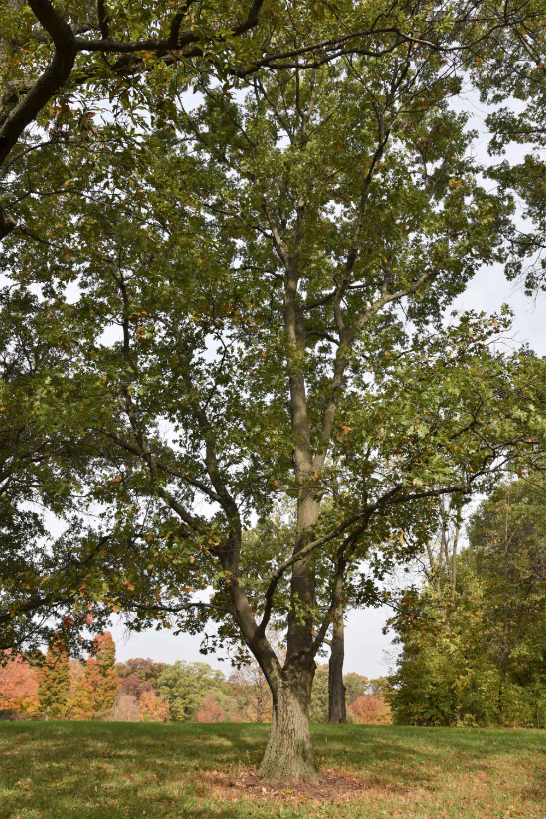
- Family: Fagaceae
- Type: Deciduous
- Average Height: 40' to 80'
- Average Width: 30' to 40'
- Native Range: Southeastern United States
- Average Years to Maturity: 50
- Average Lifespan in Years: 200
- Bark Identification: Gray or brown, smooth in young trees, deep vertical fissures with maturity
- Leaf Identification: 7 to 9 bristle-tipped, oval-shaped pointed lobes, smooth, shiny, with sinuses (spaces between lobes) being thumb-shaped
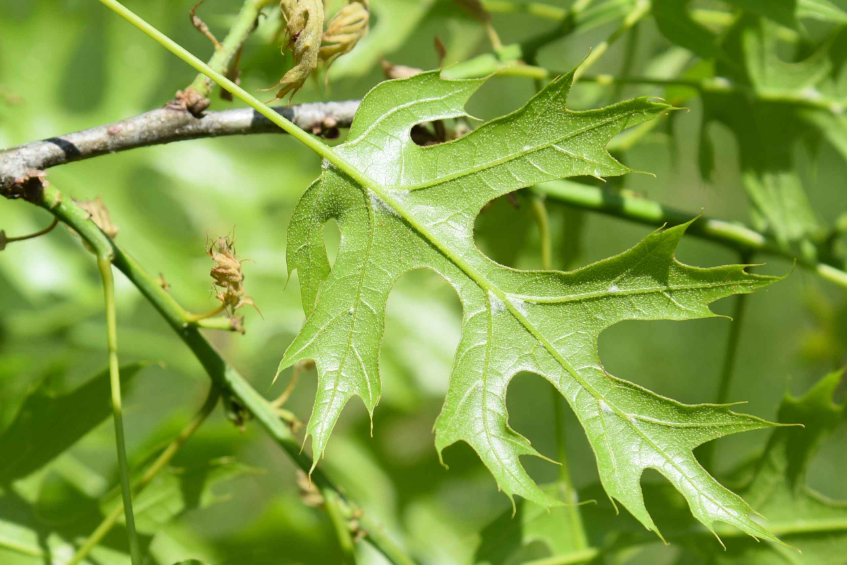
Description
The Shumard oak is one of the largest oaks and is typically found in bottomlands, swamps, and floodplains in the southeastern parts of the United States. This specific oak species is a member of the red oak group, which means that it produces acorns every two years. The Shumard oak can be distinguished from the red oak because the ridges on its trunk are more prominent at the base of the tree. This tree species also has thumb-shaped sinuses between its lobes and has more bristles on the tips of its leaves compared to the red oak. This tree species is native to Huntington County.
Horticulture Tips
The Shumard oak requires full sun exposure. It also prefers medium water supply and medium, well-drained soil. The Shumard oak is a fast-growing tree species. The acorns of this tree species are not usually produced until 25 years of age.
Benefits
The Shumard oak is commonly used as a shade tree or landscaping tree for lawns, parks, and streets. The bright red fall foliage of this tree species is attractive for public areas. The wood of this tree species is commonly generalized in the lumber industry as “red oak wood” and is used for flooring, cabinets, and furniture because of its hardiness. The Shumard oak is named for Benjamin Franklin Shumard, who was a physician and geologist in Missouri and Texas.
Insect species like the June beetle and the orange striped oak worm, as well as several others, bore into the wood of the Shumard oak and use its leaves as a food source. The acorns of this tree species are commonly eaten by birds like the ruffed grouse, wild turkey, woodpeckers, and several songbirds. White-tailed deer, white-footed mice, and several squirrel species are also known to feed on the foliage and acorns.
References
- Chicago Botanic Garden
- Indiana Department of Natural Resources
- Leopold, Donald J.; Trees of the Central Hardwood Forests of North America: An Identification and Cultivation Guide. Timber Press, 1998, pp. 363-364.
- Missouri Botanical Garden
- Morton Arboretum Photo Copyrights
- Purdue University Fort Wayne Tree Index
- Silvics of North America
- Weeks, Sally S., et al.; Native Trees of the Midwest: Identification, Wildlife Values, and Landscaping Use, Purdue University Press, West Lafayette, IN, 2005, pp. 212-213. Sourcing: Deborah J.G. Brown, Courtesy of The
Siberian elm (Ulmus pumila)
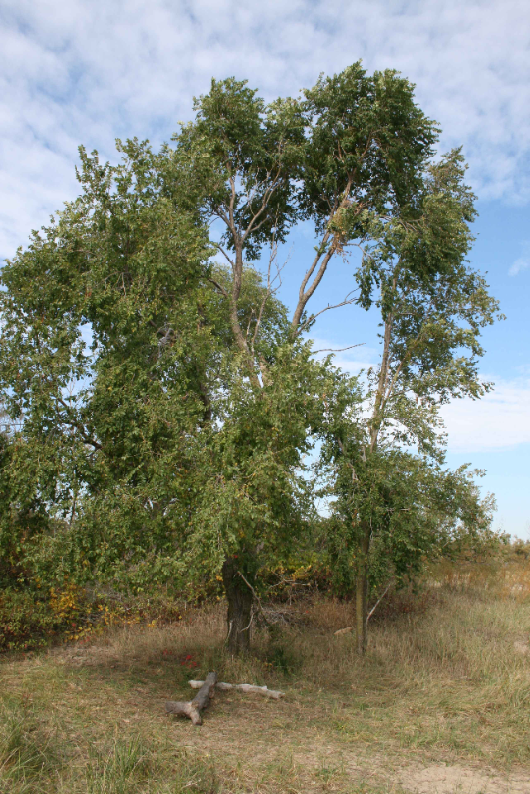
- Family: Ulmaceae
- Type: Decidious
- Average Height: 50' to 70'
- Average Width: 40' to 70'
- Native Range: Eastern Siberia, northern China
- Average Years to Maturity: 20
- Average Lifespan in Years: 75
- Bark Identification: Light gray to gray, rough texture with ridges
- Leaf Identification: Thin, tooth-edged, 1" to 2" long, base is asymmetric
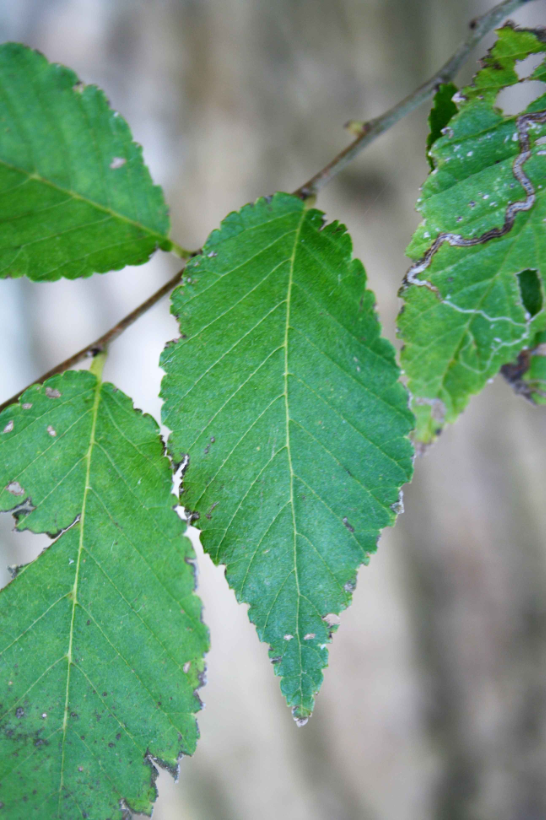
Description
The Siberian elm is typically found in manmade habitats, since it is a nonnative species to North America. This tree species was planted in the United States, starting in the 1950’s, because of its rapid growth and its resistance to Dutch elm disease, which was destroying the American elm population. This species is difficult to control in the wild and has the capacity to become an invasive species, particularly in the prairie states region. The Siberian elm is known for its serrated, glossy leaves, which are small in comparison to the American elm. This tree species is not native to Huntington County.
Horticulture Tips
The Siberian elm requires full sun exposure. It also prefers medium to dry water supply and medium to dry, well-drained soil. The branches of this tree species are known to be weak-wooded and brittle, which makes them susceptible to storm damage. Additionally, Siberian elms are known to have their foliage damaged by elm leaf beetles and borers.
Benefits
The Siberian elm is commonly used as a windbreak tree and for erosion control. It is not commonly used as a landscaping tree for lawns or streets because of its weakness and susceptibility to diseases. It is also a messy, weedy-looking tree that is not often found appealing for streets. The specific epithet pumila means dwarf, which refers to the small leaves and small shrubby habit of the Siberian elm. The wood of the Siberian elm is not used often because of its weakness.
Despite being nonnative, the Siberian elm is used by insects, mammals, and bird species as a food source and nesting site. The caterpillars of the moth species the elm sphinx and the large lace border are known to eat the leaves of the Siberian elm. The elm leaf beetle and the small European elm bark beetle, along with several other insect borers, eat the wood and foliage of this tree species. The seeds and buds are eaten by bird species like the wild turkey, purple finch, house sparrow, and rose-breasted grosbeak, as well as mammals like the Eastern chipmunk and fox squirrel. Since the Siberian elm is known for its weak branches that break off, the cavities of this tree species are used by bird species like the house sparrow and downy woodpecker as nesting sites.
References
- Go Botany Native Plant Trust
- Illinois Wildflowers
- Missouri Botanical Garden
- Morton Arboretum Photo Copyrights
Silver maple (Acer saccharinum)
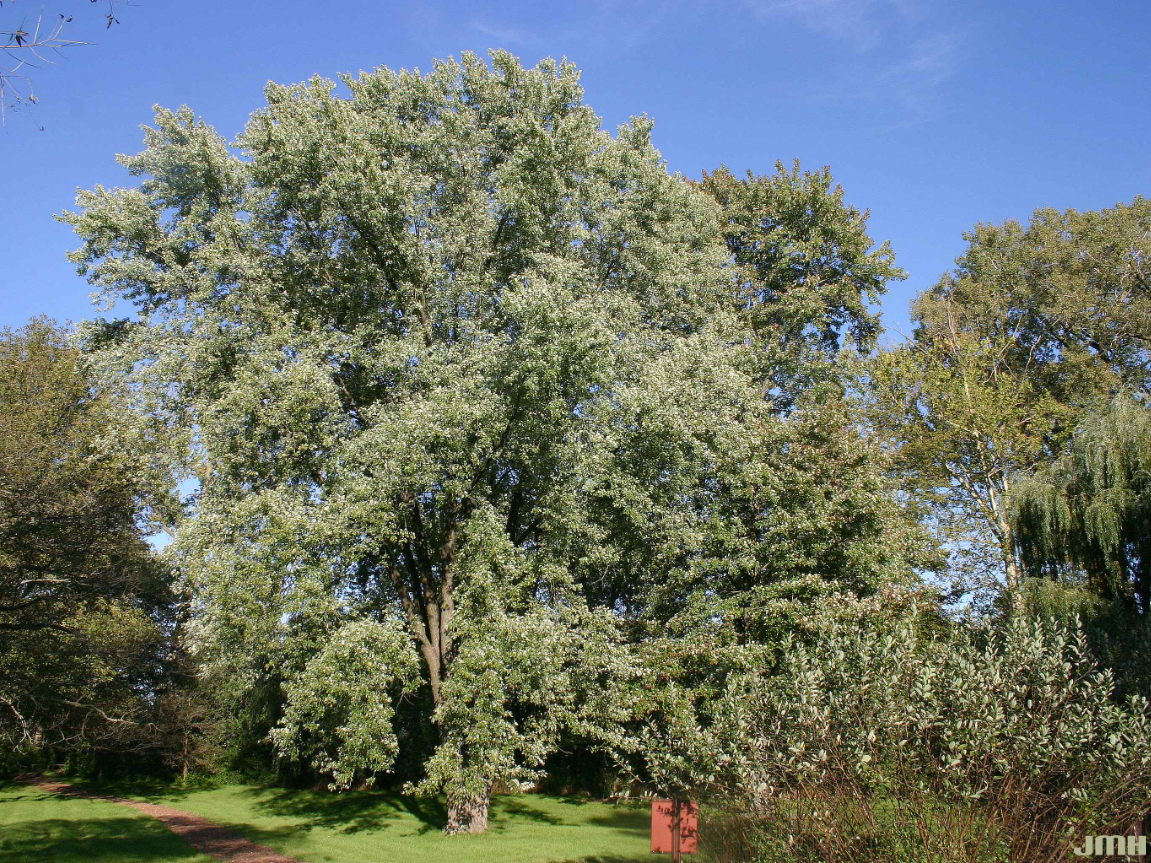
- Family: Sapindaceae
- Type: Decidious
- Average Height: 50' to 80'
- Average Width: 35' to 70'
- Native Range: Eastern North America
- Average Years to Maturity: 20
- Average Lifespan in Years: 100
- Bark Identification: Gray with long plates with loose edges in maturity, smooth when young
- Leaf Identification: 5 lobes, deep sinuses (spaces between lobes), silvery white underneath
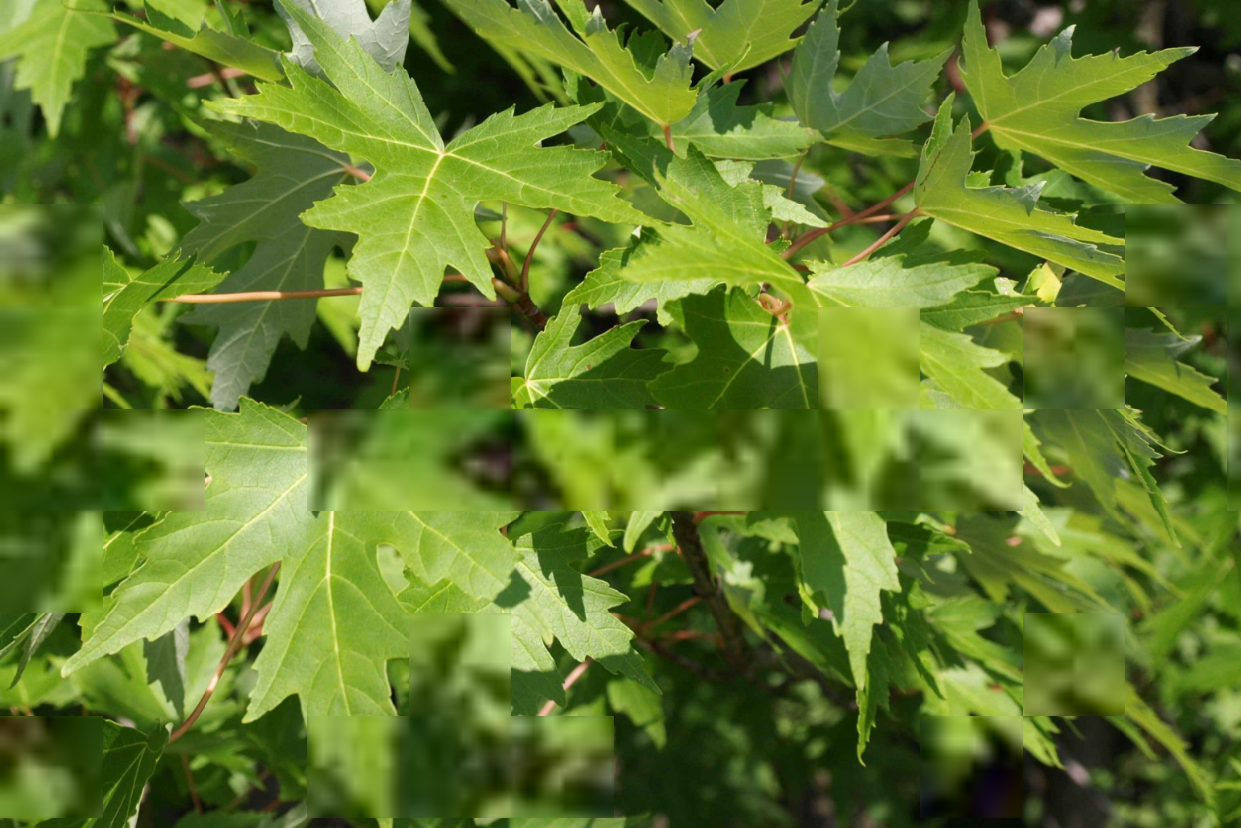
Description
The silver maple is typically found in bottomlands, lake shores, swamps, and forested floodplains. This tree species gets its common name from the silvery white undersides of its leaves. It is distinguishable from other maple species because of its shaggy, peeling bark plates and the deep sinuses on its leaves. This tree species is native to Huntington County.
Horticulture Tips
The silver maple prefers full sun exposure but can grow successfully in part shade environments. It also prefers medium to wet water supply and medium to wet, well-drained soil. The wood of the silver maple is weak and brittle, breaking off easily in high winds and winter weather. This tree species is extremely fast-growing.
Benefits
The silver maple is commonly used as a landscaping tree or shade tree for lawns, parks, and streets. Like other maple species, the silver maple has attractive yellow, orange, and red fall foliage. The specific epithet saccharinum comes from the Latin word for sugar, which is in reference to the sap that comes from the silver maple that can make maple syrup. However, the sap quality and quantity of the silver maple are far less than that of the sugar maple. The wood of the silver maple is soft and is often sold under the name “red maple wood” in the lumber industry. This is where the silver maple gets another of its common names: soft maple.
The larvae of several long-horned beetle species and the larvae of wood-boring beetles and moths eat the leaves and wood of the silver maple. The seeds and buds are eaten by birds like the Northern cardinal, rose-breasted grosbeak, purple finch, and American robin. Mammals like the black bear, raccoon, Eastern chipmunk, and several squirrel species eat the seeds of the silver maple.
References
- Chicago Botanic Garden
- Go Botany Native Plant Trust
- Illinois Wildflowers
- Indiana Department of Natural Resources
- Leopold, Donald J.; Trees of the Central Hardwood Forests of North America: An Identification and Cultivation Guide. Timber Press, 1998, pp. 80-82.
- Missouri Botanical Garden
- Morton Arboretum Photo Copyrights
- Purdue University Fort Wayne Tree Index
- Silvics of North America
- Weeks, Sally S., et al.; Native Trees of the Midwest: Identification, Wildlife Values, and Landscaping Use, Purdue University Press, West Lafayette, IN, 2005, pp. 54-55.
Smooth sumac (Rhus glabra)
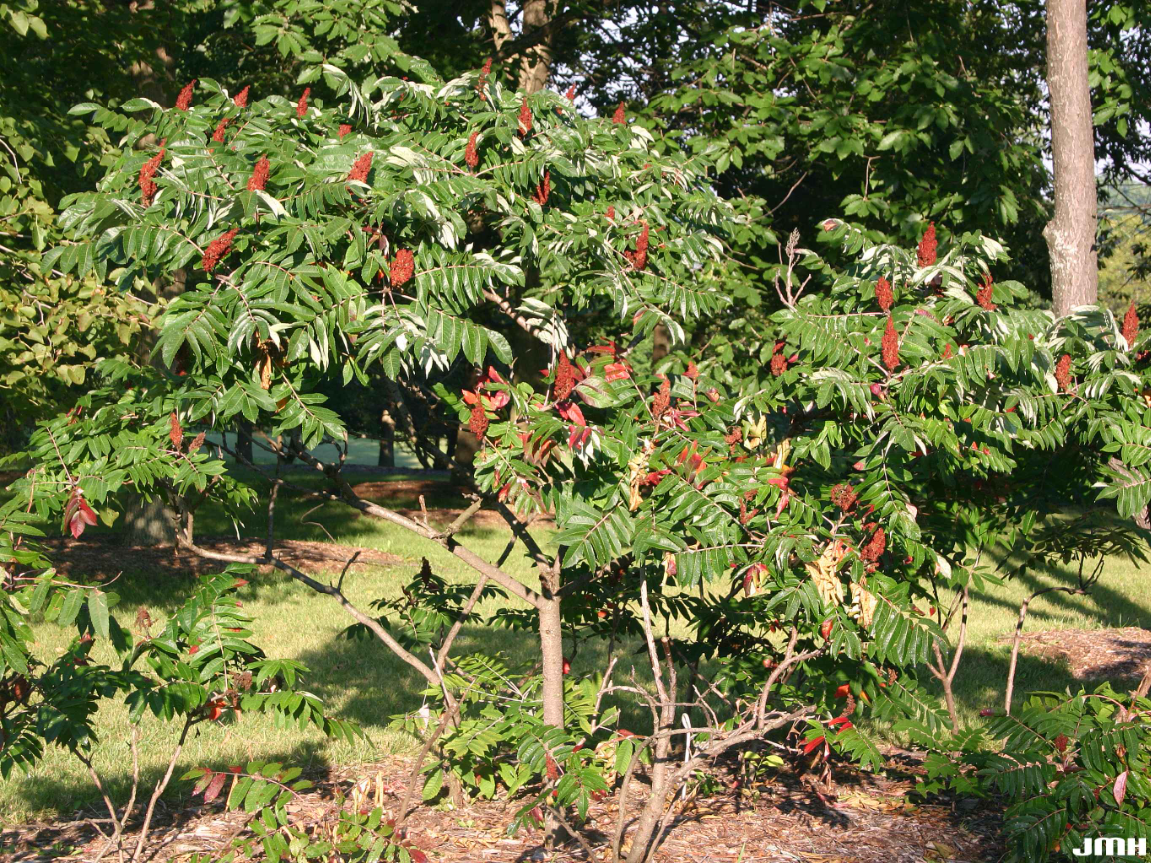
- Family: Anacardiaceae
- Type: Deciduous
- Average Height: 10' to 20'
- Average Width: 10' to 20'
- Native Range: North America
- Average Years to Maturity: 20
- Average Lifespan in Years: 100
- Bark Identification: Brown to gray, horizontal fissures
- Leaf Identification: Shiny, 9 to 27 leaflets per leaf (up to 18" long), fern-like
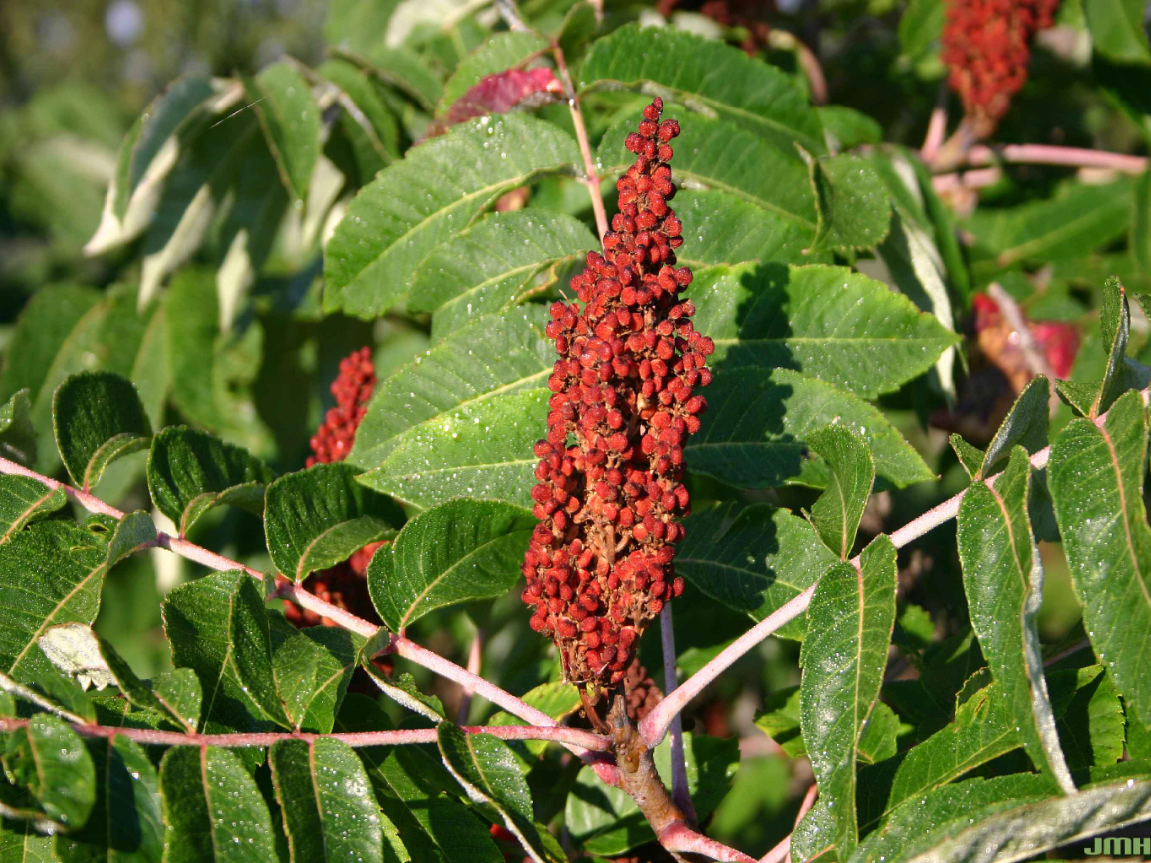
Description
The smooth sumac is typically found in prairies, fields, and man-made habitats. The smooth sumac can be distinguished from the staghorn sumac because of its smooth stems, as opposed to the hairy, down covered stems of the staghorn. This is also how the smooth sumac received its common name. The smooth sumac is an attractive tree because of its pyramidal, red fruit clusters and for its dark red fall foliage. This tree species is native to Huntington County.
Horticulture Tips
The smooth sumac prefers full sun exposure but can be in part shade environments. It also prefers dry to medium water supply and dry to medium, well-drained soil.
Benefits
The smooth sumac can be used as a small landscaping tree for lawns. The specific epithet glabra comes from the Latin word for without hair. The fruit of the smooth sumac is eaten by birds like the ruffed grouse, ring-necked pheasant, Northern cardinal, Northern flicker, pine warbler, catbird, and several woodpeckers. White-tailed deer and cottontail rabbits eat the leaves and twigs.
References
- Chicago Botanic Garden
- Go Botany Native Plant Trust
- Illinois Wildflowers
- Missouri Botanical Garden
- Morton Arboretum Photo Copyrights
Sugar maple (Acer saccharum)
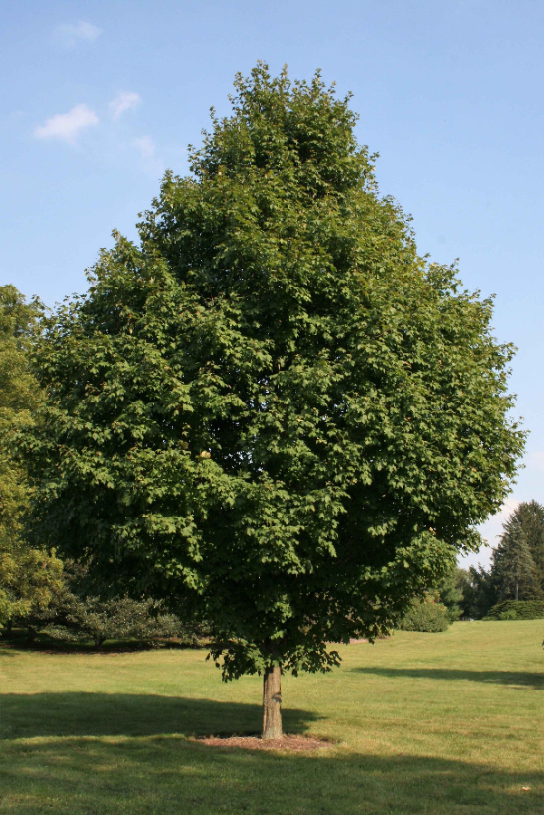
- Family: Sapindaceae
- Type: Deciduous
- Average Height: 40' to 80'
- Average Width: 30' to 60'
- Native Range: Eastern North America
- Average Years to Maturity: 50
- Average Lifespan in Years: 200
- Bark Identification: Gray to brown, thick ridges and curved plates in maturity, smooth when young
- Leaf Identification: Three to five lobes, 3" to 6" long, thick with a leathery texture, glossy
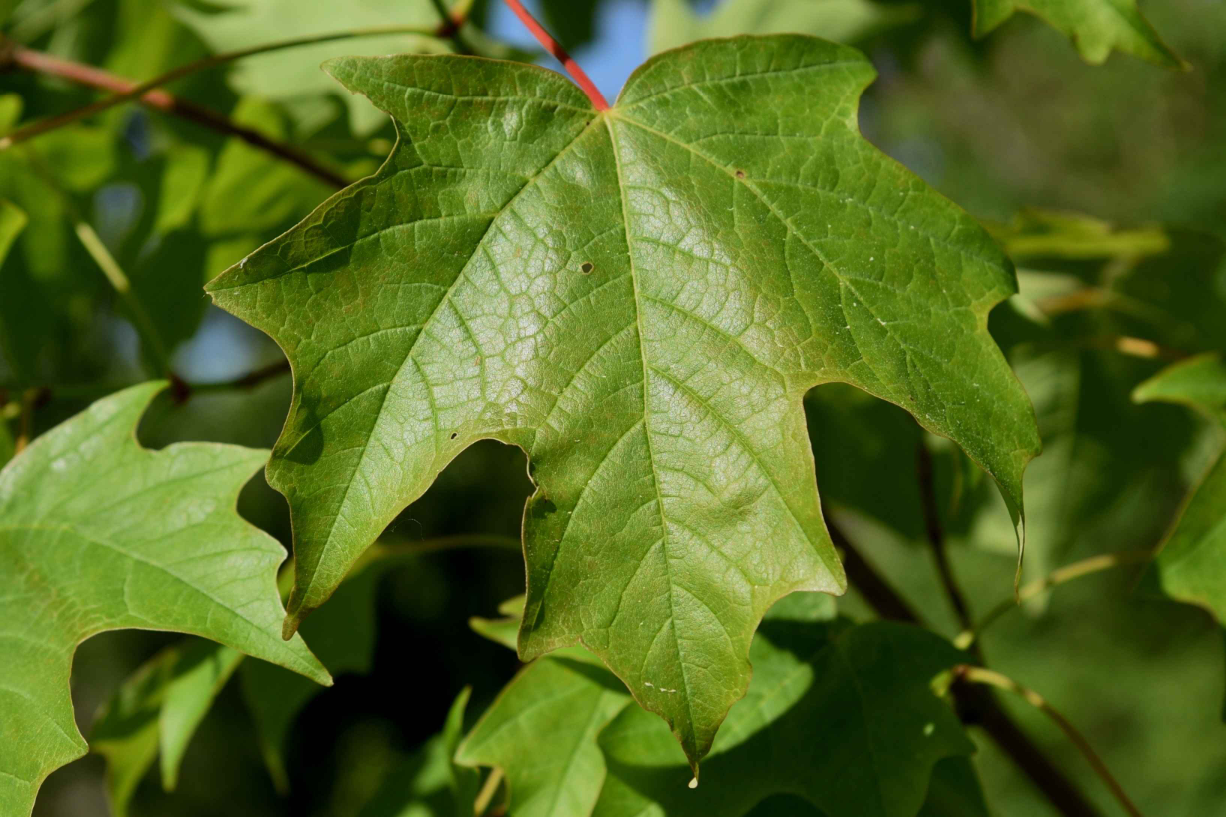
Description
The sugar maple is typically found in floodplains and forests. This tree species is distinguishable by its colorful fall foliage, which is often yellow and orange, and its dense, rounded form. This tree species is native to Huntington County. The cultivar ‘Fall Fiesta’ is known for its resistance to extreme weather like summer heat, wind and drought. It is also more resistant to tree diseases like leaf tatter and leaf scorch. The ‘Fall Fiesta’ cultivar is also distinguishable because it presents brighter red foliage in the fall than the typical yellow and orange leaves of other sugar maples.
Horticulture Tips
The sugar maple prefers full sun exposure but can grow successfully in part shade environments. It also prefers medium water supply and medium, well-drained soil. This tree species is slow growing and long living. The sugar maple is intolerant to road salt.
Benefits
The sugar maple is commonly used as a landscaping tree because of its attractive fall foliage and can also be used as a shade tree. It is frequently planted in lawns and parks, as well as on streets. The specific epithet saccharum means “sugary” in Latin, in reference to its sap. The sap of this tree species is preferred to make maple syrup, and over 24,000 gallons of maple syrup were produced in Indiana in 2020. The sugar maple leaf is the national symbol of Canada. The wood of the sugar maple is used in construction and to build furniture, musical instruments, bowling pins, baseball bats, and flooring. The sugar maple is a hardwood species, which gives the sugar maple other common names like hard maple and rock maple. The sugar maple is by far the most common tree in Indiana, as there are over 3 million growing in the state.
Several butterfly species, like the red admiral butterfly and the comma butterfly, use the sap of the sugar maple as a food source. Several bird species, such as the Northern cardinal, rose-breasted grosbeak, purple finch, and American robin eat the seeds and buds of this tree species. The yellow-bellied sapsucker drills holes into the trunk of the sugar maple to feed on its sap. Beavers use the wood as food and to build their dams, and bat species like the evening bat and the Eastern red bat nest in the cavities of older trees.
The sugar maple is the state tree of Wisconsin, Vermont, West Virginia, and New York.
References
- Chicago Botanic Garden
- Go Botany Native Plant Trust
- Illinois Wildflowers
- Indiana Department of Natural Resources
- Leopold, Donald J.; Trees of the Central Hardwood Forests of North America: An Identification and Cultivation Guide. Timber Press, 1998, pp. 82-85.
- Missouri Botanical Garden
- Morton Arboretum Photo Copyrights
- Purdue University Fort Wayne Tree Index
- Silvics of North America
- Weeks, Sally S., et al.; Native Trees of the Midwest: Identification, Wildlife Values, and Landscaping Use, Purdue University Press, West Lafayette, IN, 2005, pp. 56-57.
Swamp white oak (Quercus bicolor)
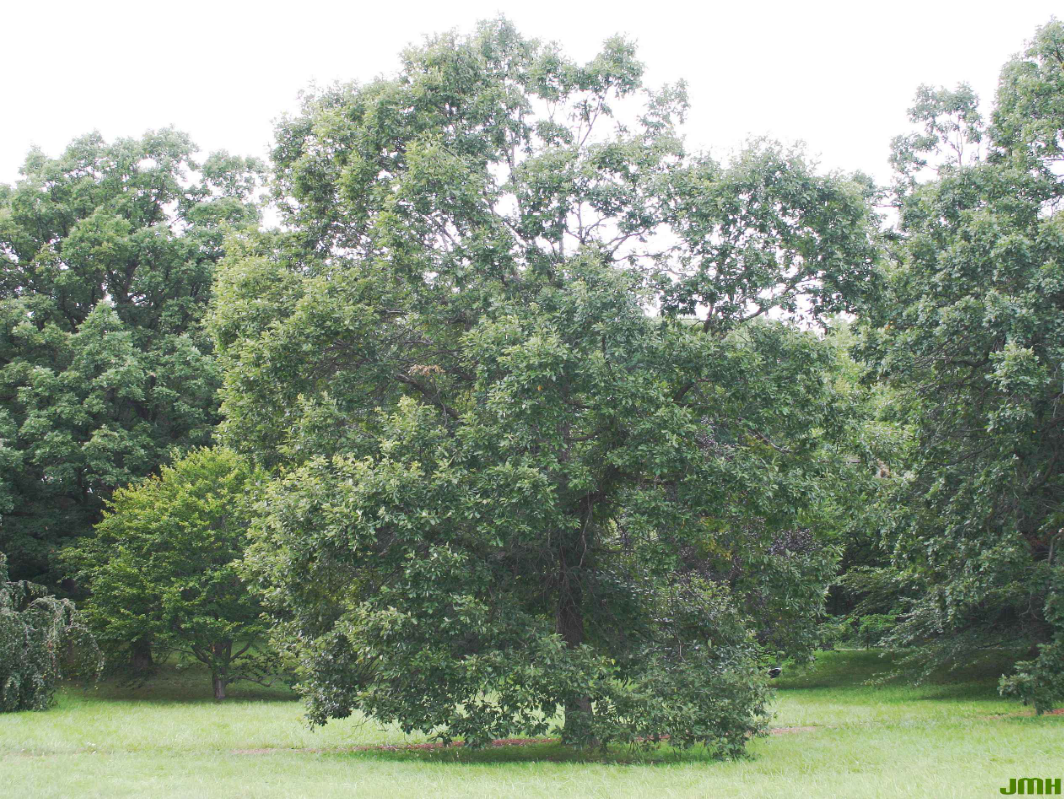
- Family: Fagaceae
- Type: Deciduous
- Average Height: 50' to 60'
- Average Width: 50' to 60'
- Native Range: Eastern North America
- Average Years to Maturity: 50
- Average Lifespan in Years: 200
- Bark Identification: Brown or gray, scaly ridges separated by deep fissures with maturity, peeling bark
- Leaf Identification: Obovate (oval tapering to a point at the base), six to 10 rounded lobes, silvery white, hairy underside, 4" to 7: long
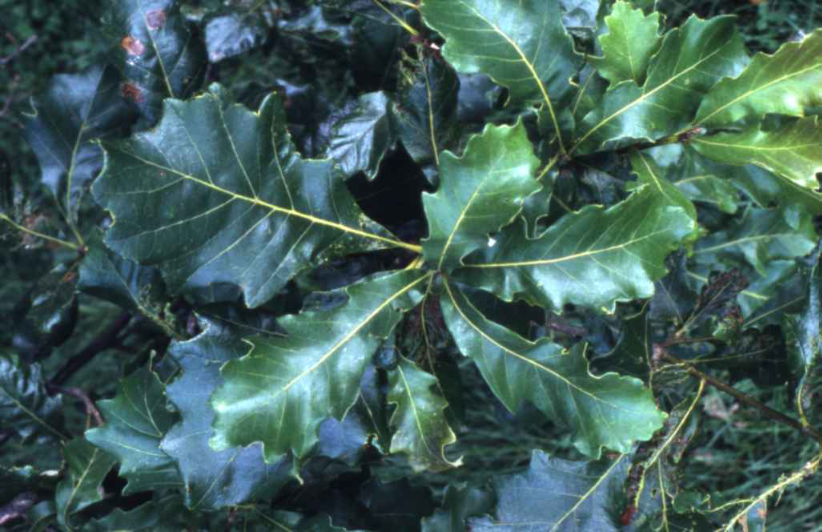
Description
The swamp white oak is typically found in floodplains, forests, and swamps. The swamp white oak is given its common name because it typically grows in wet environments, like swamps, and the undersides of its leaves are a silvery white. This is also where the specific epithet bicolor comes from, as the leaves are a shiny green above and white beneath. This distinguishing feature can help separate the white swamp oak from the bur oak and the chinkapin oak. The swamp white oak can also be distinguished from the bur oak because the bur oak has a shaggy cap on its acorn, while the swamp white oak has a long-stemmed acorn. Also, the chinkapin oak has points at the end of the lobes on its leaves, while the swamp white oak does not. Since the swamp white oak belongs to the white oak group, its acorns are produced annually. This tree species is native to Huntington County.
Horticulture Tips
The swamp white oak requires full sun exposure. It also prefers medium to wet water supply and medium to wet, well-drained soil. This tree species is known to be fast growing and long-living.
Benefits
The swamp white oak is commonly used as a lawn tree or a street tree because of its shade. This large tree species is typically used in large, open spaces. The wood of this tree species commonly generalized as “white oak wood” in the lumber industry and is heavy, strong, and typically rot resistant, making it a preferred lumber source. It can be used to make furniture, cabinets, flooring, and boat hulls.
Insects like the oak timberworm and the oak stem borer use the swamp white oak as a food source and bore into its wood. The acorns of the swamp white oak are eaten by birds like the wood duck, wild turkey, ruffed grouse, and several woodpeckers. The acorns are also eaten by the black bear, raccoon, white-tailed deer, and several squirrel species.
References
- Chicago Botanic Garden
- Go Botany Native Plant Trust
- Illinois Wildflowers
- Indiana Department of Natural Resources
- Leopold, Donald J.; Trees of the Central Hardwood Forests of North America: An Identification and Cultivation Guide. Timber Press, 1998, pp. 329-331.
- Missouri Botanical Garden
- Morton Arboretum Photo Copyrights
- Purdue University Fort Wayne Tree Index
- Silvics of North America
- Weeks, Sally S., et al.; Native Trees of the Midwest: Identification, Wildlife Values, and Landscaping Use, Purdue University Press, West Lafayette, IN, 2005, pp. 182-183.
Sweetgum (Liquidambar styraciflua)
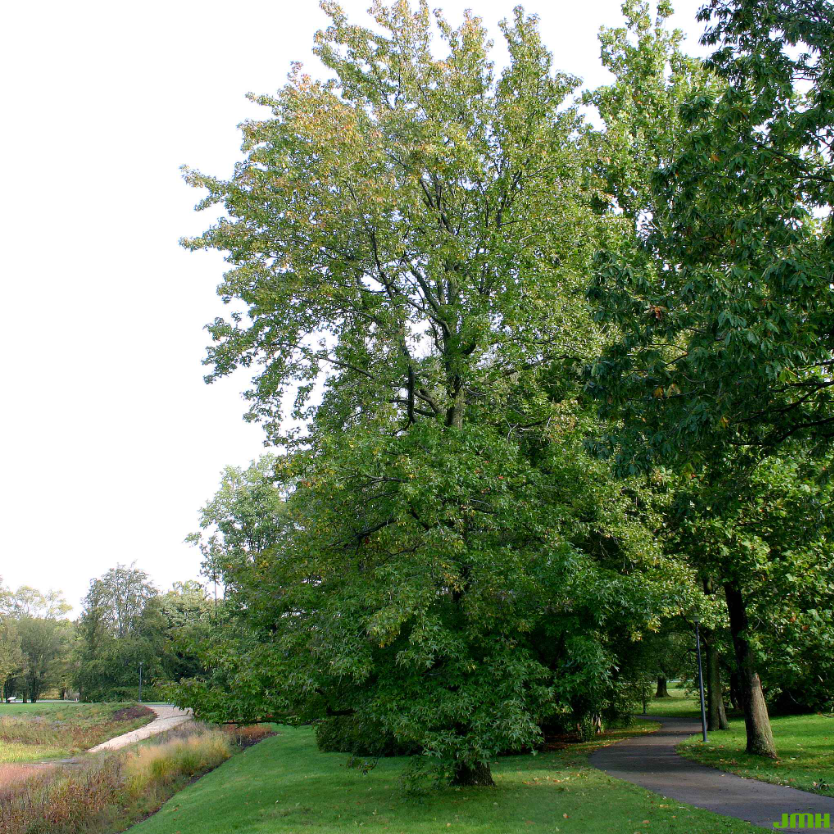
- Family: Altingiaceae
- Type: Deciduous
- Average Height: 40' to 60'
- Average Width: 40' to 60'
- Native Range: Southeastern United States
- Average Years to Maturity: 30
- Average Lifespan in Years: 200
- Bark Identification: Dark gray or brown, deep fissures, vertical ridges
- Leaf Identification: Star-shaped, five to seven lobes, glossy, 3" to 5" long
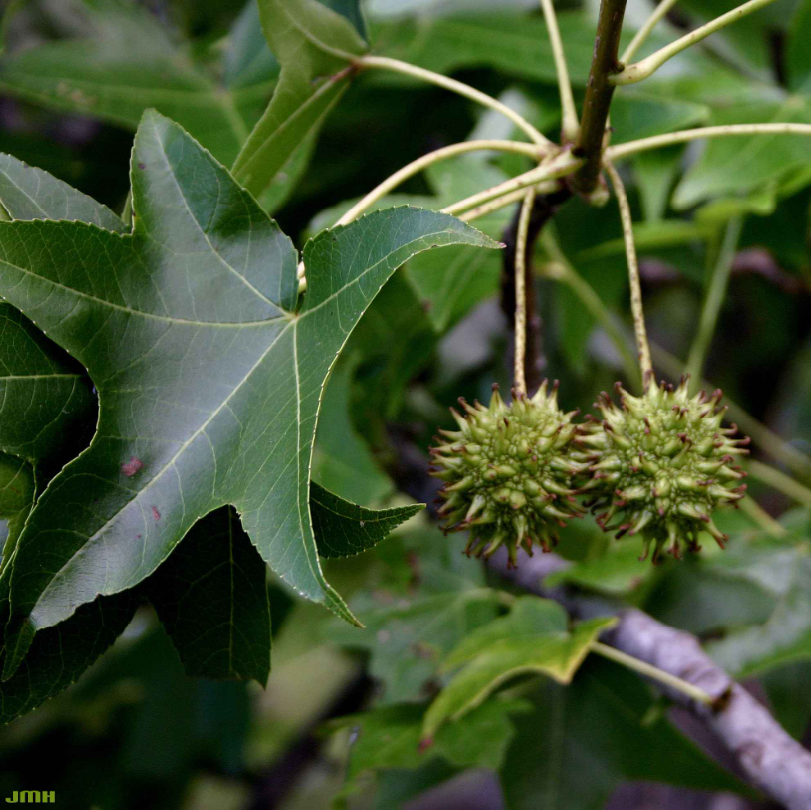
Description
The sweetgum is typically found in swamps and wetlands. The sweetgum is known for its fragrant, star-shaped leaves. These leaves are attractive in the fall, ranging from yellow to purple or red. The flowers of this tree species turn into gum balls, which are hard, bristly clusters of fruit that are typically 1-½" in diameter. These gum balls, which resemble sea urchins, turn dark brown as they mature and typically remain on this tree species throughout the winter. The common name sweetgum refers to the fragrant balsam or gum that comes from this tree species. This tree species is not native to Huntington County but is native to southeastern Indiana.
The cultivar "Moraine" is the most resistant to the colder temperatures of the northern United States of the sweetgum tree varieties.
Horticulture Tips
The sweetgum requires full sun exposure. It also prefers medium water supply and medium, well-drained soil. When planting this tree species, avoid alkaline soils.
Benefits
The sweetgum is commonly used as a shade or ornamental tree for lawns. The wood of the sweetgum is used for flooring and furniture. The gum harvested from the fruit can be used to make chewing gum, incense, perfume, and flavorings. It has also been used in home remedies for common illnesses. The specific epithet styracifula means flowing storax, which refers to the resin that comes from the sweetgum. This is also where another common name, sapgum, comes from.
Insects like the luna moth and the large paectes, as well as several other moth species, eat the leaves of the sweetgum. The seeds are eaten by bird species like the mourning dove, Eastern towhee, Eastern goldfinch, and purple finch. In wetland habitats, the wood and branches of this tree species are used by beavers.
References
- Chicago Botanic Garden
- Go Botany Native Plant Trust
- Illinois Wildflowers
- Indiana Department of Natural Resources
- Leopold, Donald J.; Trees of the Central Hardwood Forests of North America: An Identification and Cultivation Guide. Timber Press, 1998, pp. 235-237.
- Missouri Botanical Garden
- Morton Arboretum Photo Copyrights
- Purdue University Fort Wayne Tree Index
- Silvics of North America
- Weeks, Sally S., et al.; Native Trees of the Midwest: Identification, Wildlife Values, and Landscaping Use, Purdue University Press, West Lafayette, IN, 2005, pp. 128-129.
Tulip tree (Liriodendron tulipifera)
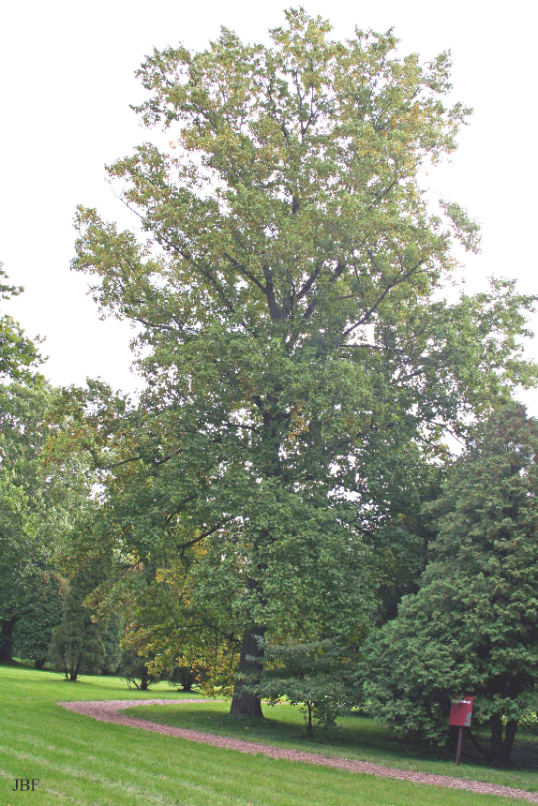
- Family: Magnoliaceae
- Type: Deciduous
- Average Height: 60' to 90'
- Average Width: 30' to 50'
- Native Range: Eastern North America
- Average Years to Maturity: 20
- Average Lifespan in Years: 250
- Bark Identification: Gray and smooth with shallow fissures when young, dark brown with ridges and deep fissures in maturity
- Leaf Identification: Unique four-lobed shape, 5" to 7" long
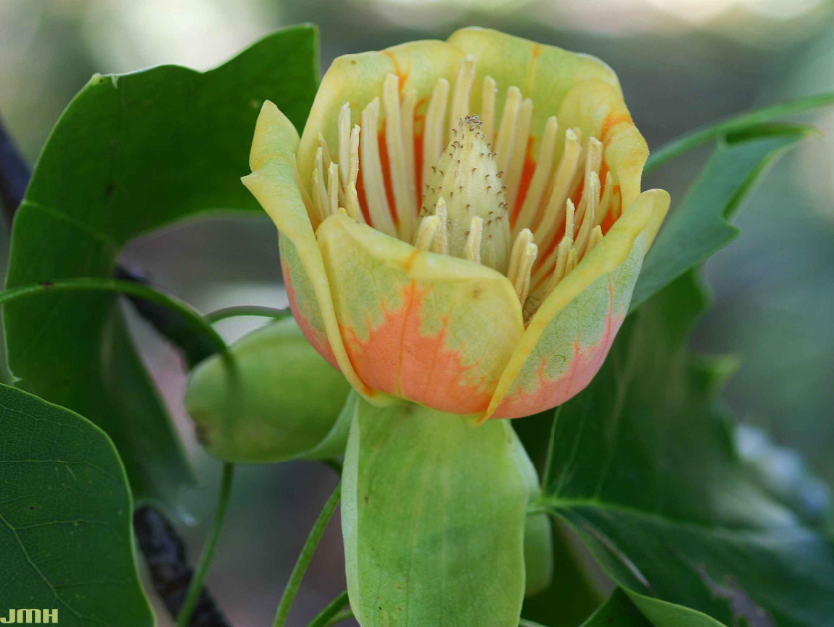
Description
The tulip tree is typically found in man-made habitats and forests. The genus name comes from the Greek words leirion, which means lily, and dendron, which means a tree for the flowers. This tree species is known for its yellow, cup-shaped, tulip-like flowers that bloom in spring. This tree species is also given the common name yellow poplar because of its yellow wood. This tree species is native to Huntington County.
Horticulture Tips
The tulip tree prefers full sun exposure but can be in part shade environments. It also prefers medium water supply and moist, well-drained soil. The tulip tree is not recommended to be a street tree because of its large size. This tree species is known to typically be fast growing.
Benefits
The tulip tree is commonly used as a landscaping tree in parks because of its attractive flowers and leaf color. It can also be used as a shade tree for large areas. The wood of this tree species, which is soft wood, is used for furniture, wood pulp for paper, and general lumber. Native Americans made canoes from the trunks because of the wood’s light quality.
The tulip tree moth and tulip tree aphid, as well as many other insects, use the foliage, sap, and wood of the tulip tree as a food source. The seeds of this tree species are eaten by the Northern cardinal, American goldfinch, fox squirrel, and gray squirrel. Horses, cattle, and deer eat the leaves and twigs.
The tulip tree is the state tree of Kentucky, Tennessee, and Indiana. Specifically in Indiana, settlers used the wood of the tulip tree to build log cabins because of its straight trunks and soft, light wood.
References
- Chicago Botanic Garden
- Go Botany Native Plant Trust
- Illinois Wildflowers
- Indiana Department of Natural Resources
- Leopold, Donald J.; Trees of the Central Hardwood Forests of North America: An Identification and Cultivation Guide. Timber Press, 1998, pp. 237-240.
- Missouri Botanical Garden
- Morton Arboretum Photo Copyrights
- Purdue University Fort Wayne Tree Index
- Silvics of North America
- Weeks, Sally S., et al.; Native Trees of the Midwest: Identification, Wildlife Values, and Landscaping Use, Purdue University Press, West Lafayette, IN, 2005, pp. 130-131.
White mulberry (Morus alba)
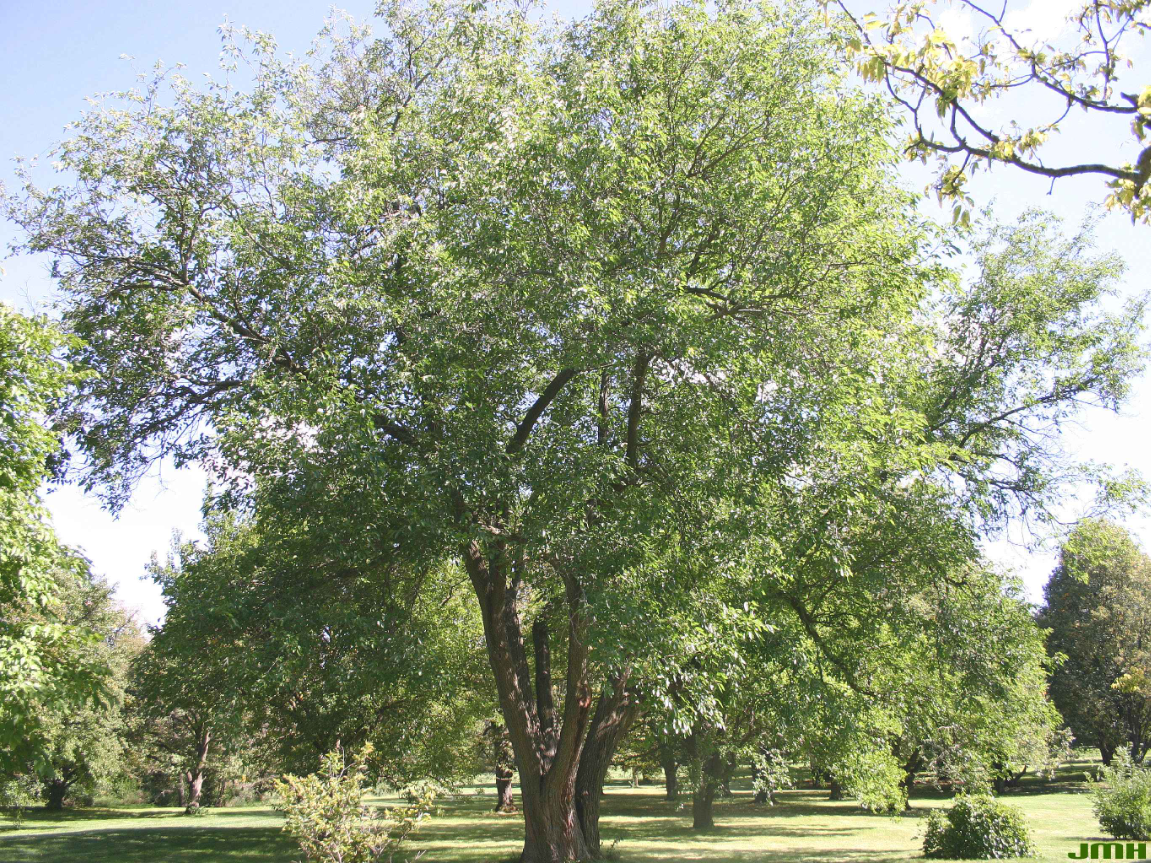
- Family: Moraceae
- Type: Deciduous
- Average Height: 30' to 50'
- Average Width: 30' to 50'
- Native Range: China
- Average Years to Maturity: 15
- Average Lifespan in Years: 60
- Bark Identification: Light brown, dark orange furrows and brown ridges
- Leaf Identification: Glossy, rounded, three to five lobes, serrated edges, 8" long
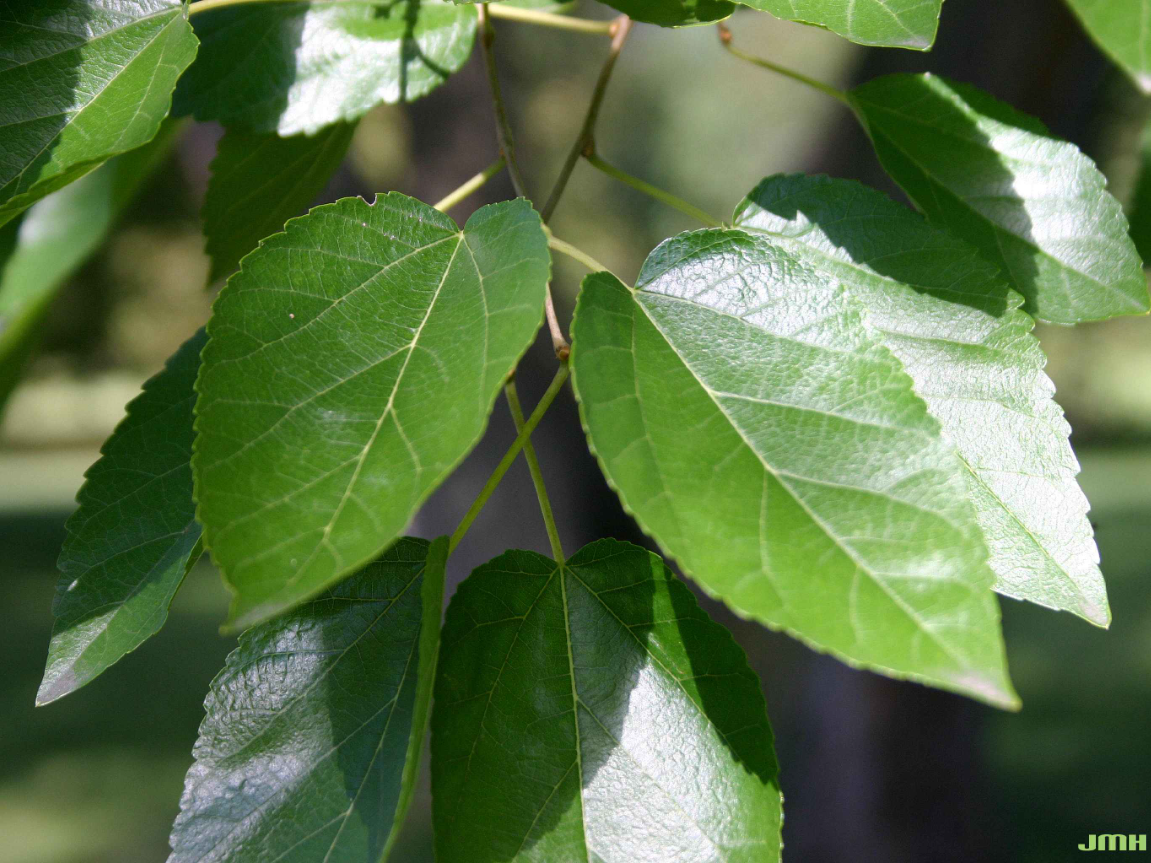
Description
The white mulberry is typically found in man-made habitats, forests, thickets, and prairies. The leaves of the white mulberry were a prime food source for silkworms, who produce the fibers needed to weave silk together. In an attempt to create a silk industry in America, this tree species was planted widely throughout the United States. Even though the industry did not succeed as well as initially hoped, the white mulberry still naturalized in prairies and fields to be used by wildlife. The glossy nature of the white mulberry’s leaves distinguishes it from the red mulberry, a similar species which is native to North America. This tree species is also unique because of the variable number of lobes that can be on the leaves of a single white mulberry tree. This tree species is not native to Huntington County.
Horticulture Tips
The white mulberry requires full sun exposure. It also prefers medium water supply and moist, well-drained soil. The fruit of the white mulberry stains extremely easily. The fruit is edible, and it is used to make jams and jellies and resembles a black berry in shape and color.
Benefits
The white mulberry is not commonly used as a landscaping tree because of its messy, staining fruit. While the white mulberry is nonnative to the United States, several bird species, like the ruffed grouse, blue jay, cedar waxwing, Baltimore oriole, yellow warbler, rose-breasted grosbeak, and catbird eat the fruit. The fruit is known as a drupe and resembles a raspberry or blackberry in appearance and color. Mammals like the opossum, raccoon, and fox squirrel eat the fruit. Whitetailed deer eat the leaves and twigs, and beavers eat the wood. The Eastern box turtle and the ornate box turtle also eat the drupes of this tree species.
References
- Go Botany Native Plant Trust
- Illinois Wildflowers
- Leopold, Donald J.; Trees of the Central Hardwood Forests of North America: An Identification and Cultivation Guide. Timber Press, 1998, pp. 258-259.
- Missouri Botanical Garden
- Morton Arboretum Photo Copyrights
White oak (Quercus alba)
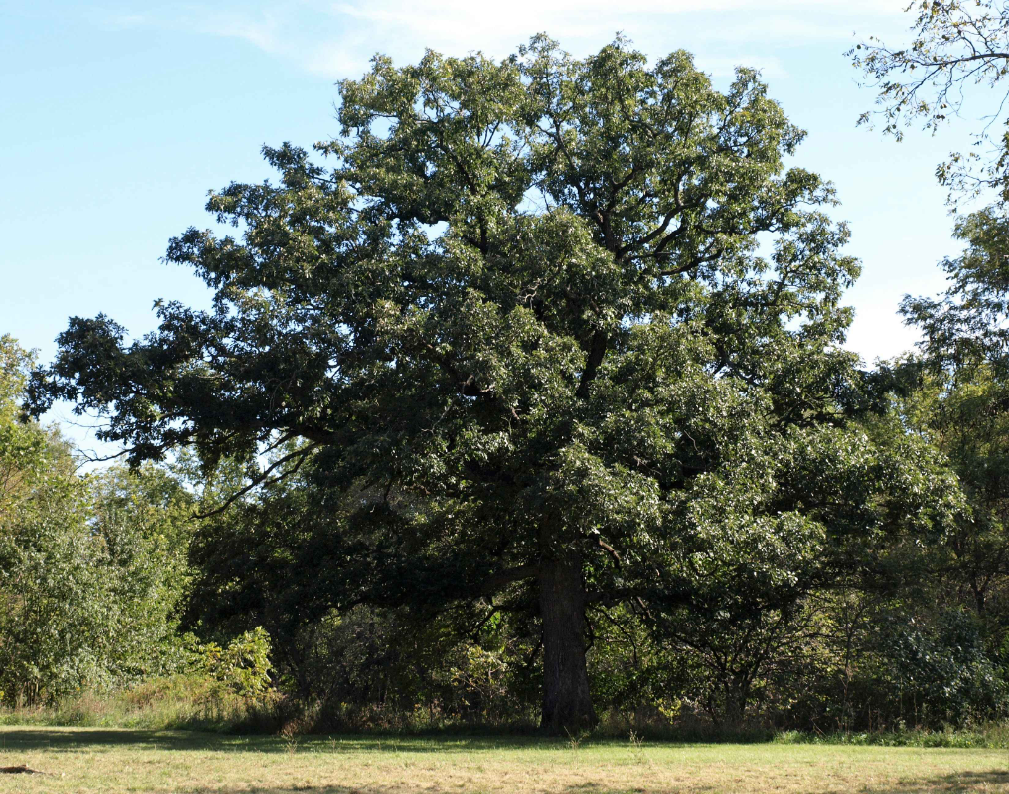
- Family: Fagaceae
- Type: Decisuous
- Average Height: 50' to 80'
- Average Width: 50' to 80'
- Native Range: Eastern North America
- Average Years to Maturity: 50
- Average Lifespan in Years: 200
- Bark Identification: Light gray, narrow flat plates, shallow furrows
- Leaf Identification: Seven to nine rounded lobes, deep sinuses (spaces between lobes), white undersides, 4" to 9" long
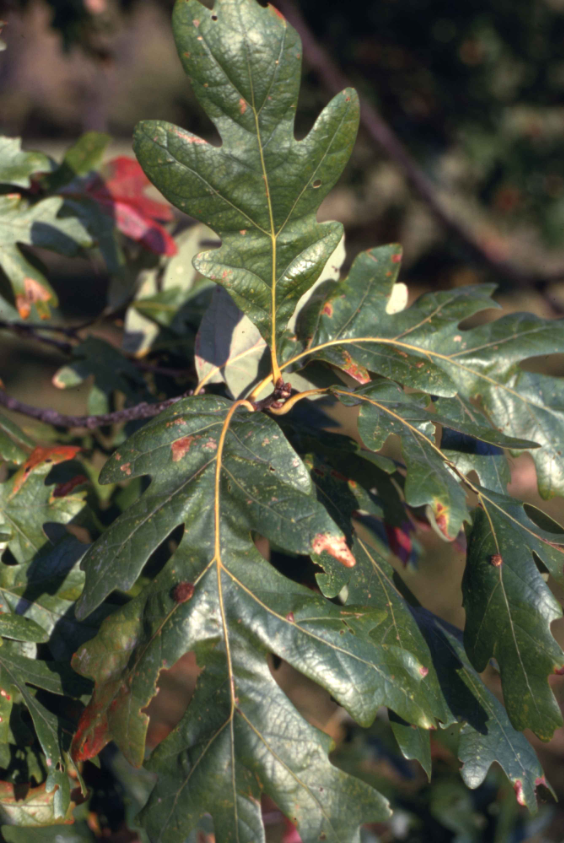
Description
The white oak is typically found in woodlands, bottomlands, and prairies. As it is in the white oak group, the acorns of this tree species are produced every year. The acorns of the white oak are ovalshaped and have wart-like scales on their cups, which distinguishes it from the typical flat scales on other oak species’ acorns. The white oak is also unique from other oak species because of the variable, rounded lobes on its leaves. The white oak gets its common name from its light gray bark and the white undersides of its leaves. This tree species is native to Huntington County.
Horticulture Tips
The white oak requires full sun exposure. It also prefers medium to dry water supply and medium to dry, acidic soil. The white oak is a slow-growing tree species compared to other oaks.
Benefits
The white oak is commonly used as a landscaping and shade tree for large lawns and golf courses. However, because of its large size and crown, the white oak is not commonly used as a street tree. The specific epithet alba means “white” in Latin, which is in reference to the light bark of this tree species. The wood of the white oak is hard and strong, making it preferred in the lumber industry. The wood can be used to make furniture, flooring, naval ships, and is used as firewood. Another common name for the white oak is the stave oak, which refers to the common use of this wood to make barrels.
Caterpillars, like the Northern hairstreak and the striped hairstreak, use the white oak as a food source. Bird species like the ring-necked pheasant, ruffed grouse, and blue jay, and mammals like the black bear, raccoon, wild hog, and several squirrel species eat the acorns of the white oak. White-tailed deer and cottontail rabbit eat the twigs and foliage.
The white oak is the state tree of Illinois.
References
- Chicago Botanic Garden
- Go Botany Native Plant Trust
- Illinois Wildflowers
- Indiana Department of Natural Resources
- Leopold, Donald J.; Trees of the Central Hardwood Forests of North America: An Identification and Cultivation Guide. Timber Press, 1998, pp. 327-329.
- Missouri Botanical Garden
- Morton Arboretum Photo Copyrights
- Purdue University Fort Wayne Tree Index
- Silvics of North America
- Weeks, Sally S., et al.; Native Trees of the Midwest: Identification, Wildlife Values, and Landscaping Use, Purdue University Press, West Lafayette, IN, 2005, pp. 182-183.
Use an interactive map and PDF to learn more about the tree collection at Evergreen Park & Arboretum!
Useful Links
Contact Us
Superintendent of Parks and Recreation
- Phone: (260) 358-2323
- Staff Directory
- Hours: 7 a.m. to 3 p.m.
Monday through Friday